Significant Cut in Jeonse-to-Wolse Conversion Rate from 4% to 2.5%
Only Applies to Existing Contracts... New Contracts Exempt
Lower Monthly Rent Burden for Tenants Switching from Jeonse to Wolse
Landlords 'Boiling'... Concerns Over Sharp Rise in Jeonse Deposits
[Asia Economy reporters Moon Jiwon and Lee Chunhee] The government’s decision to significantly lower the 'monthly rent (jeonse-to-monthly rent) conversion rate'?the rate applied when converting jeonse deposits to monthly rent?from the existing 4% to 2.5% is expected to cause further fluctuations in the rental market. Primarily, as the conversion rate decreases, the monthly rent charged when converting jeonse to monthly rent will also decrease, reducing the financial burden on tenants. Given the ongoing low-interest-rate environment, with jeonse loan interest rates dropping to 2.26%, many argue that adjusting the conversion rate to the 2% range is inevitable to maintain fairness.
However, since the conversion rate only applies when converting existing jeonse contracts to monthly rent and does not apply to new monthly rent contracts, its effect may be limited. It is considered insufficient to curb the current market trend where landlords evict existing tenants and raise rent prices for new tenants. Another limitation is that there is no penalty for violating the conversion rate.
Jeonse-to-Monthly Rent Conversion Rate Drops from 4% to 2.5%... How Much Will Monthly Rent Burden Decrease?
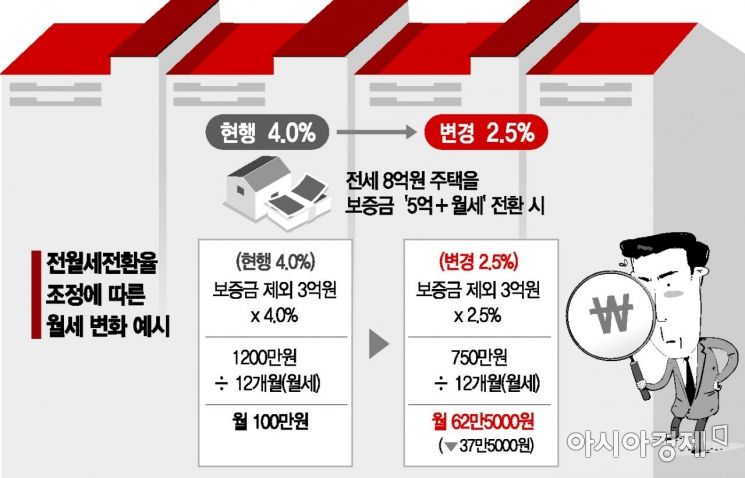
Let’s take an example where an apartment with a jeonse deposit of 800 million KRW lowers the deposit to 500 million KRW and converts the remaining 300 million KRW into monthly rent.
Applying the current 4% conversion rate, multiplying 300 million KRW by 4% and dividing by 12 months results in a monthly rent of 1 million KRW. If the deposit is lowered to 50 million KRW, the monthly rent becomes 2.5 million KRW (750 million KRW x 0.04 / 12). However, if the conversion rate is lowered to 2.5%, the monthly rent with a 500 million KRW deposit becomes 625,000 KRW, and with a 50 million KRW deposit, it becomes 1,562,500 KRW. Tenants can save approximately 400,000 to 900,000 KRW in monthly rent.
On the other hand, landlords gain less by converting jeonse to monthly rent, weakening the incentive to do so. The industry expects the recent surge in monthly rent conversions, driven by increased property taxes on multi-homeowners and a cap on rent increases at 5%, to calm down somewhat. The Ministry of Land, Infrastructure and Transport (MOLIT) explained, "It was necessary to lower the statutory monthly rent conversion rate to alleviate tenants’ housing cost burdens."
Changed Jeonse-to-Monthly Rent Conversion Rate... When and to Whom Does It Apply?
The conversion rate is calculated by adding the Bank of Korea’s base interest rate (currently 0.5%) to a rate set by enforcement decree (3.5%). Since the government plans to lower the rate set by the enforcement decree to adjust the conversion rate, revising the enforcement decree is necessary. MOLIT expects to apply the new conversion rate as early as early October after a legislative notice at the end of August.
The conversion rate applies to existing lease contracts. A MOLIT official stated, "The conversion rate applies only when converting jeonse to monthly rent during the renewal of an existing contract or when the tenant exercises the right to renew the contract. It does not apply to the initial contract."
Renewal contracts made before the revised enforcement decree takes effect in early October will also apply the existing conversion rate instead of the new one. This means there will be no retroactive application of the changed conversion rate.
Therefore, landlords may evict existing tenants and raise monthly rent significantly for new tenants. Since profit realization from monthly rent is limited, concerns are growing that jeonse prices will rise further.
Because the Housing Lease Protection Act, which regulates the conversion rate, is part of civil law, landlords cannot be administratively punished for violations. However, if the conversion rate is not followed, the contract becomes invalid, and tenants can demand the return of unfair profits gained by the landlord. A MOLIT official said, "Rent exceeding the cap is considered unjust enrichment, so tenants can recover it through civil lawsuits or dispute mediation committees."
The government plans to expand the jurisdiction of dispute mediation committees operated by the Korea Land and Housing Corporation (LH) and the Korea Appraisal Board and to ensure at least one committee operates in cities with populations over 500,000 in preparation for an increase in disputes between landlords and tenants.
"How Can We Pay Property Tax with 2.5% Monthly Rent?"... Landlords Are Frustrated
Landlords have expressed dismay at the news of the lowered conversion rate. They complain that their property rights are severely restricted by the rent cap and the right to request contract renewal, and now they cannot freely set monthly rent either. A landlord in his 40s, Mr. A, said, "How can I pay property tax with only 2.5% monthly rent? The government keeps raising official property prices, increasing the tax burden. What are we supposed to do?"
Tenants share similar concerns. A tenant in their 30s, Mr. B, worried, "Since the new rate does not apply to new contracts, won’t jeonse prices rise even more?"
Ann Myung-sook, head of the Real Estate Investment Support Center at Woori Bank, said, "Since the current conversion rate is high relative to interest rates, adjustment is necessary," but added, "To stabilize the rental market, it is not enough to simply remove landlords’ incentives to lease." She suggested, "Some landlords might prefer to leave properties vacant considering taxes and maintenance fees. Therefore, complementary measures such as lowering the deemed rent rate, which serves as the tax base for deposits, from the current 1.8% should be implemented."
© The Asia Business Daily(www.asiae.co.kr). All rights reserved.

















