Over 50 Confirmed Cases in Paju Starbucks Cluster Infection
Concerns Over Virus Spread Through Air Conditioner Airflow
Experts Urge Strict Compliance with Quarantine Guidelines and Government Recommendations
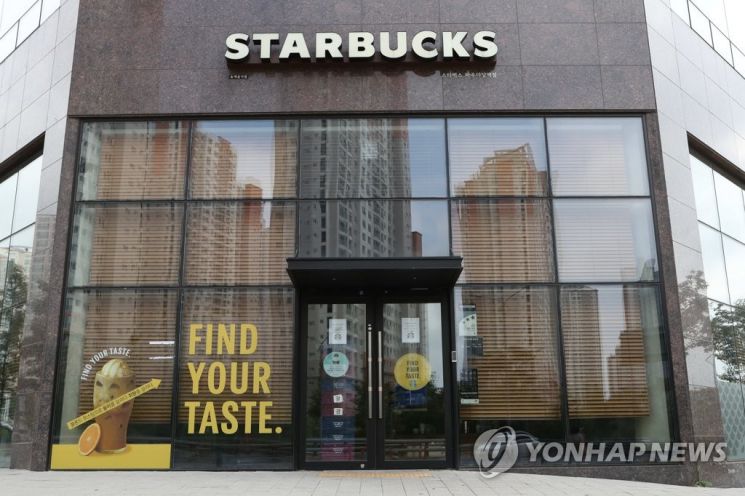 On the 18th, Starbucks Yadang Station branch in Paju-si, Gyeonggi-do. Closed due to a cluster infection of the novel coronavirus disease.
 Photo by Yonhap News
[Asia Economy Reporter Han Seung-gon, Intern Reporter Kang Joo-hee] As a cluster infection of the novel coronavirus disease (COVID-19) is spreading at the Starbucks in Yadang-dong, Paju-si, Gyeonggi Province, the virus carried by the air conditioner breeze has been identified as the cause of infection, raising concerns about airborne transmission.
Experts emphasized the need for strong government-level recommendations to ensure strict adherence to quarantine guidelines.
According to Paju City and quarantine authorities on the 18th, Ms. A, a woman in her 30s residing in Unjeong 3-dong and the initial transmitter at the Starbucks Paju Yadang Station branch, visited the location around 7:30 p.m. on the 8th. Subsequently, Ms. A showed suspected COVID-19 symptoms such as high fever, cough, and headache from the 9th, was tested at Ilsan Paik Hospital on the 11th, and was confirmed positive on the 12th.
At that time, Ms. A was seated right in front of one of the five air conditioners installed on the ceiling of the store's second floor and was found to have conversed with an acquaintance for about two and a half hours. Twenty-seven people who visited the same Starbucks branch as Ms. A were initially confirmed positive. Currently, secondary and tertiary infections have occurred, with at least 54 related confirmed cases as of the 18th.
Quarantine authorities believe that aerosols (air containing tiny droplets) emitted while Ms. A was conversing near the corner stair area of the second-floor store spread throughout the store carried by the air conditioner breeze.
All confirmed primary infected individuals were verified to have stayed in the second-floor store for at least a short time during that period. Among the confirmed cases, there was even an elementary school student who was on the first floor but briefly used the restroom on the second floor, leading quarantine authorities to conclude that a very strong virus spread rapidly through the air conditioner breeze.
Consequently, concerns about COVID-19 infection through air conditioner airflow in enclosed spaces are increasing.
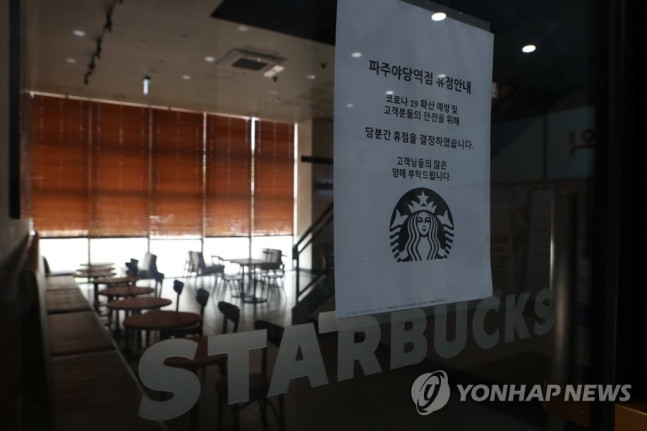 On the 18th, Starbucks Yadang Station branch in Yadang-dong, Paju-si, Gyeonggi-do. A notice of temporary closure to prevent the spread of the novel coronavirus infection is posted.
 Photo by Yonhap News
According to media reports, the World Health Organization (WHO) officially acknowledged the possibility of airborne transmission of COVID-19 last month. Previously, WHO maintained that the main transmission routes of COVID-19 were 'droplets and contact,' but after 239 scientists from 32 countries worldwide presented the possibility of aerosol transmission in an open letter, WHO accepted this.
Benedetta Allegranzi, WHO Director of Infection Prevention and Control, said at a press briefing held at the WHO headquarters in Geneva, Switzerland, "In public places, especially crowded and poorly ventilated enclosed environments, the possibility of airborne transmission cannot be excluded."
Quarantine authorities also prepared air conditioner usage guidelines for multi-use facilities in May, concerned about the possibility of COVID-19 transmission through the air.
The guidelines include: △ Air conditioners can be used with windows closed but ventilation must be done at least once every two hours △ In enclosed facilities where ventilation is impossible, all users must wear masks and disinfect at least once a day △ Airflow should not directly hit people’s bodies, and wind strength should be reduced △ Using fans together with air conditioners should be avoided as it induces air recirculation.
However, with the end of the long rainy season and the onset of intense heat waves increasing the use of cooling devices, and some facilities having difficulty ventilating, concerns have been raised about the difficulty of complying with these guidelines. Also, since the guidelines require voluntary cooperation from businesses, there are calls for strong government-level recommendations to accompany them.
 In Yadang-dong, Paju-si, Gyeonggi Province, a cluster infection of the novel coronavirus is spreading at a Starbucks, and as the virus is identified as having moved through the air conditioning airflow, concerns about infection through airborne transmission are increasing.
 Photo by Yonhap News
Quarantine authorities emphasized that enclosed space use should be avoided as much as possible, and if necessary, masks must be worn.
Jung Eun-kyung, head of the Central Disease Control Headquarters, said at a briefing held at the Korea Disease Control and Prevention Agency last month, "In 3Cs (crowded places, close-contact settings, and confined spaces) environments, if people eat, exercise, or sing without wearing masks, the risk of airborne transmission increases. Avoiding 3Cs and thorough ventilation remain the most effective quarantine measures."
Regarding the cluster infection case at Starbucks Paju Yadang Station branch on the 17th, Director Jung said, "(Customers) did not wear masks, the air conditioner was operating, and due to humid weather, ventilation was inadequate." She added, "Even if it is not airborne transmission via aerosols, in enclosed spaces, droplet transmission over 2 meters is possible, as well as transmission through hand contact and other shared facilities. Removing masks indoors is a dangerous behavior, and such actions should be minimized."
Experts stressed the need for government-level recommendations to ensure strict adherence to quarantine guidelines as COVID-19 spreads rapidly.
Professor Eom Jung-sik, an infectious disease specialist at Gachon University Gil Medical Center, told Asia Economy in a phone interview, "Airborne infection is still only presumed, but since droplets can spread through air conditioner airflow, it is important to follow related quarantine guidelines. However, the existing guidelines are not strongly recommended by the government."
Professor Eom added, "Measures should be taken to prevent strong air from air conditioners from directly hitting people, and efforts are needed to secure safe distances to prevent virus transmission in cafes and restaurants. Even if inconvenient, such guidelines should be enforced, and legal grounds for non-compliance should be considered."
© The Asia Business Daily(www.asiae.co.kr). All rights reserved.



















