TikTok Tops H1 Downloads... Parent Company Value Doubles in 2 Years
Netflix: "TikTok is a New Competitor"
US Companies Nervous About Growth of Chinese Apps
US Imposes Regulations on China for Security Reasons
Some Say It's to Check the Status of Future Technologies
[Asia Economy Reporter Kwon Jaehee] "The digital curtain is being lifted by TikTok. Americans are living in a world where they are influenced by a Chinese social networking service (SNS) platform for the first time." (New York Times)
Chinese digital apps, represented by TikTok and WeChat, are rapidly advancing, turning the global digital platform arena into a battleground for US-China hegemony. While the IT hegemony war between the two countries was previously centered on 5G technology led by Huawei, it has now shifted to social networking services (SNS) represented by Apple, Amazon, Google, and Facebook. The NYT described China's digital expansion as lifting a 'digital' curtain rather than a 'bamboo' curtain, comparing it to past reform and opening-up.
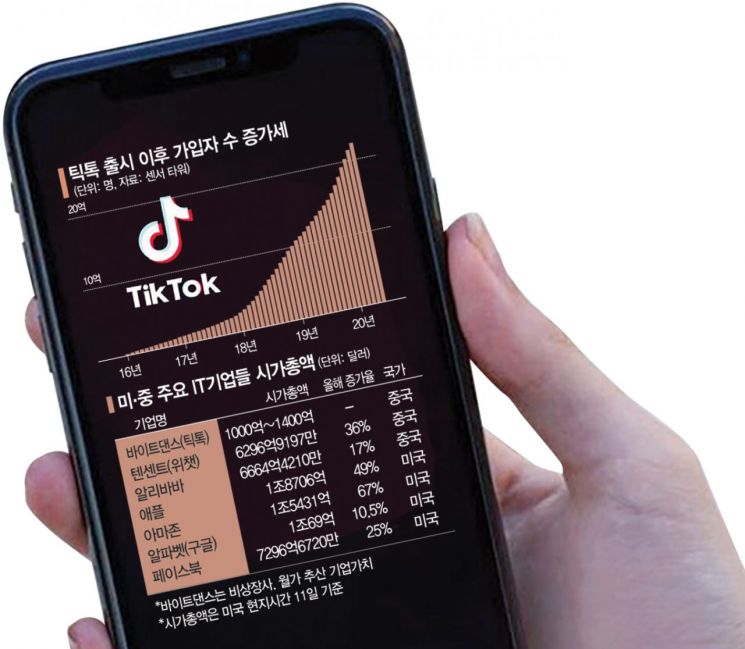
According to Sensor Tower, an app data provider, TikTok's downloads in the first half of this year reached 620 million, ranking first worldwide. During the same period, downloads of Instagram in the US were less than half of TikTok's. TikTok's parent company, ByteDance, which is preparing for a Hong Kong stock market listing, saw its corporate value nearly double from $75 billion (about 89 trillion KRW) at the end of 2018 to $140 billion (about 166 trillion KRW) this year.
The success of TikTok, which shares 15-second short videos, is not limited to the sheer number of downloads. It is worth noting that the IT mindset of Chinese companies has grown to a 'global level,' accurately targeting users' preferences. Even without professional video editing skills like YouTube, video production is possible, and a simple user interface allows videos to be shot vertically without rotating the smartphone. Because the videos are short, the dependence on language is low, and with the addition of automatic translation features, the platform has spread rapidly across borders. By effectively tapping into the tastes of Generation Z (born from the mid-1990s to early 2000s), TikTok has established itself as an effective marketing tool and distribution channel. Despite regulatory policies from the Donald Trump administration, the number of TikTok users in the US reached 26.5 million, half of whom were young people aged 16 to 24.
WeChat, with 1.2 billion users worldwide, is called an all-in-one app in China. It provides all services on smartphones, from messaging to food ordering and marriage registration. Craig Allen, chairman of the US-China Business Council (USCBC), expressed concern about the US government's regulation of Chinese apps, stating, "Those who do not live in China cannot understand what banning WeChat for US companies means," which clearly shows WeChat's status.
For this reason, there is a view that the Trump administration's regulation of Chinese apps like TikTok is not solely for national security reasons. Rather, it strongly indicates an intention to completely block access to future technologies that US companies have monopolistically influenced. The US messenger app Snapchat mentioned 'TikTok' as a competitor in a report submitted to the US Securities and Exchange Commission (SEC) last year, and Reed Hastings, CEO of Netflix, pointed out, "TikTok is our new competitor."
Attention is focused on what will happen after the regulation of TikTok and WeChat. Even if the US sanctions these companies, it is impossible to block all rapidly growing Chinese apps. Moreover, Chinese companies have recently been emerging in other advanced fields such as electric vehicles and satellite navigation devices. Beidou, which has risen as a rival to the US Global Positioning System (GPS), has established its own encrypted satellite navigation system and has begun observing the world, including the US. Beidou is China's 'GPS equivalent' project, which has been underway since 1994, with a total investment of $9 billion (about 10.8 trillion KRW). Due to rapid system updates, it is expected to surpass not only the US but also Europe's Galileo and Russia's GLONASS within a few years. Xiaopeng, known as China's Tesla, is also attracting global attention.
© The Asia Business Daily(www.asiae.co.kr). All rights reserved.

















