Extreme frugality among FIRE enthusiasts spreads mainly among 20s and 30s office workers
Monthly spending accounts for 41.4% of salary... Allowance only 22.0% of monthly pay
Concerns that extreme saving may threaten economic recovery
Experts say "Balance of saving, consumption, and investment is crucial"
"Too much saving can also lead to recession risk"
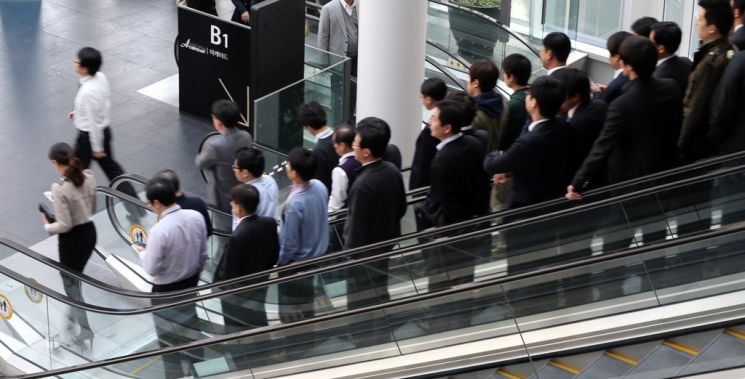 Recently, the so-called 'FIRE tribe,' who drastically reduce consumption and increase savings, is growing mainly among office workers in their 20s and 30s. The photo shows office workers riding down an escalator in a building in 2014. / Photo by Yonhap News
[Asia Economy Reporter Lim Juhyung] Recently, a so-called 'FIRE tribe' has emerged, mainly among office workers in their 20s and 30s, who practice extreme frugality. Their goal is to reduce consumption, increase savings, accumulate assets, retire early at a relatively young age, and live freely. However, some voices express concerns that the rise of the FIRE tribe could negatively impact the national economy. It has been reported that central banks, including the U.S. Federal Reserve (FED), have recently been worried about the spread of the FIRE tribe.
The term FIRE tribe is a neologism formed by taking the first letters of the four English words 'financial independence, retire early.' It spread mainly among young, highly educated, and high-income groups in the U.S. after the global financial crisis triggered by the 2008 U.S. subprime mortgage crisis.
Their parents' generation, the Baby Boomers (born between 1946 and 1965, after World War II), lived by taking excessive loans secured by real estate but faced difficulties after the financial crisis as they were burdened with debt. Having witnessed these parents during their adolescence, the FIRE tribe felt anxious about the future and thus placed more emphasis on saving rather than spending.
In South Korea as well, the number of FIRE tribe members who prioritize saving over consumption has recently increased significantly. According to a survey conducted by the employment site 'Incruit' from June 24 to 26, targeting 825 office worker members, 27.4% of respondents were saving with the goal of early retirement. They saved an average of 41.4% of their monthly salary and spent only 22.0% of their salary on monthly allowances.
 Fire families were found to spend an average of only 22% of their monthly salary on leisure activities and pocket money. / Photo by Yonhap News
However, some voices warn that the spread of the FIRE tribe could hinder economic recovery after COVID-19. There is concern that if the young generation in their 20s and 30s, who are the main drivers of consumption, suddenly stop opening their wallets, the economy could freeze.
In February, the U.S. media outlet 'The New York Times' (NYT) reported on the FED's concerns about the FIRE tribe in an article titled "Millennials Could Make Central Banks’ Jobs Harder."
According to the NYT, the proportion of U.S. office workers aged 24 to 39 with savings exceeding $100,000 (approximately 120 million KRW) recently reached 25%, a 9 percentage point increase compared to 2018.
The problem lies in the fact that as the savings rate rises, consumption decreases, negatively affecting domestic industries. According to the World Bank, the U.S. domestic industry accounts for about 68% of the total Gross Domestic Product (GDP). If office workers do not spend sufficiently, demand decreases, risking a 'deflation' scenario where economic growth and inflation rates both stagnate.
In South Korea, warnings have also been raised that so-called 'super savers'?people with an extreme tendency to save, including the FIRE tribe?could threaten economic recovery after COVID-19.
Lee Ju-yeol, Governor of the Bank of Korea, expressed concerns at a press conference on June 25 regarding the 'Price Stability Target Operation Status Check,' stating, "There is an increase in so-called 'super savers' with extreme risk-averse tendencies," adding, "The slow recovery of consumption and investment, which are pillars of growth, could act as a factor lowering inflation."
 Lee Ju-yeol, Governor of the Bank of Korea, explained that if the number of 'super savers' with extreme saving tendencies increases, it could suppress demand and lower inflation. / Photo by Yonhap News
According to the Bank of Korea, as of May, the total deposit balance in deposit banks reached 1,603.4597 trillion KRW, an increase of 5.8% compared to the end of last year, surpassing 1,600 trillion KRW for the first time. This means that households and companies prefer to accumulate money in deposit form rather than spending it.
According to World Bank data, as of 2017, the domestic industry accounted for 48% of South Korea's GDP. Compared to advanced countries such as the U.S. and the U.K., where the domestic industry accounts for 50-60% of GDP, South Korea's domestic dependency is lower. However, in the context of global trade contraction caused by COVID-19, if consumption also loses momentum, it could negatively impact economic recovery.
Experts explain that the economy can grow stably when savings, consumption, and investment are properly balanced, so if the number of people who save extremely increases, it could also negatively affect the economy.
Kang Nam-hoon, a professor of economics at Hanshin University, told Asia Economy, "The recent characteristic of the economy is that demand shortage must be resolved, and demand can be restored only if consumption increases," adding, "If savings become excessively high, demand may fall short, leading to a recession."
He continued, "For office workers who earn high salaries, being part of the FIRE tribe may not be a problem personally, but if all young people in the country practice extreme frugality, excessive savings could lead to a reduction in jobs due to decreased demand."
© The Asia Business Daily(www.asiae.co.kr). All rights reserved.



















