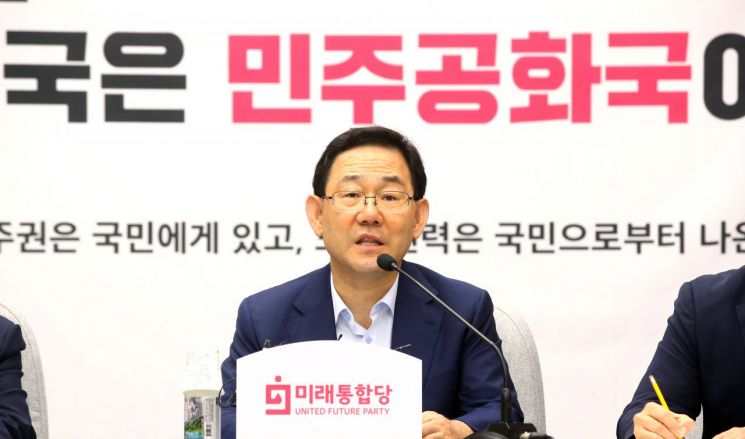
[Asia Economy Reporter Kim Hyemin] Joo Ho-young, floor leader of the United Future Party, urged the ruling party on the 14th, saying, "To directly support the citizens affected by the flood damage, it is only possible through a supplementary budget (추경)." He questioned, "Why are you refusing to implement a supplementary budget for disasters when you have already done so generously before the election?"
On the morning of the same day, Floor Leader Joo held a press conference at the National Assembly marking his 100 days in office and reiterated the necessity of the supplementary budget.
He explained, "The government seems to estimate the flood damage at around 500 billion won, but after visiting the site, I believe the damage will exceed the trillion-won level. Support is only possible for public facilities, and direct support for ordinary citizens was raised to 2 million won, but this is insufficient."
Floor Leader Joo said, "During the recent wildfires in Gangwon Province, direct support was promised to affected households and businesses but was changed to loans and credits. Even if the central government has a contingency fund of just over 3 trillion won and local governments have about 2 trillion won, there is no way to distribute it. I believe changing the support method is only possible through a supplementary budget."
He added, "When I said I would actively cooperate with the supplementary budget if necessary, it meant that direct support, which cannot be done through the existing contingency fund system, would be provided through the supplementary budget." Floor Leader Joo stated, "There may be criticisms regarding fiscal soundness, but the reason for the existence of the state is to provide necessary support to the people even if it means borrowing. We must find and reduce cases of improper execution or waste. While maintaining efforts to preserve fiscal soundness, we must also provide essential budget support."
This implies that the supplementary budget funds should be considered through expenditure restructuring by reallocating unused parts of this year's main budget and three supplementary budgets, rather than through bond issuance.
Regarding the rising approval ratings of the United Future Party and the accelerating decline of the Democratic Party, Floor Leader Joo said, "Since public opinion polls have margins of error and results vary depending on the survey method, I do not celebrate surpassing the Democratic Party in any single poll." However, he added, "I believe the public has started to steadily trust us, and I feel we must work even harder going forward."
He emphasized, "Previously, there was a sense of defeatism, but now we have confidence and recognition that 'we can do it.' This will help the party work harder in the future." He also said, "The president's declining approval rating reflects the public's evaluation of his various political actions so far. I ask the Blue House and the Democratic Party to take note of the significant drop in approval ratings and to properly act in the direction the public desires, even at this late stage."
Regarding the vacant opposition party seat for the National Assembly vice speaker and the ruling party taking all former standing committee chair positions, he said, "It is hard to expect changes unless the Democratic Party, with its new leadership, promises to return to a cooperative framework. If there is a clear promise for win-win cooperation, we would respond positively and accept changes such as regaining standing committee chair positions, but the current situation is difficult."
On the official move by the party’s special committee on platform and policy to limit National Assembly members to four terms, Floor Leader Joo expressed concerns. He said, "I understand that opinions are sharply divided. It will be resolved through party meetings and reports from external party branch chiefs. Even if implemented, it concerns a problem 11 years from now. There is debate about whether it should be decided now. While it facilitates the entry of new politicians, it also serves as a mechanism to exclude experienced and seasoned politicians, so it requires further review and consideration."
Regarding the inclusion of basic income as the first policy task, he explained, "It is a matter of timing and scope, but if this trend continues, many countries worldwide will have no choice but to adopt it. However, since adjustments and consolidation of welfare policies are necessary, we have raised the issue of introducing the concept and adjusting the necessary parts first." He also revealed, "In local governments affiliated with the United Future Party, there will soon be pilot and experimental attempts at basic income targeting certain groups."
© The Asia Business Daily(www.asiae.co.kr). All rights reserved.

















