KMA Begins Mass Strike on 14th
'Summer Vacation' Notices at Local Clinics
No Disruption in Morning Consultations... Normal Treatment
Silent Protest at Large Hospitals... Professors and Senior Medical Staff Prevent Gaps
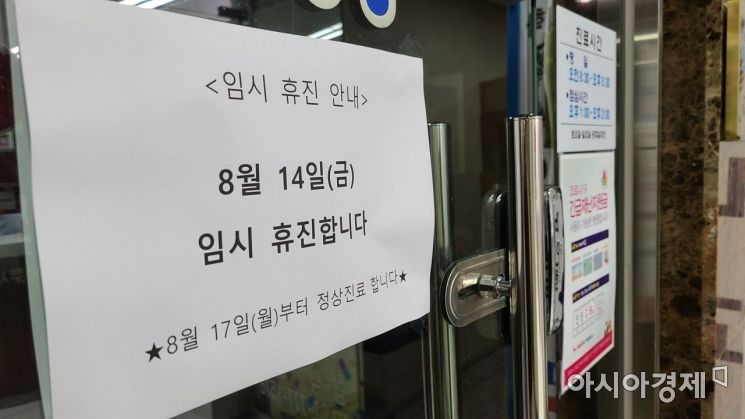 On the morning of the 14th, a notice informing of a temporary closure was posted at the entrance of an otolaryngology hospital in Jung-gu, Seoul.
 Photo by Song Seung-yoon.
[Asia Economy Reporters Song Seung-yoon and Lee Jung-yoon] "I came to the hospital I usually visit without a reservation, but they said it was closed today. How are elderly people supposed to check in advance on their smartphones to find open hospitals...?"
On the morning of the 14th, when the medical community staged a collective strike in protest against the government's plan to increase medical school quotas, Jo Yeon-soon (68, pseudonym), who visited an internal medicine clinic in Jung-gu, Seoul, sighed and turned away. A notice on the hospital door read, "Temporarily closed today." Among 10 clinic-level hospitals visited in the hospital-dense area near Seoul City Hall Seosomun 2nd Office Building in Jung-gu, Seoul, four were closed, and six were operating normally. Notices stating "Closed for summer vacation" were posted at the entrances of the closed hospitals from that day until the 17th.
The hospitals that were operating normally also appeared quiet. Around 9:40 a.m., an orthopedic clinic in Jung-gu had only two patients waiting. A hospital official said, "Usually, there are hardly any crowds around the start of consultation hours," adding, "We need to observe more, but it seems the afternoon will be no different from usual." A neurology clinic located in the adjacent building showed a similar situation. Hospital staff conducted temperature checks at the entrance and guided patients as usual.
On the same morning, about 70 residents (postgraduate trainees) and fellows in white coats, along with about 70 medical students, lined up silently in a single file about 170 meters long on the sidewalk stretching from Seoul St. Mary's Hospital Intersection in Seocho-gu, Seoul, to the hospital's new building. Entering their second refusal to provide medical services since the 7th, the residents held placards reading "Stop producing ghost medical schools without considering medical environments" and "Guarantee training environments for struggling public hospitals." At Seoul St. Mary's Hospital, about 90% of the 298 residents participated in the strike, and half of the approximately 120 fellows refrained from providing medical services that day.
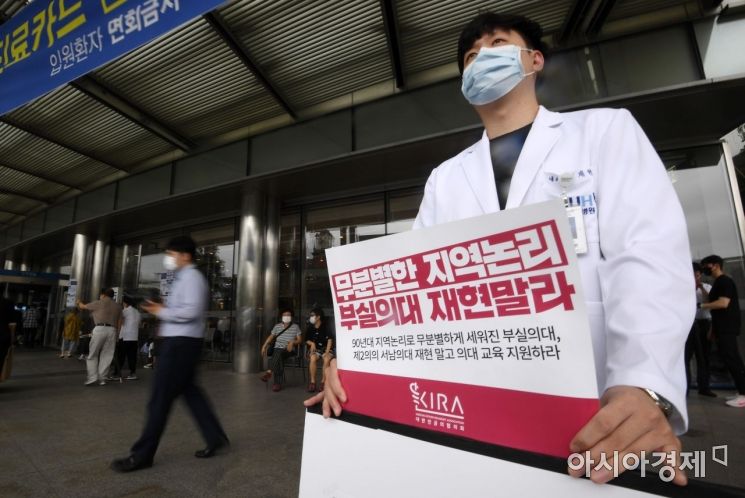 On the 14th, when the Korea Medical Association began a nationwide collective strike, residents were holding relay one-person protests in front of the main building of Seoul National University Hospital in Jongno-gu, Seoul. The Korea Medical Association announced a general strike on this day in opposition to the government's expansion of medical school quotas and the establishment of public medical schools. Photo by Hyunmin Kim kimhyun81@
However, Seoul St. Mary's Hospital appeared similar to usual that morning. To prevent disruptions in medical services due to the doctors' general strike, the hospital deployed professors and nurses from each clinical department to areas prone to medical gaps, such as the emergency room and intensive care unit. Kim (60), who visited the hospital's otolaryngology department, said, "The waiting time was similar to when I visited last week," adding, "I didn't really feel the impact of the strike on the medical services."
At Seoul Asan Hospital, where 90% of residents participated in the strike, about 10% of outpatient and inpatient appointments were postponed. A hospital official said, "With residents and fellows absent, professors and attending physicians remained at the hospital to fill the gaps in medical services," adding, "We coordinated schedules in advance for outpatients and inpatients with lower emergency levels."
That morning, residents protested against the increase in medical school quotas in front of large hospitals nationwide. At Seoul National University Hospital's main building and in front of Hyehwa Station on Subway Line 4, a four-hour one-person relay protest involving residents and fellows took place, while 20 residents conducted silent protests in eight shifts in the lobby of Ewha Mokdong Hospital. The student council of Chung-Ang University College of Medicine also held a rally in front of Heukseok Station, calling for normalization of medical policies. Resident Kim said, "Even as COVID-19 continues and flood damage compounds the difficulties faced by the public, the government's unilateral actions that drove doctors to the streets must be apologized for to the people."
The Korean Medical Association, which led the medical strike, plans to hold a "National Doctors' General Strike Rally" in the afternoon at Yeouido Culture Park in Seoul, with about 3,000 participants. This is a demonstration against the government's four major medical policies. Residents who began refusing medical services from the morning plan to join the rally in Yeouido after conducting silent protests in front of large hospitals in Seoul.
© The Asia Business Daily(www.asiae.co.kr). All rights reserved.
![From Bar Hostess to Organ Seller to High Society... The Grotesque Con of a "Human Counterfeit" [Slate]](https://cwcontent.asiae.co.kr/asiaresize/183/2026021902243444107_1771435474.jpg)

















