Korea Exchange Holds Discussion on Short Selling Market Impact and System Improvement
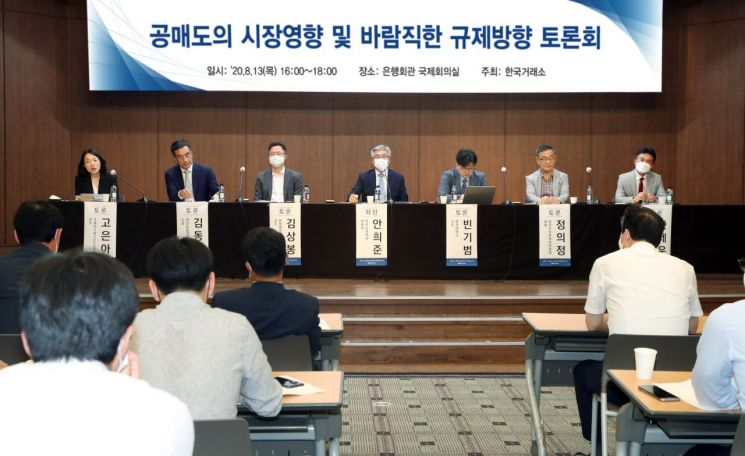 On the 13th, panelists are conducting a discussion at the "Market Impact of Short Selling and Desirable Regulatory Directions Forum" hosted by the Korea Exchange at the Korea Federation of Banks Building in Jung-gu, Seoul. (Provided by Korea Exchange)
[Asia Economy Reporter Minwoo Lee] Concerns have been raised regarding the scheduled resumption of short selling next month on the 15th. Regardless of the positive and negative functions of short selling, there are calls to improve the current system as it is unfair to individual investors. Short selling is a transaction where one borrows stocks expecting the price to fall, sells them, and then buys back the stocks at a lower price to return the borrowed shares and earn a profit.
On the 13th, the Korea Exchange held a "Discussion on the Market Impact of Short Selling and Desirable Regulatory Directions" at the Bankers Hall in Jung-gu, Seoul. Experts from academia, industry, and investors attended the event and shared various opinions. Although detailed differences in views emerged, there was a general consensus that the aspects of the current short selling system that disadvantage individuals should be corrected.
Hwang Sewoon, a research fellow at the Korea Capital Market Institute, explained the controversy over short selling by comparing it to margin buying transactions. Margin buying, where investors borrow money from securities firms to buy stocks and sell them at a higher price to repay the loan and gain capital gains, is similar to short selling. However, the reason noise arises only in short selling is due to issues of market participation fairness. In Korea, individuals cannot easily participate in short selling due to credit issues, whereas foreigners and institutions can easily borrow stocks to short sell, creating a "tilted playing field." Hwang said, "In the US, Europe, and even Japan, individuals account for about 25% of total short selling, but in Korea, the individual share is less than 1%. If I (an individual) cannot do it but others (foreigners and institutions) make money from it, dissatisfaction is inevitable."
However, he emphasized the need for more sophisticated system improvements as there are clear differences. Hwang advised, "The money borrowed in margin trading is the same commodity no matter where it is borrowed from, but the stocks borrowed in short selling are different products depending on the company, such as Samsung Electronics or Hyundai Motor. Therefore, the system should be designed more delicately with more consideration, and illegal activities should be dealt with severely."
Kim Donghwan, CEO of the Alternative Finance and Economy Research Institute, also supported this view. He pointed out, "When academia deals with the domestic short selling system, they compare and refer to countries with mature capital markets and long histories like the US and UK. However, Korea’s market size and the proportion of direct transactions by individual investors are significantly smaller, creating a large gap between theory and reality." He argued that this is why noise arises despite Korea having some of the strictest short selling regulations in the world. Kim emphasized, "We should not discuss only the absurd parts of extending the short selling ban while excluding the fact that over 95% of Korea’s short selling market consists of foreigners and institutional investors. Since everyone acknowledges that individuals cannot easily participate in short selling, the ban on short selling should be extended until improvements are made."
Professor Kim Sangbong of Hansung University’s Department of Economics also argued that since the COVID-19 pandemic, which triggered the short selling ban, is unlikely to end this year, the ban should be extended until around next year. He said, "Since December 2010, the economy has grown by 46%, but the stock market has only risen by 16%, proving that the domestic market has been undervalued rather than short selling fulfilling its price discovery function. After the short selling ban, individuals supported the stock market, but if short selling resumes, the real estate market may become volatile or money may flow overseas again. Therefore, the ban should be extended until next year and the system reviewed."
Jung Eejung, CEO of the Korea Stock Investment Federation, stated, "In the domestic stock market, foreigners and institutions achieve overwhelming victories using short selling, while individual losses are beyond imagination. The financial authorities should thoroughly investigate their profit rates and introduce a system for punitive damages if illegal activities are found."
In the industry, there were also rebuttals that these criticisms are somewhat unfair. Ko Eunah, Executive Director at Credit Suisse Securities, said, "The authorities thoroughly supervise violations of short selling regulations, and most violations are mistakes such as misunderstandings of settlement dates due to system differences between countries rather than malicious intent. While agreeing on the need for transparent management and supervision of short selling, if the ban continues, foreign investors who find it difficult to implement hedging strategies domestically may increasingly move their funds to other overseas markets." She added, "If the short selling ban is prolonged, global index providers such as Morgan Stanley Capital International (MSCI) or Financial Times Stock Exchange (FTSE) may downgrade Korea’s rating or reduce its weighting in emerging market indices, resulting in evaluation disadvantages."
© The Asia Business Daily(www.asiae.co.kr). All rights reserved.
![Clutching a Stolen Dior Bag, Saying "I Hate Being Poor but Real"... The Grotesque Con of a "Human Knockoff" [Slate]](https://cwcontent.asiae.co.kr/asiaresize/183/2026021902243444107_1771435474.jpg)
















