Samsung DS, Large-Scale Workforce Expansion
Speeding Up Semiconductor Business Growth
New Production Line Expected at Pyeongtaek Campus
[Asia Economy Reporters Changhwan Lee and Dongwoo Lee] Samsung Electronics' decision to deploy hundreds of personnel from Samsung Display to its semiconductor business is interpreted as an effort to secure a leading position in the rapidly growing global semiconductor market driven by the activation of non-face-to-face (untact) services and the Fourth Industrial Revolution.
Samsung Electronics' semiconductor division has already recruited the largest number of experienced employees in the first half of this year. The additional hiring indicates that the business expansion is continuing rapidly.
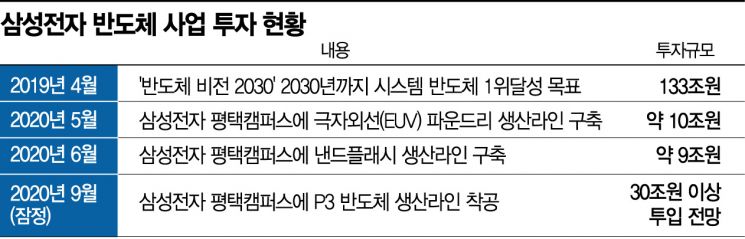
Samsung Electronics Vice Chairman Lee Jae-yong has repeatedly expressed his commitment to expanding the semiconductor business. In April last year, he announced plans to invest 133 trillion won by 2030 to become the world’s number one in system semiconductors, including foundry, following memory semiconductors.
Subsequently, in May this year, Samsung Electronics announced a 10 trillion won investment to establish an extreme ultraviolet (EUV) foundry (semiconductor contract manufacturing) production line at the Pyeongtaek Campus, and in June, it revealed plans to invest 9 trillion won to build a NAND flash production line at the same campus.
Samsung Electronics plans to focus on constructing new semiconductor factories at the Pyeongtaek Campus to expand its business. Currently, the P1 production line is operational at the Pyeongtaek Campus, with the P2 line scheduled to start in the second half of this year, and the P3 line is expected to begin construction soon.
The P3 line is expected to be Samsung Electronics’ largest single semiconductor production line, covering an area of 700,000 square meters with a minimum investment of over 30 trillion won. Samsung Electronics is also negotiating with Pyeongtaek City to build additional lines beyond P3. It is reported that many of the personnel transferring from Samsung Display will likely be assigned to the new production lines at the Pyeongtaek Campus.
Samsung Electronics’ faster-than-expected establishment of semiconductor production lines and workforce expansion is due to the anticipated rapid growth of the global semiconductor market driven by the Fourth Industrial Revolution. Semiconductors are key components in most new industries such as untact services accelerated by COVID-19, autonomous vehicles, AI (artificial intelligence), and 5G.
In fact, the global semiconductor market continues to grow despite the economic downturn caused by COVID-19. According to semiconductor market research firm IC Insights, the combined sales of the world’s top 10 semiconductor companies in the first half of this year reached $147.093 billion (approximately 174 trillion won), a 17% increase from the previous year. Samsung Electronics is rapidly expanding its scope beyond memory semiconductors, which dominate the global market, to non-memory semiconductors such as foundry business.
Professor Moon Daegyu of the Department of Display and New Materials Engineering at Soonchunhyang University said, "While Korean companies are downsizing their LCD business due to China’s low-price competition, this move is interpreted as strengthening their core semiconductor business through efficient personnel allocation."
© The Asia Business Daily(www.asiae.co.kr). All rights reserved.
![Clutching a Stolen Dior Bag, Saying "I Hate Being Poor but Real"... The Grotesque Con of a "Human Knockoff" [Slate]](https://cwcontent.asiae.co.kr/asiaresize/183/2026021902243444107_1771435474.jpg)

















