Legislative Drive Initiated by Lawmaker Lee Yong-woo of the Democratic Party
Discussion Accelerates as Financial Supervisory Service Chief Shows Strong Commitment
[Asia Economy Reporter Kim Hyo-jin] As the ruling party takes the lead in actively pushing for a measure to grant consumer-centered one-sided binding force to dispute mediation by financial supervisory authorities, the financial sector is expressing strong opposition.
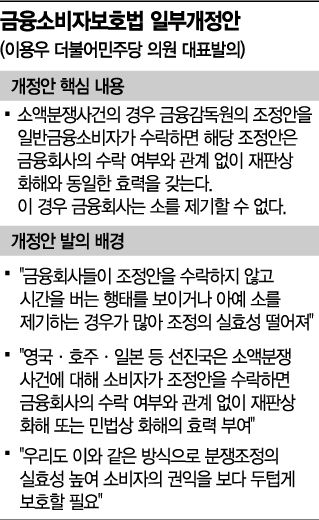
The core of the proposal is that for dispute mediation cases below a certain scale, if the consumer accepts the mediation proposal, it will take effect regardless of the financial company's consent.
If legislation proceeds as currently trending, it is expected that in about 8 out of 10 dispute mediation cases, financial companies will lose their right to file lawsuits. Although this restricts the constitutionally guaranteed 'right to a trial' and may be unconstitutional, given the seat distribution in the 21st National Assembly and the will of the financial supervisory authorities, the likelihood of realization is high, raising concerns in the financial sector.
According to the financial and political sectors on the 13th, Rep. Lee Yong-woo of the Democratic Party, a member of the National Assembly's Political Affairs Committee, officially proposed a revision bill to the Financial Consumer Protection Act containing these provisions the day before.
The revision bill stipulates that "in the case of small-amount dispute cases, if the consumer accepts the Financial Supervisory Service's mediation proposal, it shall have the same effect as a judicial settlement regardless of the financial company's acceptance, and the financial company cannot file a lawsuit."
"Automatically Effective Upon Consumer Acceptance"
Granting Same Effect as Judicial Settlement
Rep. Lee explained, "Recently, many financial companies have been refusing to accept the mediation proposals of the Financial Supervisory Service's Dispute Mediation Committee, delaying the process or even filing lawsuits, which has led to criticism that the committee's recommendations lack effectiveness," adding, "The purpose is to enhance the effectiveness of mediation and more robustly protect the rights and interests of financial consumers."
On the 11th, Financial Supervisory Service Governor Yoon Seok-heon instructed at an executive meeting, "Actively strive to prepare measures to secure the effectiveness of the dispute mediation system by granting one-sided binding force." Following Governor Yoon's remarks, the bill was proposed, rapidly accelerating the discussion.
If the bill is passed, procedures to set detailed criteria for 'small-amount cases' through subordinate regulations will proceed. Rep. Lee and the Financial Supervisory Service are strongly considering defining mediation cases involving amounts of 20 million KRW or less as small-amount cases, based on current civil litigation regulations.
Rep. Lee has identified that about 78% of the Financial Supervisory Service's dispute mediation cases involve dispute amounts of 20 million KRW or less. Although considered small amounts, excluding some fund-related cases with particularly large dispute amounts, the majority of cases would restrict the financial companies' litigation rights.
Financial Companies Lose Litigation Rights in About 80% of Cases
"One-sided Restriction of Dispute Rights Raises Concerns"
The Financial Supervisory Service's dispute mediation proposals tend to be more favorable to consumers compared to lawsuits. Moreover, ordinary consumers often find it difficult to match the financial companies' litigation capabilities, so they usually approach the Financial Supervisory Service first.
The one-sided binding force proposal was previously discussed during the enactment of the Financial Consumer Protection Act but was not adopted due to concerns about unconstitutionality. However, supported by the current government's financial policy focus on consumer protection, the discussion is rapidly progressing.
The fact that some advanced financial countries overseas already implement such systems also serves as a basis for the discussion.
The financial sector strongly opposes this movement. Concerns are particularly high in the insurance sector, which has relatively many dispute cases. A representative from an insurance company stated, "This is an attempt to unilaterally restrict the legitimate right to dispute," and added, "It is a very dangerous idea to give the Financial Supervisory Service's decisions, which is not a government agency, the same legal meaning as a court judgment through legislation."
A financial sector official pointed out, "Pressure on financial companies is already intense due to dividend restrictions justified by enhancing loss absorption capacity, policies to strengthen internal controls in financial companies, and reinforced supervisory functions regarding financial product sales," adding, "It seems that excessive suspicion toward financial companies and financial capital is being institutionally expressed."
© The Asia Business Daily(www.asiae.co.kr). All rights reserved.

















