[Asia Economy Reporter Ki-min Lee] The Federation of Korean Industries (FKI) plans to submit an opinion letter to the government expressing concerns that the proposed amendments to the Win-Win Cooperation Act, which include shifting the burden of proof for technical data and strengthening sanctions, could stifle the corporate ecosystem.
On the 13th, the FKI announced that it would deliver an opinion to the Ministry of SMEs and Startups on the 14th, urging careful review of the amendment bill to the Win-Win Cooperation Act, which the government announced for legislative notice last month.
The legislative notice includes key provisions such as ▲shifting the burden of proof for technical data ▲mandatory signing of confidentiality agreements for technical data ▲introduction of punitive damages ▲establishment of authority to order submission of evidence in damage compensation lawsuits ▲provisions for calculating and estimating damages, focusing on sanctions and penalties for acts of technology misappropriation.
The FKI foresees that if the burden of proof for technical data is shifted and direct sanctions by the Ministry of SMEs and Startups become possible through dispute mediation requests, conflicts between commissioning and commissioned companies will escalate, cooperation between companies will be hindered, and this will negatively impact companies' efforts to overcome the economic crisis caused by COVID-19.
The FKI cited the newly introduced 'obligation to present specific acts' in the Win-Win Cooperation Act as an example, pointing out that it conflicts with existing legal principles. The 'obligation to present specific acts' is a system for shifting the burden of proof, requiring the accused party to specifically explain that their own or newly commissioned company's technology is unrelated to the technology of the harmed company.
The FKI criticized that, under civil law, the burden of proof for illegal acts in damage compensation lawsuits lies with the plaintiff as a principle, and that the technical data protected under the Win-Win Cooperation Act is neither as clear as patent rights nor publicly disclosed, but managed as confidential information known best by the commissioned company asserting the rights, yet the burden of proof is being shifted to the commissioning company.
Furthermore, the FKI anticipates that if the legislative notice passes, the burden of proof on commissioned companies will be eased, creating a litigation-friendly structure, leading commissioning and commissioned companies to perceive each other as potential dispute targets and respond accordingly. Besides unnecessary costs such as recording and managing all communication and transaction evidence, joint technology development and cooperation between large and small companies may shrink to avoid risks, and there is a high possibility that business partners will be shifted to overseas companies.
Additionally, there is concern that it will become difficult to freely change established business partners, undermining contractual freedom; that the law only protects existing small businesses but may hinder the emergence and innovation of new companies; and that since multiple regulations on technology misappropriation already exist in the Subcontracting Act, the Small and Medium Business Technology Protection Support Act, the Unfair Competition Prevention Act, and the Patent Act, overlapping regulations and duplicate sanctions on the same issues may occur.
The FKI also pointed out that dispute mediation should be based on the voluntary will of the parties and mutual free agreement, but granting the mediator punitive authority and other coercive powers may diminish the meaning of dispute mediation.
Moreover, the FKI requested that legal deficiencies be addressed by referring to the Subcontracting Act, noting that the Win-Win Cooperation Act does not stipulate investigation or disposition statutes of limitations, allowing correction orders and sanctions by the Ministry of SMEs and Startups even for incidents from decades ago upon dispute mediation requests, thereby undermining legal stability.
Yoo Hwan-ik, Director of Corporate Policy, emphasized, “If the burden and uncertainty on commissioning companies increase unilaterally, changing business partners overseas becomes inevitable, cooperation between large and small companies turns into a potential risk, and protecting existing business relationships prevents innovation and growth of new small and venture companies. To overcome the economic shock caused by the novel coronavirus infection (COVID-19), it is essential to prioritize the improvement of laws and systems that support win-win cooperation among companies in line with the legislative intent of the Win-Win Cooperation Act.”
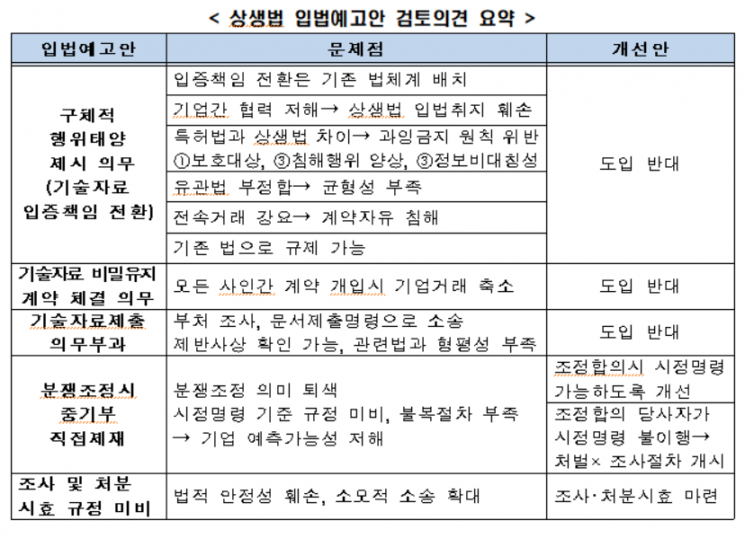 The Federation of Korean Industries plans to submit a statement expressing concerns on the 14th regarding the amendment to the Win-Win Cooperation Act, which the Ministry of SMEs and Startups announced for legislative notice last month.
© The Asia Business Daily(www.asiae.co.kr). All rights reserved.
![Clutching a Stolen Dior Bag, Saying "I Hate Being Poor but Real"... The Grotesque Con of a "Human Knockoff" [Slate]](https://cwcontent.asiae.co.kr/asiaresize/183/2026021902243444107_1771435474.jpg)











