Ministry of Oceans and Fisheries, 'Five-Year Plan for Shipping Reconstruction Performance Review and Shipping Policy Operation Direction'
HMM Reports Operating Profit of 138.7 Billion KRW in Q2… Up 251.6 Billion KRW YoY
Minister Moon: "Will Support Stable Structural Transition, Not Just Temporary Rebound"
Last Year’s Shipping Revenue at 37 Trillion KRW… Targeting 51 Trillion KRW by 2025"
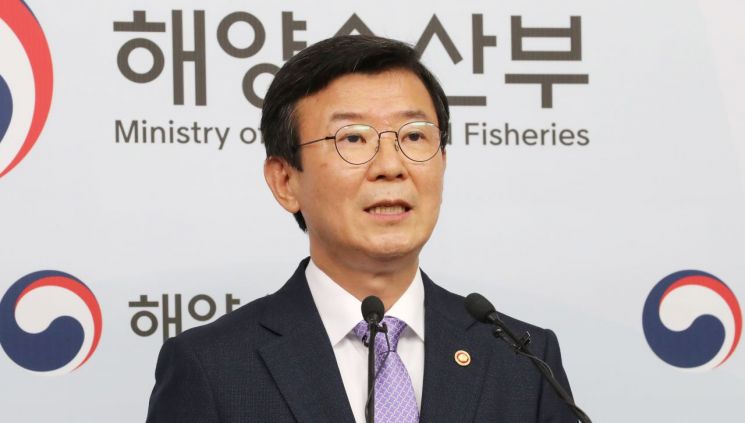
[Sejong=Asia Economy Reporter Joo Sang-don] Moon Seong-hyeok, Minister of Oceans and Fisheries, stated on the 12th, "HMM (formerly Hyundai Merchant Marine) has turned to operating profit after 21 quarters, and this is not a temporary rebound but a transition to a stable structure. We aim to achieve net profit in 2022."
Minister Moon made these remarks while announcing the "Five-Year Shipping Reconstruction Plan Performance Review and Shipping Policy Direction" at the Government Complex Sejong on the same day.
HMM disclosed that its operating profit for the first half of the year was 136.7 billion KRW, an increase of 355.2 billion KRW compared to the same period last year. The net loss was 37.5 billion KRW, improving by 341.7 billion KRW from the previous year. For Q2 alone, operating profit was 138.7 billion KRW, and net profit was 28.1 billion KRW.
Minister Moon said, "When I took office last year and HMM joined 'THE Alliance,' one of the world’s top three shipping alliances, there was skepticism about the Five-Year Shipping Reconstruction Plan. However, the fact that HMM posted operating profit after 21 quarters is undoubtedly a result of the plan’s success."
Previously, the government established the Korea Ocean Business Corporation in July 2018, an institution dedicated to stable ship acquisition and management support for shipping companies, and supported 49 shipping companies with a total of 4.283 trillion KRW over the past two years. Alongside this, to secure stable cargo?a key goal of the shipping reconstruction?the government introduced the "Excellent Shipper Certification System," which offers various benefits such as corporate tax reductions to companies demonstrating co-growth efforts between shipping companies and cargo owners, thereby strengthening symbiotic cooperation. The government also implemented a "Comprehensive Evaluation Bidding Pilot Project" for selecting public bulk cargo transport operators, improving bid success rates by over 10%. Furthermore, based on cooperation within the Korean Shipping Partnership (KSP), a collaboration among domestic container shipping companies, Janggeum Shipping and Heung-A Shipping merged to become a top 20 regional container shipping company globally. These efforts resulted in a 12.9% increase in sales and a return to operating profit. Through three rounds of restructuring Asian routes, supply was adjusted by 13 vessels, alleviating excessive competition among domestic shipping companies. Regarding vessel orders, 164 ships (estimated at 10.74 billion USD) have been ordered by July this year out of the 200 ships targeted in the Five-Year Shipping Reconstruction Plan, marking the beginning of a cooperative foundation between the shipping and shipbuilding industries, according to the Ministry of Oceans and Fisheries.
However, Minister Moon emphasized, "Just because there was a profit in one quarter does not mean HMM has fully normalized its management. The Five-Year Shipping Reconstruction Plan must be further supplemented."
The Ministry of Oceans and Fisheries plans to supplement the existing Five-Year Shipping Reconstruction Plan with targets such as 51 trillion KRW in shipping revenue, a controlled fleet of about 100 million tons, and 1.2 million TEU of deep-sea container capacity by 2025. To achieve this, they will promote ▲strengthened support centered on the Korea Ocean Business Corporation ▲management innovation support for container shipping companies ▲and the establishment of infrastructure supporting the shipping industry.
First, ship-owning companies will own vessels and lease them to shipping companies at reasonable prices to alleviate financial burdens and high debt ratios associated with vessel ownership, allowing shipping companies to focus on profit generation through improved transport services. To this end, from the second half of this year, the Korea Ocean Business Corporation will add operating lease business to its ship purchase and re-lease (S&LB) operations. In the mid-to-long term, the establishment of a specialized leasing ship-owning company involving shipping companies, shipbuilders, and public institutions will be pursued to enhance cost competitiveness and create a foundation for stable vessel investment even during downturns. Additionally, the Ministry plans to revise the Korea Ocean Business Corporation Act within this year to allow exceptional credit guarantees for emergency liquidity support to shipping companies during situations like the COVID-19 pandemic. They will also review the feasibility of introducing advanced shipping tax systems (such as accelerated depreciation of vessels) to establish a newbuild ordering system. Alongside this, efforts will be made to strengthen domestic shipping companies’ capabilities and risk management through the development of an independent freight index, a vessel price fluctuation database, and comprehensive consulting services.
Management innovation for container shipping companies will also be supported. Based on 2022 performance, the domestic shipping company HMM will be monitored and evaluated continuously through a scientific decision-making system to ensure net profit achievement. The current container vessel capacity of 590,000 TEU will be expanded to 1 million TEU by 2022, with new routes to the US West Coast, South America, and the Middle East to be developed. Additionally, container yard facilities will be secured in China, and cooperation with US railway companies will be strengthened to enhance inland transportation services in the Americas. Truck and air-linked transport services will also be developed in Europe.
Infrastructure support for the shipping industry, such as seafarers and overseas logistics, will be reinforced. To provide overseas employment opportunities for seafarers, young maritime officers will be supported for onboard training with overseas shipping companies in Europe and other regions. Through the APEC Seafarer Network (SEN), established in Busan last October, international onboard training projects for seafarers in the Asia-Pacific region will be supported. Guidelines will be established and strictly enforced to expand remote medical services, improve compensation for injured seafarers, and guarantee the rights of trainee seafarers.
Minister Moon said, "While the first half of the Five-Year Shipping Reconstruction Plan focused on restoring the shipping industry’s status before Hanjin Shipping’s bankruptcy, the latter half must prepare for a higher leap forward. For the sustainable development of Korean shipping, we will faithfully implement the shipping policies announced today throughout the remaining plan period."
© The Asia Business Daily(www.asiae.co.kr). All rights reserved.
![User Who Sold Erroneously Deposited Bitcoins to Repay Debt and Fund Entertainment... What Did the Supreme Court Decide in 2021? [Legal Issue Check]](https://cwcontent.asiae.co.kr/asiaresize/183/2026020910431234020_1770601391.png)















