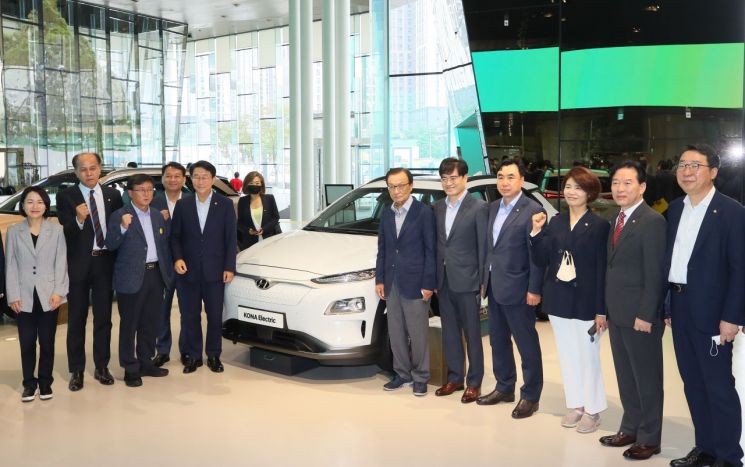
 Lee Hae-chan, leader of the Democratic Party of Korea, Cho Jung-sik, chairman of the Policy Committee, and Gong Young-woon, president of Hyundai Motor Company, are taking a commemorative photo with electric and hydrogen vehicles in the background at the Democratic Party of Korea K-New Deal Committee and Future Car Field Meeting held on the 12th at Hyundai Motorstudio in Goyang, Gyeonggi Province. Photo by Yonhap News
[Asia Economy Reporter Kiho Sung] Regarding the 'Green New Deal' promoted by the government and the ruling party, the domestic automobile industry has called for continuous support for infrastructure development such as electric and hydrogen charging stations and technology development. In particular, they emphasized, "Our companies' eco-friendly vehicle technology is world-class," adding, "However, since a global showdown for eco-friendly vehicles will take place starting next year, active policy support is necessary."
On the 12th, the Future Transition K-New Deal Committee of the ruling party, including Lee Hae-chan, leader of the Democratic Party of Korea, visited Hyundai Motorstudio in Goyang and held an on-site policy meeting on the theme of 'Innovative Growth and Early Transition Plan for Future Vehicles,' attended by government officials, private companies, and experts.
In his greeting at the meeting, Chung Eui-yun, President of Hyundai Motor Company, said, "Although eco-friendly vehicles are still somewhat expensive, we will significantly lower prices to enable customers to make reasonable purchases," adding, "Especially, we believe it is our companies' role to grow together with partner companies working together to enter the global market."
Jeong Manki, chairman of the Korea Automobile Manufacturers Association, who gave a presentation, stated, "Hydrogen vehicles are leading the global market for domestic companies, and battery technology is also advancing," but pointed out, "However, there are still shortcomings in price issues due to wages and productivity, as well as competitiveness of key components."
Chairman Jeong further requested the government's eco-friendly vehicle policy direction to include ▲continuous activation of the electric vehicle market ▲establishment of a foundation for autonomous vehicle industry development ▲enhancement of companies' future vehicle development capabilities ▲strengthening of the future vehicle ecosystem competitiveness and regulations at a level equal to global standards. He especially emphasized that a corporate environment where companies can focus on management without worrying about defending management rights should be created, and asked, "Please legislate after reviewing both the advantages and side effects of bills such as the Commercial Act amendment and the Fair Trade Act amendment."
Son Jung-won, CEO of Hanon Systems, who also presented, emphasized the importance of government research and development (R&D) support for parts suppliers' transition to future vehicles. He said, "Through government R&D support, Hanon Systems currently generates 55% of its sales from future vehicle parts production," and projected, "This will reach 70-80% by 2025."
During the subsequent open discussion, vivid voices from the field poured out. Kim Pil-soo, chairman of the Korea Electric Vehicle Association, pointed out ▲refined operation of the eco-friendly vehicle subsidy system ▲support for nurturing future vehicle talent ▲policy review related to electric vehicle fees and systems. He particularly explained regarding electric vehicle fees, "Basic fees are being charged even for unused chargers, causing companies to discard some chargers," adding, "Because of this, the burden of basic fees is also being passed on to consumers."
Shin Jae-haeng, head of the Hydrogen Convergence Alliance Promotion Group, emphasized the expansion of hydrogen charging stations and proposed ▲subsidy plans for hydrogen charging station operating costs ▲the fact that hydrogen charging stations operate under general electricity rates unlike other gas stations ▲facility investment for small and medium enterprises ▲and nurturing of related specialized personnel.
Kim Yong-hwan, CEO of Smart Radar System (an autonomous driving venture company), stressed the need for ▲active government R&D support ▲active collaboration between domestic large corporations and venture companies ▲and the creation of an environment for demonstration and testing to ensure the success of autonomous driving systems.
In his closing remarks, Democratic Party leader Lee Hae-chan said, "The party and government will actively seek ways for industrial structure transformation and our companies to move forward together," and added, "We will continuously communicate with the field for a major transition in our society."
Based on the opinions discussed at today's meeting, the Future Transition K-New Deal Committee plans to jointly prepare with the party, government, and the Blue House measures to reform the future vehicle subsidy system, strengthen the mandatory sales system for eco-friendly vehicles, establish charging infrastructure plans, and support the industrial sector for the transition of the future vehicle industry.
© The Asia Business Daily(www.asiae.co.kr). All rights reserved.

















