'2020 OECD Korea Economic Report'
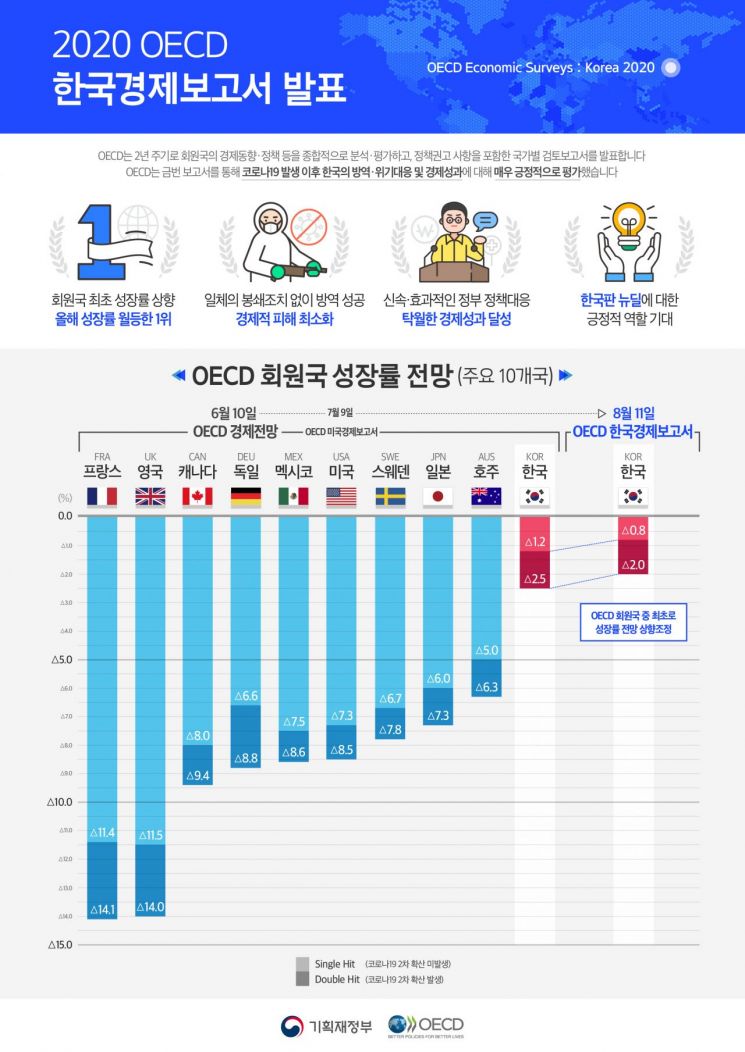
[Asia Economy Reporter Jang Sehee] The Organisation for Economic Co-operation and Development (OECD) has revised upward its economic growth forecast for South Korea this year to '-0.8%'. This reflects an assessment that the economic shock was limited thanks to swift and effective policy responses.
Regarding the government's fiscal policy, the OECD emphasized the continued need to support the economy through fiscal measures, while advising that in the long term, increased government revenue will be necessary due to rising public expenditures associated with an aging population.
In the '2020 Korea Economic Report' published on the 11th, the OECD projected South Korea's economic growth rates for this year and next year at -0.8% and 3.1%, respectively, assuming no second outbreak of COVID-19. This upward revision reflects the GDP performance in the second and fourth quarters and ranks first among member countries. Australia (-5.0%) ranked second, followed by Japan (-6.0%) and Sweden (-6.7%).
The OECD Economic Report is published every two years, providing a comprehensive analysis and evaluation of member countries' economic trends and policies, along with policy recommendations. Although originally scheduled for release in May, it was postponed to this month to incorporate the impact of COVID-19.
This report is composed of three sections: ▲macroeconomic trends and policies ▲job policies in preparation for aging ▲technology diffusion to improve productivity.
◆Expectations for 'Economic Recovery' through the Korean New Deal... Call for Improvement in Job Quality for the Elderly= The OECD expressed expectations for economic recovery through investments in digital, green, and human capital. In particular, it anticipated that expanding support for renewable energy and eco-friendly technologies would have a high fiscal multiplier effect, contributing to solidifying economic recovery.
However, it urged that the introduction of the sickness allowance system proposed in the Korean New Deal should be designed to support workers' rehabilitation and return to work.
It also emphasized the need to strengthen social safety nets for non-regular and platform workers and to encourage compliance with social insurance enrollment. The OECD further forecasted that the contraction in trade volume due to the global economic downturn and weakening global supply chains would act as downward factors for exports and investment.
Meanwhile, regarding the real estate market, the OECD evaluated that, compared to member countries, flexible housing supply and sound financial policies have maintained stability in nationwide real housing prices. However, it pointed out the need to be cautious about financial stability risks such as excessive inflows of market liquidity into the real estate market in the future.
© The Asia Business Daily(www.asiae.co.kr). All rights reserved.
![From Bar Hostess to Organ Seller to High Society... The Grotesque Con of a "Human Counterfeit" [Slate]](https://cwcontent.asiae.co.kr/asiaresize/183/2026021902243444107_1771435474.jpg)
















