Ministry of Education and Metropolitan/Provincial Offices Announce Three Major Safety Nets for Quarantine, Learning, and Care
Revision of 'Academy Act' to Sanction Academies Violating Quarantine Rules
Expansion of Remote Counseling to Encourage Psychological Support
Customized Guidance and Consulting for Academically Vulnerable Groups
Various Remote Learning Models to Be Proposed
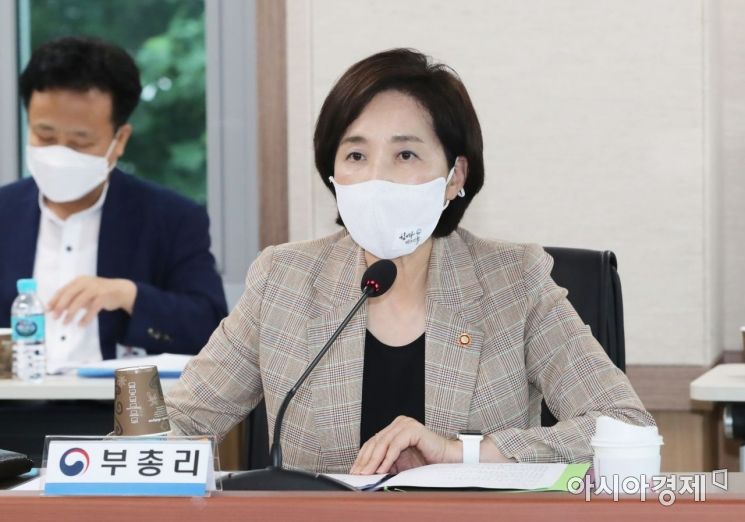 ▲Deputy Prime Minister and Minister of Education Yoo Eun-hye is giving opening remarks at a meeting with superintendents of education from the Yeongnam region held at the Busan Metropolitan Office of Education on the 15th of last month. (Provided by the Ministry of Education)
[Asia Economy Reporter Lee Hyun-joo] To reduce the learning gap caused by the full implementation of remote classes due to the novel coronavirus infection (COVID-19), the Ministry of Education plans to develop and distribute a learning management program utilizing artificial intelligence (AI). While strengthening the quarantine safety net that also covers psychological treatment, an EduTech mentor group of about 2,000 people, mainly composed of elementary school members, will guide students from vulnerable groups.
On the 11th at 3 p.m., the Ministry of Education jointly announced these measures at the Sejong Special Self-Governing City Office of Education with the National Council of Superintendents of Education. The core is to establish three major education safety nets centered on students: quarantine, learning, and care.
◆Addressing psychological quarantine amid the COVID crisis= A mobile application (app) will be developed to allow students and staff to self-diagnose their health status, equipped with a push notification function. Free influenza vaccinations will be provided to all 5.34 million students nationwide starting in September. To strengthen school quarantine capabilities, experts in infectious diseases and quarantine will be assigned to education support offices and designated as professional positions. Quarantine inspections and management will be thoroughly strengthened for private academies, and in the mid-to-long term, revisions to the Private Academy Act will be pursued to impose sanctions if quarantine rules are violated at academies.
Customized counseling and psychological support will be available through the school-based Wee Class for general students, including those in self-quarantine, confirmed cases, and high-risk students. The Ministry of Education will especially support psychological treatment as much as possible for self-quarantined and confirmed students who may face psychological shock or stigma until their return to school. Non-face-to-face counseling and 24-hour mobile counseling will be available, centered on a psychological support team composed of specialists.
◆'Prevent learning loss'... AI utilization and mentoring= To address learning gaps, a learning management program will be developed that uses AI to diagnose math learning levels for first and second graders in elementary school, analyze individual learning data, and recommend learning content in areas where learning loss is predicted. This will be available through game-based apps or e-learning platforms.
A new 'EduTech Mentoring Project' will be established, operating with about 20 vulnerable students per mentor. Additionally, about 500 excellent teachers will provide one-on-one online and offline consulting for 3,000 high school students who need self-directed learning skills.
Students lacking basic academic skills or those requiring specially tailored education, such as vulnerable groups, will receive intensive guidance during summer vacation through both in-person and remote classes, and from the second semester, one-on-one or small group customized face-to-face guidance will be provided.
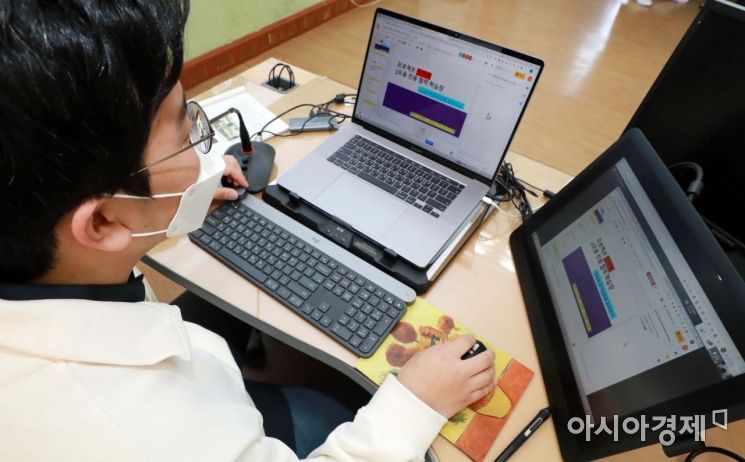
To improve the quality of school classes conducted both in-person and remotely, the Ministry of Education plans to reorganize class content according to student levels and offer various teaching models such as blended learning. Support will be provided to expand real-time interactive classes, especially in high school credit system pilot districts, and to operate various non-face-to-face activities such as arts, physical education, and creative experiential activities.
To allow teachers to focus on lesson preparation, school support organizations for in-person and remote classes will be established according to the conditions of each city and province, and the placement of tech managers (tentative name) will be promoted where necessary.
To share excellent teaching content, the Ministry of Education will improve 'SchoolOn' to allow teachers to share videos and presentations (PPT) they have created, and early next year, a new 'Integrated Educational Content Platform' will be launched to provide and recommend public and private Open Education Resource (OER) content. Customized classes for students with disabilities and Korean remote class video materials for multicultural students will be provided in multiple languages.
Promoting Local Government and School Cooperation Model
Providing 750 Units Annually for Two Years Starting Next Year
"Please Trust the Education Authorities"
◆Establishing a care service network linked with schools and local governments= Care services will be conducted by providing classrooms available for use in elementary schools, with local governments operating the care services. Starting next year, a total of 1,500 rooms will be provided over two years, 750 rooms annually, serving about 30,000 elementary school students.
By the end of the year, integrated information on elementary care classrooms will be provided through linkage with the government comprehensive civil service portal Government24, and an online application system will be established.
Deputy Prime Minister and Minister of Education Yoo Eun-hye said, "Going forward, the Ministry of Education and metropolitan and provincial offices of education will cooperate organically to establish and support an education safety net system in schools so that the school field does not become exhausted amid the prolonged COVID-19 situation."
Choi Gyo-jin, chairman of the National Council of Superintendents of Education (Superintendent of Sejong Special Self-Governing City Office of Education), emphasized, "To enable teachers, students, and parents to stand tall as the main agents of education, the 17 metropolitan and provincial offices of education and the Ministry of Education will join forces and actively support individual schools, so we ask parents to trust the education authorities."
© The Asia Business Daily(www.asiae.co.kr). All rights reserved.


















