Tonight's Pause, Heatwave Returns Tomorrow
Expansion Resumes from the Afternoon of the Day After Tomorrow
7,512 Disaster Victims in 11 Cities and Provinces
Landslide Warning in Northeastern Region
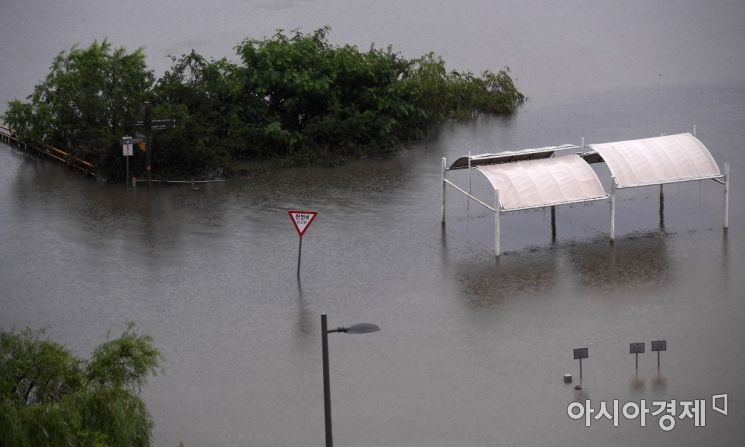 The rainy season in the central region has continued for 49 days, setting a record for the longest duration. On the 11th, the Hangang Park near Dongjak Bridge in Seoul was submerged in water. According to the Korea Meteorological Administration, the rainy season in the central region began on June 24 and has continued for 49 days as of this day. As a result, this year is recorded as having the longest rainy season along with 2013, which also lasted 49 days. Photo by Kim Hyun-min kimhyun81@
[Asia Economy Reporters Jo In-kyung and Lee Hyun-joo] On the 11th, heavy rain poured down in Seoul, the metropolitan area, and the central region. As a result, the monsoon season in the central region has continued for 49 days, matching the record for the longest monsoon period (2013). The rain is expected to continue until the 16th, so this year's monsoon is projected to exceed 50 days.
From early dawn, due to the influence of the stationary front (monsoon front), heavy rain fell in Seoul, northern Gyeonggi Province, and northwestern Gangwon Province. The rain cloud band is gradually moving southward, and the Korea Meteorological Administration forecasted that very heavy rain accompanied by gusts and thunder/lightning will fall in southern Gyeonggi, southern Gangwon, Chungcheong, and Jeonbuk.
Expected rainfall amounts are 50-100 mm in southern Gyeonggi, southern Gangwon, Chungcheong, and Jeonbuk, with some places receiving over 150 mm. Seoul, northern Gyeonggi, and northern Gangwon are expected to record 30-80 mm, while northern Gyeongbuk, Jeonnam, and the five West Sea islands will see 20-60 mm. Except for northern Gyeongbuk, Gyeongsang Province and Jeju mountain areas are forecasted to receive 5-40 mm.
Heavy rain will continue until the morning, but the intensity will weaken somewhat from the afternoon and mostly stop by night. Tomorrow (the 12th), as the stationary front temporarily moves northward to North Korea, the rain will enter a lull. Instead, a heatwave approaching 33 degrees Celsius is expected. The highest daytime temperatures tomorrow are forecasted to be 35 degrees in Daegu, 34 degrees in Gyeongsan, and 30 degrees in Seoul. Due to atmospheric instability, there is a possibility of showers from daytime to nighttime in the central inland, southern regions, and Jeju.
On the 13th, northern cool air moves southward, reactivating the stationary front
Monsoon rain continues in the central region until the 16th, expected to be the longest period
From the afternoon of the day after tomorrow, cool air from the north will move southward, reactivating the stationary front. Rain will begin in northern Gyeonggi and northwestern Gangwon from daytime and expand to other central regions. The Korea Meteorological Administration expects monsoon rain to continue in the metropolitan area and Gangwon from the 14th to the 16th. Chungcheong will be cloudy, and the southern region will have mostly cloudy skies.
If the rain continues as forecasted until mid-August, the monsoon period is expected to exceed 50 days. The monsoon started on June 24 in the central region and has continued for 49 days. Together with 2013's 49 days, this is the longest monsoon period. On the 12th, one day later, it will set a new record for the longest monsoon period at 50 days.
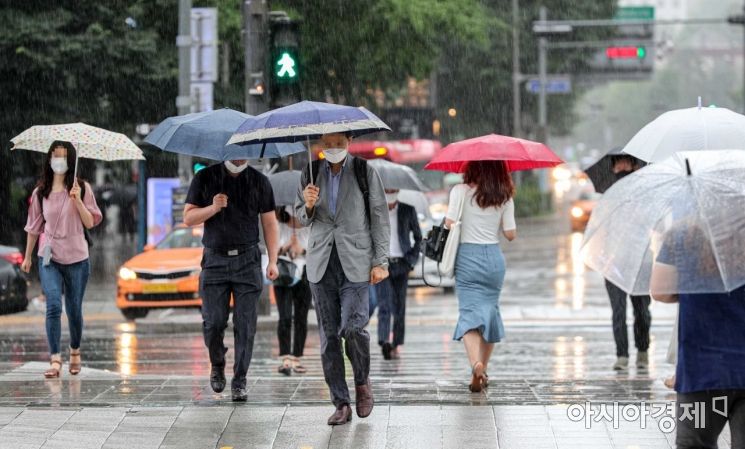 On the 11th, during the ongoing rainy season, office workers are seen heading to work with umbrellas at the Sejongno intersection in Jongno-gu, Seoul. Photo by Jinhyung Kang aymsdream@
Meanwhile, as the monsoon rain continues, rain damage is occurring in various places. On the morning of the same day, the roof of a one-story house in Singil-dong, Seoul, collapsed, trapping a man in his 60s who was later rescued. Also, in the early dawn of the same day, a man in his 60s was swept away by a rapid current while walking along Seongbukcheon Stream and was rescued by the dispatched fire rescue team. Since the 1st of this month, nationwide casualties include 31 deaths, 11 missing, and 8 injured. There have been 4,349 households and 7,512 people displaced across 11 cities and provinces, and about 20,800 cases of damage to roads, bridges, houses, vinyl greenhouses, and farmland have been reported.
Due to the weakened ground from heavy rain, landslide warnings have been issued in northeastern areas such as Jungnang, Gangbuk, Nowon, and Dobong districts in Seoul. Each local government sent disaster alert messages to residents, urging caution against landslide damage and guiding evacuation to safe areas in case of emergencies.
Additionally, with major roads being controlled in many places, the morning commute was severely congested. The entire entrance ramp of the Eastern Seoul Beltway and the Yeoui upstream and downstream interchanges on Olympic-daero were closed. Yangjaecheon Bridge, Yeongdong 1 Bridge, Sacheon Bridge, and the underpasses of Jeungsan Bridge were fully closed, and the underpass of Gae-hwa Yookgapmun, the southern underpass of Banghwa Bridge, the section from beside Seongsan Bridge's southern end to Yangpyeong Interchange, the underpass of Dongjak Bridge near Shindonga Shopping Center, and Dangsan-ro 52-gil were all completely prohibited for vehicle passage. The Jamsu Bridge has been restricted for ten days. Due to this, vehicles repeatedly stopped and started on some sections of Olympic-daero and Gangbyeonbuk-ro during rush hour, and traffic congestion continued on the Western Seoul Beltway. Due to heavy rain overnight, soil slid near Namcheongra IC on the Seoul Metropolitan Area 2nd Ring Expressway, temporarily closing three lanes and causing severe traffic jams.
© The Asia Business Daily(www.asiae.co.kr). All rights reserved.
![Clutching a Stolen Dior Bag, Saying "I Hate Being Poor but Real"... The Grotesque Con of a "Human Knockoff" [Slate]](https://cwcontent.asiae.co.kr/asiaresize/183/2026021902243444107_1771435474.jpg)












