Unprecedented Monsoon Causes Sharp Decline in Lettuce and Aehobak Greenhouse Vegetable Supply
Concerns Over Grocery Prices Ahead of Chuseok
Large Marts Strive to Secure Alternative Agricultural Production Areas
Government Takes Action to Stabilize Agricultural Supply and Prices
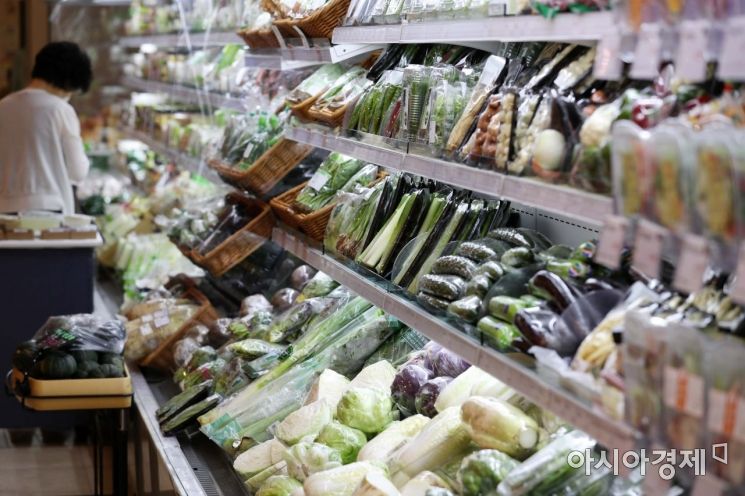 On the 9th, as prolonged monsoon rains and flooding hit, vegetable prices fluctuated while citizens shopped at a large supermarket in Seoul. Photo by Mun Ho-nam munonam@
[Asia Economy Reporters Kim Hyun-jung and Lim Hye-seon] An unprecedented prolonged rainy season has triggered an emergency in the supply and pricing of agricultural products. The supply of facility-grown vegetables such as lettuce and zucchini has sharply decreased, causing prices to soar, while fruits, whose demand increases ahead of Chuseok, have suffered damage from floods that have compromised their marketability. As a result, major retailers have begun expanding their supply sources. The government has decided that the impact of this flood damage could last from as short as Chuseok to as long as the kimchi-making season in November, and has started preparing countermeasures.
Full Effort to Secure Alternative Production Areas for Agricultural Products
On the 11th, major retailers are facing difficulties in securing agricultural product supplies due to heavy rains. Flood damage to farmland is increasing, and shipments of various vegetables are sharply declining. The three major retailers are making every effort to secure alternative production areas to ensure normal product supply. According to Gyeonggi Province, as of 7 a.m. on the 11th, 8,602 vinyl greenhouses and 3,579 hectares of crops were flooded. Livestock deaths are estimated at around 250,000 animals. Lotte Mart, unable to procure assorted ssam (wrap) products due to damage to farms in Yongin, Gyeonggi Province, sought alternatives by sourcing lettuce varieties and assorted ssam from less affected areas such as Maninsan in Chungnam and Gwangju in Gyeonggi Province.
In the case of cucumbers, the main production area in Hongcheon, Gangwon Province, has seen a significant decrease in sunlight due to the rainy season, leading to a sharp drop in shipments and a decline in quality. Flooded fields and submerged stems have made normal shipments difficult even after the rainy season. Emart previously purchased vegetables from areas like Icheon and Yeoju in Gyeonggi Province for logistical efficiency. However, with rain continuing for over a week, they expanded production areas to eight provinces nationwide, including Nonsan and Geumsan in Chungnam, Chungju in Chungbuk, Miryang in Gyeongnam, and Wanju in Jeonbuk, focusing on regions with less rainfall. For fruits, excessive moisture absorption often leads to rot and increased fruit drop, significantly reducing the supply of high-quality products. Major watermelon production areas shipping around this time each year include Nonsan and Buyeo in Chungnam, Jinan in Jeonbuk, and Yeongyang and Bonghwa in Gyeongbuk. This year, Iksan in Jeonbuk was urgently selected as an alternative production area to increase supply.
Concerns Over Agricultural Product Crisis Ahead of Chuseok
The problem is Chuseok. If the rainy season continues until mid-month, a supply crisis for agricultural products could persist ahead of the Chuseok holiday. Facility-grown vegetables such as young napa cabbage, lettuce, and zucchini, which are highly sensitive to weather conditions, have already seen prices surge due to heavy rains and lack of sunlight. The wholesale price of young napa cabbage (4 kg) rose from 6,098 won in June to 6,645 won in July, and further to 15,117 won between August 1-6, more than doubling. Lettuce (4 kg, wholesale) also jumped from 18,954 won in June to 28,723 won in July, and 46,126 won between August 1-6.
For fruits, the marketability of seasonal fresh fruits such as peaches and grapes has significantly declined. Due to the rainy season lowering sugar content, the price of peaches (yellow-flesh, 4.5 kg, wholesale) dropped slightly from 18,019 won in July to 17,725 won between August 1-6, and grapes (Campbell, 5 kg, wholesale) fell from 23,010 won to 15,047 won. Recently shipped 2020 apples and pears scheduled for shipment in late August have seen reduced supply due to cold damage this year, with quality expected to deteriorate ahead of Chuseok.
Major retailers have reduced the volume of discounted products by 30-40% compared to usual to defend against price increases caused by rising wholesale prices, but a sharp rise in vegetable prices appears inevitable. A representative from a major retailer said, "Price increases for vegetables at marts will begin from Thursday, the 13th."
Government Takes Steps to Stabilize Agricultural Product Supply and Prices
The government plans to implement supply stabilization measures focusing on key agricultural products. On the 10th, the Ministry of Agriculture, Food and Rural Affairs formed an 'Emergency Task Force (TF) for Agricultural Product Supply Stabilization' to respond swiftly to damage caused by heavy rains and the rainy season and to manage supply conditions steadily. The TF will monitor daily the damage status of major vegetables sensitive to summer temperatures and rainfall, as well as supply trends in production areas, to review countermeasures.
Additionally, the government will flexibly release stockpiled supplies and those stored in the Agricultural Cooperative's shipment control facilities to respond to price increases caused by recent supply instability. As part of price management, early shipments will be made using contracted volumes under the vegetable price stabilization program. Kwon Jae-han, Director of Distribution and Consumer Policy at the Ministry of Agriculture, Food and Rural Affairs and head of the TF, emphasized, "Summer brings many weather fluctuations such as typhoons and heatwaves in addition to the rainy season. We will assess damage and supply conditions to minimize secondary damage and do our best to manage supply so that the burden does not fall on farmers and consumers struggling due to COVID-19."
© The Asia Business Daily(www.asiae.co.kr). All rights reserved.

















