"Issues Occurring Within the Framework of North Korea Sanctions"
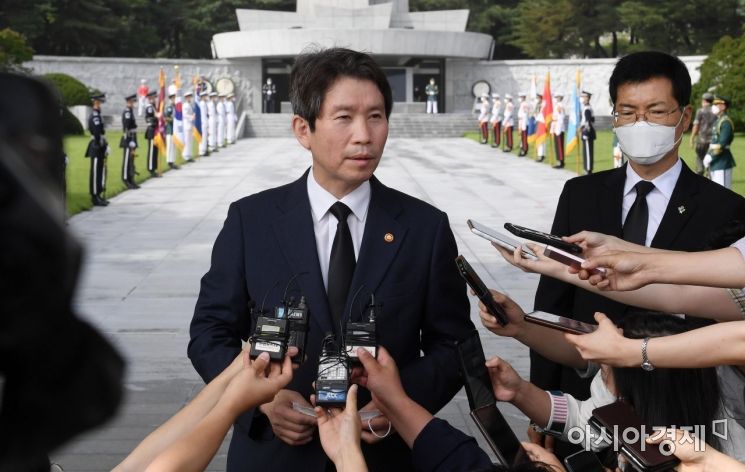 Minister of Unification Lee In-young is seen interviewing with reporters after paying respects at the National Seoul Memorial Cemetery in Dongjak-gu, Seoul on the 30th of last month. Photo by Kim Hyun-min kimhyun81@
The Ministry of Unification stated on the 11th that the government’s plan for barter trade between South and North Korea is not a matter for consultation between South Korea and the U.S. through the South Korea-U.S. Working Group.
A Ministry of Unification official said to reporters on the same day, in response to a question asking whether the barter trade plan between South and North Korea is subject to consultation between South Korea and the U.S., “In principle, matters conducted within the framework of sanctions against North Korea are not considered issues for consultation by the South Korea-U.S. Working Group.”
He added, “If necessary, communication with the U.S. side is possible,” but “at this stage, it is not a phase to speak about specifics.”
The government has stated that it will promote inter-Korean exchange and cooperation possible within the framework of international sanctions against North Korea, and especially regarding humanitarian cooperation, it has expressed the position that independent initiatives are also possible.
Minister of Unification Lee In-young has advocated the idea of “small-scale trade” through barter with North Korea even before taking office. The idea is to start from small-scale trade between the two Koreas, such as exchanging North Korea’s water from Mount Kumgang and Mount Baekdu and Daedonggang Makgeolli for South Korea’s rice and medicines, and then expand to larger-scale exchanges.
On the 5th, the South Korean NamBukGyeongChong Unification Agricultural Cooperative announced that it had signed a contract at the end of June with North Korea’s Kaesong Goryeo Ginseng Trading Company and others to exchange North Korea’s Kaesong Goryeo Ginseng Liquor and Deuljjuk Liquor for South Korea’s sugar, and the Ministry of Unification is currently reviewing import and export approval for this case.
The Ministry of Unification believes that adopting the barter trade method will not cause sanction issues because it does not involve transactions between banks or large cash transfers with North Korea. It is also known that Minister Lee discussed barter trade methods possible within the framework of sanctions against North Korea during a meeting on the 5th with Lee Do-hoon, the Ministry of Foreign Affairs’ Special Representative for Korean Peninsula Peace and Security Affairs, who is in charge of U.S.-North Korea nuclear negotiations.
Minister Lee acknowledges the effectiveness of the South Korea-U.S. Working Group but holds the view that not all matters need to be bound by the Working Group.
On the 3rd, Minister Lee met with executives of civic groups in the social and cultural fields and promised to strive to resume dialogue and cooperation with North Korea, stating, “We will distinguish between parts that require consultation with the South Korea-U.S. Working Group and those that do not, and proceed accordingly.”
At last month’s confirmation hearing, he also said, “Humanitarian cooperation, which is outside the scope of sanctions, can be independently judged and promoted,” and “Furthermore, parts corresponding to humanitarian cooperation can be expanded into trade.”
© The Asia Business Daily(www.asiae.co.kr). All rights reserved.

















