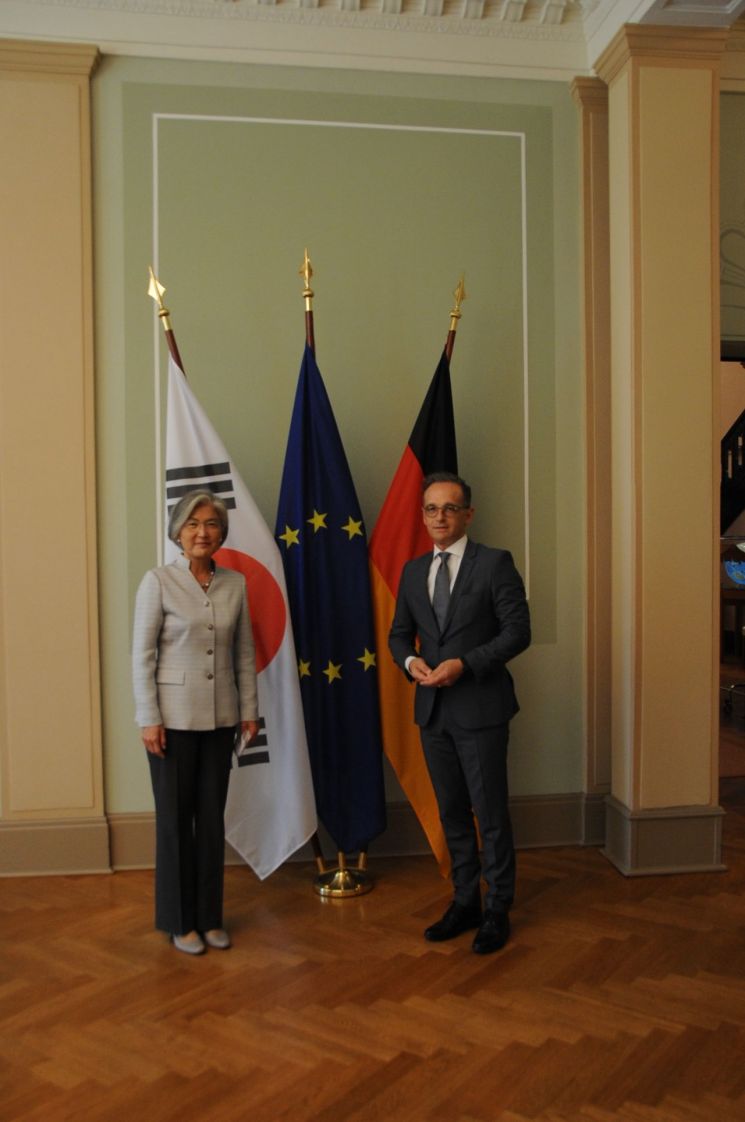
[Asia Economy Reporter Lim Cheol-young] On the 10th (local time), Foreign Minister Kang Kyung-wha held the 2nd Korea-Germany Foreign Ministers' Strategic Dialogue with German Foreign Minister Heiko Maas at the German Foreign Ministry's guesthouse in Berlin. They discussed △bilateral relations △cooperation in response to COVID-19 and post-COVID-19 economic recovery △major global issues △the situation on the Korean Peninsula and regional affairs.
The two ministers highly evaluated that the two countries, as key allies, are closely cooperating even amid the unprecedented situation of COVID-19, and that both countries are internationally recognized as exemplary nations in responding to COVID-19 while making every effort to provide economic support and stimulate the economy. They also agreed to work together for the swift stabilization of the COVID-19 situation and the global economic recovery after COVID-19.
Minister Kang expressed, regarding COVID-19, “I am pleased that Korea and Germany are closely cooperating for COVID-19 response, including the Korea-Germany government joint video conference (April 3),” and added, “I hope to overcome the COVID-19 crisis quickly together with Germany, which is recognized as a model country in Europe for COVID-19 response.” She also highly praised Germany’s leading role in the successful cooperation among EU member states, such as the recent agreement on the Recovery Fund. In response, Minister Maas said that to achieve economic recovery after COVID-19, they should work together to maintain a free and fair multilateral trading system based on rules and build a sustainable economic structure.
Furthermore, Minister Kang evaluated the EU’s announcement of the European Green Deal and requested to explore cooperation measures with Korea’s Green New Deal initiative.
Both sides agreed to cooperate beyond borders for the development and distribution of COVID-19 vaccines and treatments as public goods for humanity. Minister Kang requested Germany’s accession to the International Vaccine Institute (IVI), headquartered in Korea and actively participating in vaccine development. They also shared the view that essential human exchanges between the two countries, such as businesspeople, international students, and humanitarian visits, should not be hindered amid the COVID-19 crisis, and agreed to continue consultations to this end.
Minister Maas emphasized the need to strengthen multilateralism to respond to global issues such as COVID-19 and evaluated Korea and Germany as important partners in strengthening multilateralism, sharing fundamental values such as democracy, human rights, and market economy.
?
In response, Minister Kang appreciated Germany’s leadership in promoting multilateral solidarity and expressed pleasure that Korea is also participating in multilateral solidarity. She suggested that the two countries closely communicate not only on COVID-19 response but also on various global issues such as △climate change △disarmament and non-proliferation.
At the joint press conference, Minister Maas welcomed Korea’s participation if the G7 summit is held this fall, especially noting that Germany regards Korea as an important country in the international community and a close partner sharing values, which makes Germany particularly pleased. Minister Kang welcomed the invitation from the U.S. side and said Korea would actively participate.
Meanwhile, Minister Kang requested Germany’s special interest and support for Yoo Myung-hee, the head of Korea’s Trade Negotiations Headquarters, who is running for the Director-General of the World Trade Organization. The two ministers also exchanged views on the situation on the Korean Peninsula and major regional affairs.
Minister Kang expressed hope that Germany, as the EU Council Presidency in the second half of this year, will wisely overcome internal and external challenges of the EU, and expressed gratitude for Germany’s consistent support for the Korean government’s efforts for peace on the Korean Peninsula. Minister Maas evaluated the Korean government’s efforts to improve inter-Korean relations and the denuclearization of North Korea through dialogue.
Meanwhile, Minister Kang’s visit to Germany was her first overseas trip in about six months since the COVID-19 outbreak, serving as part of efforts to normalize diplomacy through the resumption of face-to-face diplomacy. It became an opportunity to deepen strategic cooperation with Germany, a key partner in Europe, the EU Council Presidency, and a G7 member leading Europe’s post-COVID economic recovery.
The two ministers agreed that this meeting served as an opportunity to strengthen cooperation between Korea and Germany based on broad exchanges of views on bilateral interests as well as international affairs and global issues, and agreed to hold the next strategic dialogue in Seoul.
© The Asia Business Daily(www.asiae.co.kr). All rights reserved.

















