Hankyung Research Institute Report on "Analysis and Implications of Temporary Leave Trends"
"Sharp Increase in COVID-19 Temporary Leave Workers... More Severe than IMF and Financial Crisis"
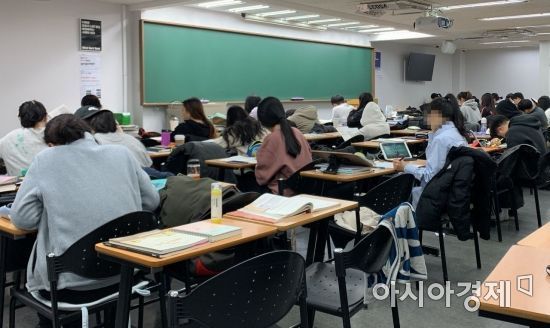 On the morning of January 2nd, at a civil service exam academy located in Noryangjin, Dongjak-gu, Seoul, examinees are deeply focused on their studies. Photo by Seulgi Kim, intern reporter sabiduriakim@asiae.co.kr
[Asia Economy Reporter Han Seung-gon] "It's hard to find a job, the economy is tough, everything is just difficult."
Kim, a job seeker in his 20s, said, "Even though more than half a year has passed since the outbreak of COVID-19, there seems to be no sign of resolution," adding, "Companies are struggling on their own, and job seekers are having a hard time as job openings decrease." He continued, "Looking around or watching the news, there seem to be many so-called 'COVID-19 unemployed,' people who lost their jobs after the pandemic," he lamented.
The economic situation, including the employment market, is becoming increasingly uncertain due to the impact of the novel coronavirus (COVID-19) pandemic. Some opinions suggest it is far more severe than during the foreign exchange crisis or the global financial crisis.
According to the Korea Economic Research Institute's (KERI) "2020 Analysis of Temporary Leave Trends and Implications" on the 9th, the number of temporarily laid-off workers in March, April, and May this year was 1.6 million, 1.48 million, and 1.02 million, respectively. Temporary leave refers to cases where workers or business owners have a workplace or business but did not work at all during the survey period due to temporary illness, bad weather, vacation or leave, labor disputes, or other reasons.
According to Statistics Korea, the total number of temporarily laid-off workers from March to June this year, when COVID-19 began to affect industries broadly, was 4,841,000. Monthly figures were 1,607,000 in March, 1,485,000 in April, 1,020,000 in May, and 729,000 in June. More than half (58.2%) of temporarily laid-off workers answered that they temporarily stopped working due to business downturns and production stoppages.
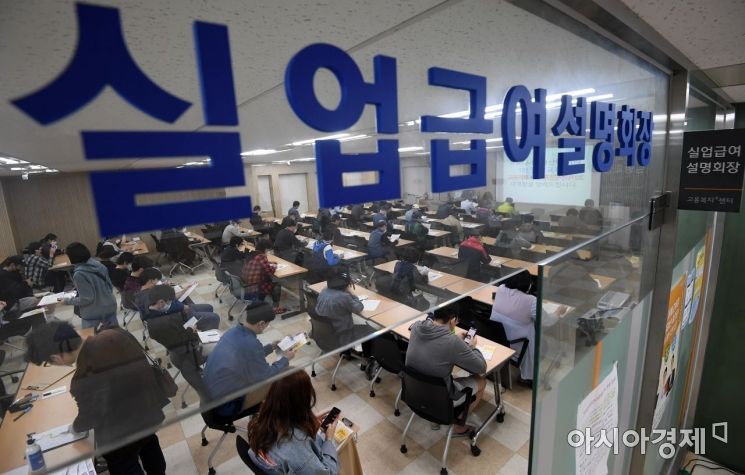 On May 12th, an unemployment benefits briefing session was held for unemployed individuals at the Seoul Employment Welfare Plus Center in Jung-gu, Seoul. [Image source=Yonhap News]
The proportion of temporarily laid-off workers was highest in industries with frequent face-to-face contact: 19.3% in "Health and Social Welfare Services" and 17.6% in "Educational Services." This was followed by "Manufacturing" (8.13%), "Accommodation and Food Services" (8%), and "Wholesale and Retail Trade" (7.1%). By gender, the proportion of women was 62.5%, higher than men at 37.5%, indicating that women were more severely affected.
Meanwhile, companies are showing signs of employment adjustments. A representative from a Seoul-based company explained, "Due to the impact of COVID-19, we are inevitably forced to make employment adjustments," adding, "We are currently monitoring the economic situation." He emphasized, "Not only employment adjustments but also all possible measures to sustain the company, including new hiring and cutting unnecessary expenses, are being prepared."
According to a survey by the Korea Chamber of Commerce and Industry of 301 domestic companies, 4 out of 10 companies said that employment adjustments were necessary due to reduced workloads caused by the COVID-19 situation. More than half either "gave up on new hiring (19.3%)" or "postponed hiring schedules (31.2%)."
New hiring is also expected to shrink. When asked about "hiring schedules" this year, more than half of the responding companies said they either "gave up on new hiring" (19.3%) or "postponed hiring schedules" (31.2%). Meanwhile, 31.9% said they "completed as planned," and 17.6% said they "plan to proceed as scheduled."
Regarding the "scale of new hiring," 40.7% responded that they had "reduced or were considering reducing" the scale compared to the original plan. Other responses included "completed as planned" (41.2%), "plan to proceed as scheduled" (16.9%), "reduced hiring" (11.9%), "considering reduction" (28.8%), and others (1.2%).
As a result, job seekers' sighs are increasing. Park, a job seeker in his late 20s, said, "From the perspective of job seekers, COVID-19 is scary, but the reality that employment is not going well is also frightening. As this period drags on, I sometimes wonder, 'Is there really a job market?'" He added, "I am continuing to prepare for employment, but since companies drastically reduce hiring scales, it is psychologically very difficult."
Indeed, as Park lamented, with the COVID-19 situation continuing for over half a year, cases of "COVID depression," where people complain of depressive symptoms, are also increasing. According to the Ministry of Health and Welfare on the 9th, the total number of COVID-related depression counseling cases conducted at the National Trauma Center and others from February to June 3 this year reached 374,221.
The government has stated its intention to continuously work to alleviate the public's depression and anxiety caused by COVID-19. Additionally, psychological counseling will continue to be provided through disaster psychological recovery support centers in 17 cities and provinces nationwide for economically vulnerable groups such as small business owners.
Park Neung-hoo, the first deputy head of the Central Disaster and Safety Countermeasure Headquarters and Minister of Health and Welfare, said at a COVID-19 regular briefing held at the Government Seoul Office on the afternoon of the 9th, "As people cannot go out, various psychological depressions and frustrations may increase," urging, "The government is preparing measures, but we ask the public to take good care of themselves to overcome this crisis more healthily."
Meanwhile, the report suggested strengthening employment and working hour flexibility to respond to the employment market after COVID-19. Eugene Sung, a researcher at KERI, emphasized, "To provide reemployment opportunities for workers who lost their jobs after COVID-19, creating new jobs is important," adding, "It is necessary to expand companies' capacity to create jobs through employment flexibility."
© The Asia Business Daily(www.asiae.co.kr). All rights reserved.
![Clutching a Stolen Dior Bag, Saying "I Hate Being Poor but Real"... The Grotesque Con of a "Human Knockoff" [Slate]](https://cwcontent.asiae.co.kr/asiaresize/183/2026021902243444107_1771435474.jpg)


















