Necessity of 4th Supplementary Budget Agreed by Both Parties
Ministry of Economy and Finance: "Covered by Reallocation of Existing Budget and Contingency Funds"
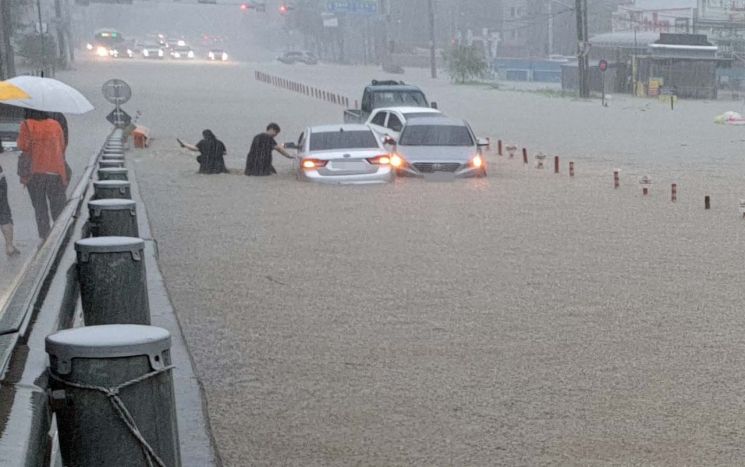
[Asia Economy Reporter Park Cheol-eung, Sejong=Reporter Kim Hyun-jung] As the scale of flood damage increased nationwide last weekend, the Democratic Party of Korea announced that it would reverse its previous stance on the formulation of the 4th supplementary budget (supplementary budget) and proceed through consultation with the government. If the 4th supplementary budget is formulated as claimed by the political circles, it will be the first time in 59 years. The government found itself in a difficult situation due to the sudden emergence of the 4th supplementary budget proposal ahead of the 2021 budget formulation. While the emphasis is on covering related costs through the remaining contingency funds of over 2 trillion won and the reallocation of the existing budget rather than formulating a supplementary budget, it is not easy to rule out the possibility that the related budget may be exhausted if damage spreads due to typhoons and other factors.
◆Both ruling and opposition parties say "4th supplementary budget is necessary"= The first to raise the necessity of the 4th supplementary budget within the Democratic Party was Representative Kim Du-kwan. He argued that since the effectiveness of the first disaster relief fund was proven, it should be paid once more to offset the economic downturn this year to some extent. However, this was merely a minority opinion within the party, and most, including the leadership, did not mention the 4th supplementary budget. This is because the financial burden has increased up to the 3rd supplementary budget, and social controversy is inevitably very high. Kim Tae-nyeon, the floor leader of the Democratic Party, mentioned in an interview with Asia Economy at the end of last month that "Currently, we are not considering the 4th supplementary budget."
This stance did not change significantly even after the flood damage occurred. On the 7th, Yoon Kwan-seok, senior deputy chairman of the Democratic Party's Policy Committee, said in a phone interview with Asia Economy, "Now is the time to deal with next year's main budget, so we are not considering the 4th supplementary budget," adding, "We should respond to the flood damage through disaster contingency funds." Representative Lee Nak-yeon also said on Facebook on the 9th, "It is still difficult to grasp the exact scale of damage nationwide, but it seems that we can cope with it with 2 trillion won in contingency funds and the existing budget." However, Representative Shin Dong-geun, who challenged for the Democratic Party's Supreme Council membership, reignited the issue. On the 9th, he stated on Facebook, "The damage in several places is beyond the level that can be resolved by declaring a special disaster area," and "It is difficult to cope with just the contingency funds available now. We inevitably have to formulate the 4th supplementary budget."
The opposition parties have already raised the necessity. On the 6th, Ahn Cheol-soo, leader of the People’s Party, proposed a 'disaster supplementary budget' at the party's Supreme Council meeting, and Kim Jong-in, emergency committee chairman of the United Future Party, said, "The flood damage is so severe that many disaster areas have occurred, and if there is no budget allocation for that, we have no choice but to make a supplementary budget." The Democratic Party is reminding that supplementary budgets have been made in the past when the scale of disasters was large. Park Kwang-on, a Supreme Council member of the Democratic Party, said, "There was a 4 trillion won supplementary budget during the 2002 typhoon, and supplementary budgets were also injected in 2006," adding, "The National Assembly needs to proactively review the supplementary budget and propose it to the government."
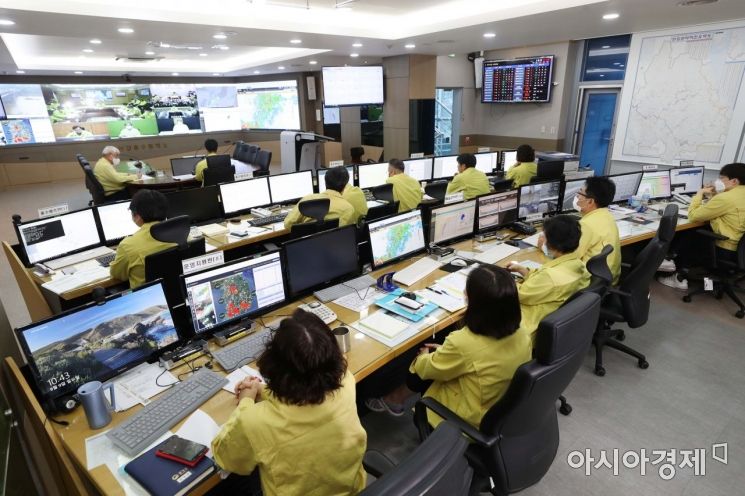 On the 9th, with the monsoon rain and Typhoon Jangmi No. 5 approaching, employees are working emergency shifts on a holiday at the Hangang Flood Control Office in Seocho-gu, Seoul. Photo by Mun Ho-nam munonam@
◆Ministry of Economy and Finance: "Cover with contingency funds and existing budget"= The Ministry of Economy and Finance, the main department in charge of the budget, stated that it plans to respond to flood recovery using existing contingency funds of over 2 trillion won. Contingency funds, which are allocated annually without specifying their use to be used for urgent matters, amount to about 5.6 trillion won this year. This includes general contingency funds of 1.4 trillion won and purpose-specific contingency funds of 4.2 trillion won. Due to the impact of the novel coronavirus infection (COVID-19), the purpose-specific contingency funds were increased by about 2.2 trillion won.
The remaining contingency funds currently exceed 2 trillion won, and the Ministry of Economy and Finance expects that the remaining contingency funds and the reallocation of the existing budget can cover the costs of supporting flood recovery work. A ministry official explained, "The Ministry of the Interior and Safety is currently assessing and aggregating the scale of flood damage and the expected recovery amount," adding, "As of now, it is a level that can be handled through the reallocation of the existing budget and contingency funds."
If the 4th supplementary budget, which has been raised in some political circles, is actually formulated, it will be the first time in 59 years since 1961. Especially if the monsoon period is longer than expected and the damage spreads, the central government and local governments, whose response budgets have been depleted due to the COVID-19 situation, will have no choice but to fill the gap with a supplementary budget. If the flood damage is severe and designated as a special disaster area, the government must support half of the damage recovery costs from the national treasury according to the 'Framework Act on the Management of Disasters and Safety.' If there is damage to housing and livelihoods such as agriculture and fisheries, disaster relief funds are provided, and relief funds for deaths and injuries are also paid. In addition, various public utility fee reduction benefits such as water and sewage, electricity bills, health insurance premiums, communication fees, and city gas fees will also receive national support.
During Typhoon Rusa in 2002, which caused 246 deaths and missing persons, the government formulated a 4 trillion won supplementary budget limited to damage recovery. At that time, the government designated 203 cities, counties, and districts in 16 provinces including Gangneung City, Gangwon Province, which suffered heavy damage, as special disaster areas, and the related budget was intensively used for urgent recovery of social overhead capital facilities (SOC) such as roads and railways and for damage recovery in special disaster areas.
Due to the recent heavy rain, the government declared seven local governments as special disaster areas on the 7th, including Anseong City in Gyeonggi Province, Cheorwon County in Gangwon Province, Chungju and Jecheon Cities and Eumseong County in Chungbuk Province, and Cheonan and Asan Cities in Chungnam Province. It is expected that additional designations will be requested through damage surveys for areas such as Gwangju, Jeonnam, Gokseong, and Damyang, where damage increased over the weekend.
© The Asia Business Daily(www.asiae.co.kr). All rights reserved.


















