Democratic Party Criticizes Constitutional Violation as "Mud and Illusion"
White House and Administration Say "No Problem" While Considering Possible Lawsuits
Dispute Could Delay Stimulus Bill Agreement if Controversy Expands
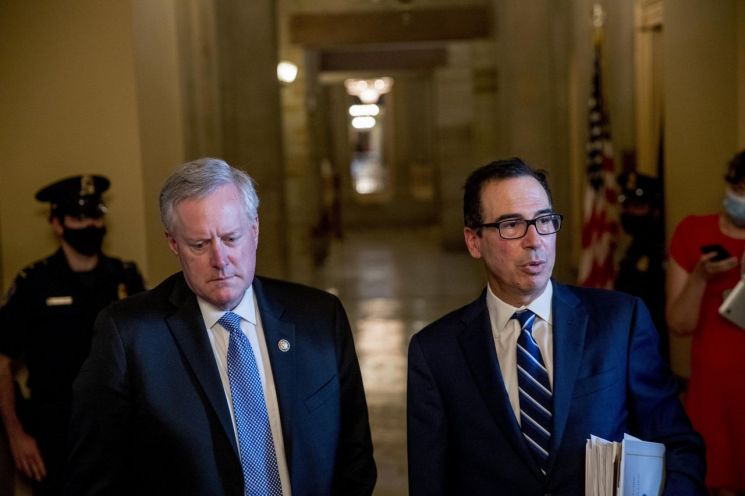 Steven Mnuchin (right), U.S. Secretary of the Treasury, is holding a press conference with Mark Meadows, White House Chief of Staff, after negotiations on the stimulus bill with the Democratic Party on the 4th.
 [Image source=AP Yonhap News]
[Asia Economy New York=Correspondent Baek Jong-min] Controversy over constitutional violations is emerging as U.S. President Donald Trump unilaterally signed executive orders for economic stimulus. Dark clouds are gathering over the possibility of a bipartisan agreement on the stimulus bill.
On the 8th (local time), President Trump announced four major policies involving large budgets, including payroll tax deferral and reduced additional unemployment benefits, in the form of executive orders and memorandums while visiting his own golf resort over the weekend. In response, the Democratic Party criticized the president for overstepping his authority and even raised the possibility of lawsuits.
Democratic House Speaker Nancy Pelosi appeared on Fox News on the 9th, condemning President Trump's actions as a "constitutional mess (slop)" and an "illusion," stating there is no legal basis for them.
Senate Minority Leader Chuck Schumer also pointed out, "It is ineffective. Because it was created in an irrational manner, most of it will not take effect."
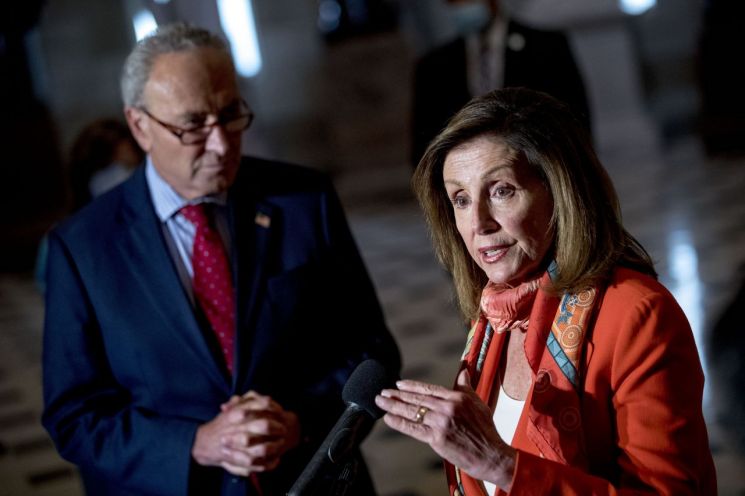 Nancy Pelosi (right), Speaker of the U.S. House of Representatives, is holding a press conference on the 4th after negotiations on the stimulus bill with Treasury Secretary Steven Mnuchin. [Image source=AP Yonhap News]
White House and administration officials defended President Trump's executive orders.
Treasury Secretary Steven Mnuchin said in a Fox News interview, "We obtained approval from the Office of Legal Counsel for all these measures," adding, "If the Democrats want to file lawsuits in court and suspend unemployment benefit payments, they will have a lot to explain."
He also warned that if the Democrats engage in legal battles over the executive orders, the stimulus bill agreement will be further delayed. Additionally, he pressured the Democrats to reduce the budget for state government support affected by COVID-19 in order to reach an agreement on the stimulus bill negotiations.
Larry Kudlow, Director of the National Economic Council at the White House, acknowledged on ABC that the final conclusion could be made in court but expressed determination to proceed, saying, "We believe we can do this. We will proceed with our actions regardless."
Peter Navarro, Director of Trade Policy and one of the most hardline figures in the White House, showed a more blunt stance and expressed resentment toward the Democrats. He even claimed that "executive orders were created by God and the Founding Fathers."
The executive orders signed by President Trump include ▲ deferral of payroll tax payments until the end of the year ▲ additional unemployment benefits reduced from $600 to $400 per week ▲ suspension of student loan repayments and eviction moratoriums for tenants.
The White House and U.S. government had warned that if the Democrats did not reach an agreement by the 7th, President Trump would take unilateral action.
The hottest issue among President Trump's measures is the payroll tax deferral. Payroll tax is a concept similar to our national pension. This tax, collected from employers and workers, is used for social welfare budgets, and while deferring it may stimulate consumption, it inevitably creates a hole in the social welfare budget. This is why opposition to payroll tax exemption arises even within the ruling Republican Party.
Regarding this, Secretary Mnuchin emphasized that the payroll tax reduction would not lead to a reduction or suspension of social welfare pensions.
Earlier, regarding additional COVID-19 stimulus, the Democrats prepared a $3 trillion budget plan and the Republicans a $1 trillion plan, but the gap was too large to reach an agreement. The Democrats lowered the stimulus size to $2 trillion, but the Republicans still oppose it. As the agreement is delayed, concerns are rising that the expiration of expanded unemployment benefits on the 31st of last month will negatively impact the U.S. economy.
© The Asia Business Daily(www.asiae.co.kr). All rights reserved.


















