Sweden's COVID-19 Strategy Avoiding Lockdowns
Failed to Protect High-Risk Groups, High Death Rate per Capita
Reduced Economic Decline
[Asia Economy Reporter Naju-seok] The international community has long debated Sweden's response to the novel coronavirus infection (COVID-19). While most European countries implemented full lockdown policies, Sweden adopted looser quarantine measures, allowing restaurants and bars to operate. Analyses of Sweden's choice ranged from claims that it was conducting a herd immunity experiment to criticisms that it sacrificed public protection for the economy. On the other hand, some argued that Sweden, recognizing that COVID-19 could not be ended immediately, took sustainable quarantine measures based on social trust.
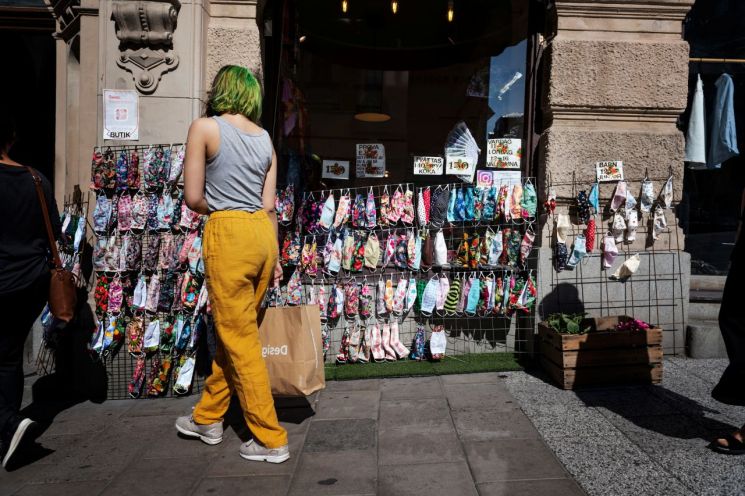
Why did Sweden take a different approach from other European countries, and was this experiment successful?
According to the Korea Institute for International Economic Policy on the 9th, since the outbreak of COVID-19 in March, Sweden has not implemented official lockdown measures. Elementary schools and childcare facilities for preschool children were allowed to remain open. Indoor sports facilities, restaurants, and pubs were all closed. This response differs from other European countries that closed all but essential stores such as pharmacies.
Because of this approach, Sweden was criticized for pursuing herd immunity. Herd immunity refers to a state where 50-75% of the population has immunity to an infectious disease, preventing further spread. In other words, it was speculated that the Swedish government deliberately allowed infections to spread, tolerating a situation where a significant portion of the population became infected with COVID-19.
However, the Swedish government has repeatedly stated that it is not pursuing herd immunity. Moreover, Sweden also promoted social distancing emphasizing individual responsibility and made efforts to curb the spread. Therefore, although Sweden minimized legally enforced measures, it emphasized personal responsibility, which some argue is a unique political and social outcome of Sweden.

To some extent, this quarantine strategy based on citizen participation worked. Public transportation usage decreased, and the rate of telecommuting increased.
However, it remains questionable whether Sweden's strategy was successful. Sweden aimed to protect high-risk groups while maintaining social life, but COVID-19 spread mainly in elderly care facilities, resulting in many deaths. As of the 8th, Sweden had 82,323 confirmed cases and 5,763 deaths. This equates to 570 deaths per one million people, which is a high level globally.
However, there was some effect on the economy. Despite the COVID-19 pandemic, Sweden performed better economically than other European countries.
Sweden's growth rate in the second quarter of this year was -8.6%. Although this is the worst economic growth rate in Sweden's history, the situation looks different when compared to other European countries. Countries that implemented full lockdowns had worse growth rates than Sweden.
The Eurozone, which uses the euro, recorded a growth rate of -12.1% in the second quarter of this year. Spain, which suffered massive damage from COVID-19, recorded a -18.5% economic growth rate in the second quarter. Portugal had -14.1%, and France -13.8%, also suffering severe damage.
Sweden is expected to show a stronger economic recovery in the third quarter than other European countries. Robert Bergqvist, chief economist at SEB, a Swedish bank, predicted, "Eurozone countries are expected to rebound strongly in the third quarter of this year, but the Swedish economy will show an even stronger recovery."
David Oxley, senior economist at Capital Economics, pointed out, "Although it has been confirmed that Sweden's loose lockdown policy did not result in immunity to COVID-19, the growth rate in the first half of this year contrasts sharply with other European countries, especially those in Southern Europe."
© The Asia Business Daily(www.asiae.co.kr). All rights reserved.
![Clutching a Stolen Dior Bag, Saying "I Hate Being Poor but Real"... The Grotesque Con of a "Human Knockoff" [Slate]](https://cwcontent.asiae.co.kr/asiaresize/183/2026021902243444107_1771435474.jpg)

















