Some Lawmakers and Local Governments Oppose Metropolitan Public Rental Housing Supply Plan
Continued Rejection of Rental Housing... 1,068 Complaints Against Construction in Last 2 Years
Experts: "Social Mixing Needed to Promote Interaction Among Various Groups"
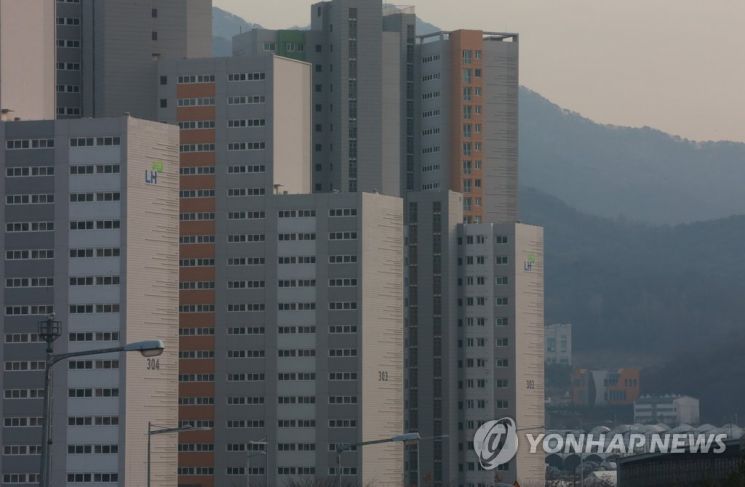 A public rental apartment in Seoul. On the 4th, the government announced a real estate policy to supply large-scale public rental housing by utilizing idle land. / Photo by Yonhap News
[Asia Economy Reporter Lim Ju-hyung] Some members of the Democratic Party of Korea and local government officials, whose constituencies include the designated sites, have openly expressed dissatisfaction with the 'August 4 Real Estate Measures,' which include plans to discover new housing sites and supply large-scale public rental housing. This has led to criticism that this is a typical 'NIMBY (Not In My Backyard)' phenomenon. Experts advise resolving conflicts through socially mixed residential plans that encompass various social classes, including the wealthy and the poor.
Earlier, on the 4th, the government announced the August 4 Real Estate Measures, which include plans to supply an additional 132,000 housing units. The core of the plan is to introduce a public reconstruction system to relax floor area ratios and build large-scale public rental housing on idle land.
However, after the measures were announced, dissatisfaction erupted among some lawmakers and local government heads whose constituencies include parts of the idle land. Democratic Party lawmaker Jeong Cheong-rae wrote on his Facebook on the same day, "Residents of Sangam-dong are protesting vehemently. The rental housing ratio in Sangam-dong already reaches 47%, so why build more rental housing?" He emphasized, "It should develop appropriately as a Digital Media City."
Also, Yoo Dong-gyun, mayor of Mapo-gu and a member of the Democratic Party, stated on the 5th, "While I agree with the government's policy direction to increase new housing supply, using the idle land in Sangam-dong is an unreasonable real estate policy that treats Mapo merely as a means of housing supply," and protested, "Developing land that should be used for future job creation and regional development into housing is absolutely unacceptable."
On the 6th, Kim Jong-cheon, mayor of Gwacheon, set up a 'tent office' in front of the government complex in Gwacheon and declared, "I will continue working in the tent office until the government withdraws the plan."
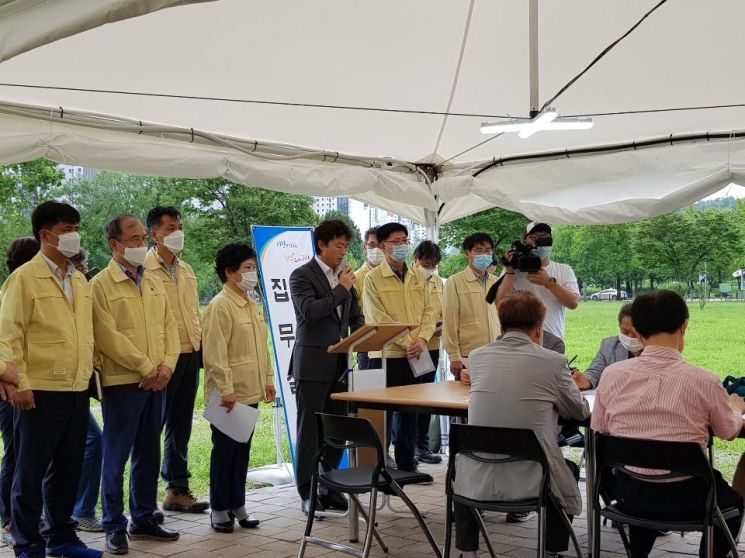 Mayor Kim Jong-cheon of Gwacheon installed a tent office in the front yard of the Government Complex Gwacheon on the 6th. Mayor Kim stated that he will continue the "tent administration" until the government withdraws its plan to build about 4,000 public housing units in the area around the Gwacheon Complex. / Photo by Yonhap News
In response to such remarks from ruling party figures, some view this as a NIMBY phenomenon that regards public rental housing as a nuisance. While some argue that opposition arises from residents' concerns that high-density housing development could degrade quality of life, others say that opposing housing policies for low-income groups amid an unstable real estate market is inappropriate behavior for public officials.
This phenomenon is not limited to politicians. Among citizens, there are also negative perceptions of rental housing. In 2018, a petition to the Blue House requested the suspension of a permanent rental apartment construction plan in Gwangmyeong, Gyeonggi Province, likening it to the 'world's largest urban poor ghetto,' sparking controversy over discrimination against the poor.
There have also been complaints from residents who did not want children of rental housing residents to attend the same schools as their own children. On June 21, a residents' representative group in an apartment complex in Sejong City collectively opposed being grouped into the same school district as rental apartments, causing controversy.
The leaflet released by the group at the time stated opposition on the grounds that "when adjusting school districts (including rental apartments), student generation rates increase and traffic volume rises," and "being classified into a school district that includes rental apartments raises concerns about the apartment's image deteriorating."
The local community's reluctance toward rental housing stems from concerns about environmental pollution and traffic congestion due to housing overcrowding, as well as the so-called 'working-class housing' image primarily inhabited by the poor.
After the announcement of the August 4 Real Estate Measures, residents of newly designated housing sites flooded the national petition board with concerns about traffic chaos. One petitioner criticized, "Gwacheon has been considered a livable city largely because of its green spaces, but the plan to build large-scale apartments in the heart of the city will cause new problems."
Another petitioner lamented, "Taereung Golf Course is Seoul's only green space that has existed for more than half a century. It must be protected," adding, "Moreover, the area is a habitual congestion zone with eight lanes of traffic; building apartments on Taereung Golf Course will open a hellgate for nearby residents."
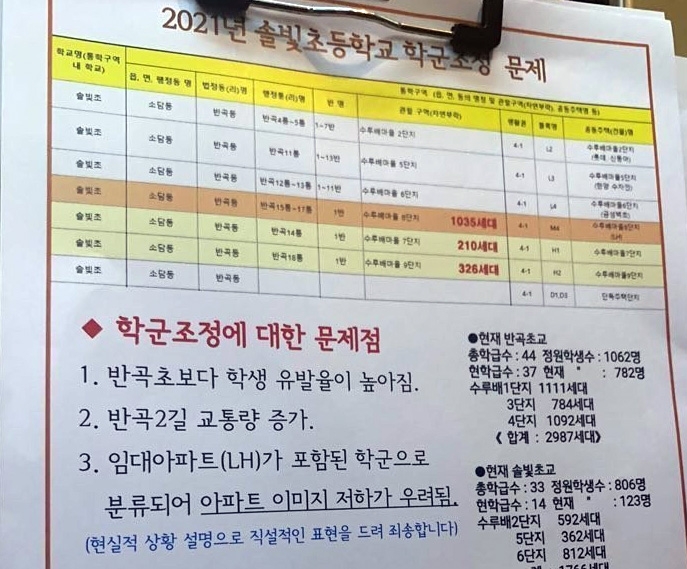 A flyer posted by the residents' representative meeting of an apartment in Sejong City last June opposing the Sejong school district adjustment plan. / Photo by Yonhap News
In response, Lee Jae-sung, representative of the Owners' Association of Eunma Apartments, a symbol of development in Seoul's Gangnam area, appeared on a radio broadcast on the 6th and said, "It is true that public rental residents face unfavorable views," adding, "Conflicts between public rental housing and the complex are not resolved by the government. They become our burden."
Consequently, there are movements opposing the construction of rental housing itself. According to data released by the Anti-Corruption and Civil Rights Commission last year, from May 2017 to June last year, there were 1,068 complaints opposing public rental housing construction, the highest among all rental housing-related complaints.
Experts suggest that to resolve such rejection phenomena, residential plans that can practically achieve 'social mixing' within housing complexes must be prepared. Social mixing refers to creating communities where various social classes, such as the wealthy and the poor, and disabled and non-disabled, live together.
According to the paper "Spatial Composition and Social Mixing of Mixed Sale and Rental Apartment Complexes," published by the Seoul National University Land Issues Research Institute, social mixing is being attempted in Korea through 'mixed complexes' that supply housing for various social classes together.
However, the institute pointed out, "Simply supplying sale and rental apartments within the same district cannot achieve the goals of mixed complexes if there is no interaction between classes, and the meaning fades, leading to exclusion rather than social mixing."
They advised, "It is necessary to design spaces with low barriers and without distinctions between sale and rental units to enable residents of different classes to interact."
© The Asia Business Daily(www.asiae.co.kr). All rights reserved.
![Clutching a Stolen Dior Bag, Saying "I Hate Being Poor but Real"... The Grotesque Con of a "Human Knockoff" [Slate]](https://cwcontent.asiae.co.kr/asiaresize/183/2026021902243444107_1771435474.jpg)


















