Cost Reduction and Cargo Favorable Dual Drive
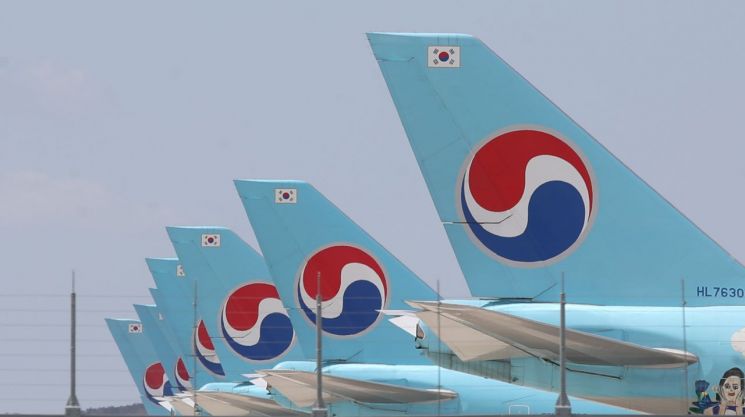
[Asia Economy Reporter Yu Je-hoon] Despite the crisis caused by the COVID-19 pandemic, Korean Air succeeded in turning a profit in the second quarter. This is attributed to cost reductions through large-scale furloughs and the effective targeting of the air cargo "niche market" by Cho Won-tae, Chairman of Hanjin Group.
Korean Air announced on the 6th that its consolidated sales for the second quarter were tentatively estimated at 1.6909 trillion KRW, with an operating profit of 148.5 billion KRW. Although sales decreased by 44% compared to the same period last year, the company succeeded in turning its operating profit positive.
The sharp decline in sales is attributed to strengthened entry restrictions by various countries due to COVID-19. In fact, the passenger business division saw demand decrease across all routes, with transport performance (Revenue Passenger Kilometers, RPK) dropping by 92.2% year-on-year. Typically, the passenger division accounts for about 80% of Korean Air’s sales.
On the other hand, the cargo business division showed favorable performance as the global reduction in passenger flights led to decreased belly cargo supply, causing rates to rise. Korean Air’s cargo transport performance (Freight Ton Kilometers, FTK) increased by 17.3% year-on-year, and sales rose by 94.6% (549 billion KRW) to 1.2259 trillion KRW.
Additionally, various cost controls such as furloughs for 70% of employees were analyzed as key factors. Korean Air explained, "Under Chairman Cho’s leadership, all employees made painful efforts and sacrifices such as salary returns and furloughs to overcome the crisis."
Industry insiders view Chairman Cho’s "contrarian" strategy as having yielded results. In March, when many passenger routes were suspended due to COVID-19, Cho proposed converting passenger aircraft to cargo planes, stating that "using idle passenger aircraft cargo holds can diversify supply sources while also reducing fixed costs such as parking fees."
A Korean Air official said, "When Korean Air was planning to reduce its cargo fleet from 30 aircraft to nearly half in 2016, Chairman Cho (then Executive Vice President) saw an opportunity for a rebound and reduced the scale of cuts. The remaining 23 cargo aircraft have indeed played a pivotal role in overcoming the COVID-19 crisis." He added, "Furthermore, Chairman Cho has continuously invested in maximizing the handling capacity of dedicated cargo terminals worldwide and introduced a new cargo system starting last year."
Despite these surprising results, the outlook for the second half of the year remains bleak. The COVID-19 situation is ongoing, and the resulting economic downturn is causing a decline in international air cargo demand. The International Air Transport Association (IATA) forecasts that air cargo demand will decrease by 14-31% compared to last year.
Korean Air plans to leverage the advantages of its high-efficiency large cargo fleet in the second half, actively attracting demand for high-priced items such as quarantine supplies, e-commerce shipments, semiconductor equipment, and automobile parts. It also aims to expand supply by converting passenger aircraft seats to cargo configurations.
© The Asia Business Daily(www.asiae.co.kr). All rights reserved.
![Clutching a Stolen Dior Bag, Saying "I Hate Being Poor but Real"... The Grotesque Con of a "Human Knockoff" [Slate]](https://cwcontent.asiae.co.kr/asiaresize/183/2026021902243444107_1771435474.jpg)
















