Forced Implementation of Lease 3 Laws Continues, Expansion of Rent Cap System for New Lease Contracts Planned
Reviewing Lowering of Monthly Rent Conversion Rate... Academia and Legal Circles Call It "Anti-Market Idea"
Market Already in 'Jeonse War'... Supply Disappearance and Rapid Increase in Landlord-Tenant Conflicts
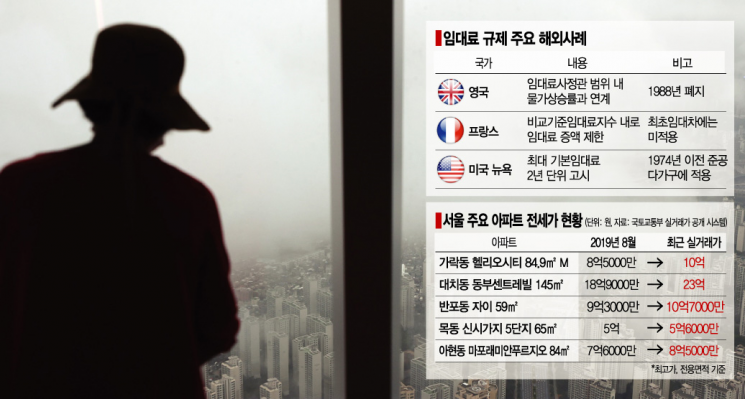
[Asia Economy Reporters Yuri Kim, Sangdon Joo, Onyu Lim] The government and ruling party, which pushed forward the implementation of the so-called 'Three Lease Laws'?the rent ceiling system, the right to request contract renewal, and the rent reporting system?are now escalating controversy by announcing plans to expand the rent ceiling system to new lease contracts as well. While concerns are being raised not only in the market but also in academia and the legal community that this is an anti-market idea, the government appears determined to enforce it under the pretext of 'market stabilization,' suggesting that the controversy will intensify.
According to the government and political circles on the 6th, the spark for the controversy over the rent-to-monthly rent conversion rate was ignited by Kim Hyun-mi, Minister of Land, Infrastructure and Transport. On the 4th, she appeared on a broadcast and stated, "I think the 3.5% added to the base interest rate is somewhat excessive, so I am considering lowering the rent-to-monthly rent conversion rate." The ruling party also fueled the fire. Kim Tae-nyeon, floor leader of the Democratic Party of Korea, said, "We will consider measures to minimize landlords switching from jeonse (key money deposit lease) to monthly rent." There is discussion about lowering the current 4% rent-to-monthly rent conversion rate to the 2% range and making it mandatory rather than just a recommendation. Independent lawmaker Lee Yong-ho has proposed a bill to impose fines of up to 20 million won if landlords charge monthly rent higher than the rent-to-monthly rent conversion rate.
◆Academia and Legal Circles Say "This Goes Too Far"= In response to the ruling party and government’s stance, academia has expressed concerns about market distortion. The legal community points out that there is a possibility of unconstitutionality due to infringement on private property rights. Hong Ki-yong, professor of Business Administration at Incheon National University, told Asia Economy in a phone interview, "Lowering and enforcing the rent-to-monthly rent conversion rate is a measure that deviates from market economy principles," adding, "It undermines the market function determined by supply and demand, which will ultimately accelerate the contraction and shrinkage of the rental market."
Professor Park Ji-soon of Korea University Law School sees a constitutional issue with the forced application of the rent-to-monthly rent conversion rate. Professor Park said, "The basic spirit of the constitution allows some restrictions on property rights if it contributes to public welfare," and "the government enforces various real estate regulatory policies based on this, but the regulatory grounds and expected effects are not well correlated." He emphasized, "Even though the constitution permits restrictions on property rights, it does not mean they can be applied arbitrarily at any time," and "direct intervention and infringement on citizens' property rights should be a last resort."
Song In-ho, head of the Economic Strategy Research Department at the Korea Development Institute (KDI), advised that incentives rather than penalties for landlords are needed to stabilize the rent market. He said, "In the current low-interest rate environment, it is natural for leases to shift from jeonse to monthly rent, so it would be better to provide tax benefits to landlords who maintain jeonse or convert monthly rent back to jeonse."
◆Market Sees Sharp Drop in Listings at Double or Triple Prices: "The Jeonse War Is Already Underway"= As talk arises about strengthened legislation in addition to the hastily implemented Lease Protection Act, the market has fallen into confusion. Even with the existing Three Lease Laws, side effects such as conflicts between landlords and tenants and shortages of listings are rampant, and if the '5% rule' is pushed for new lease contracts as well, the chaos is expected to become uncontrollable, according to voices from the field.
In particular, frontline real estate agencies report that landlords who had planned to list their properties at prices several hundred million won below market value at move-in and then charge market rates after two years are showing reactions beyond dissatisfaction. The head of a real estate agency near Helio City in Garak-dong, Songpa-gu, Seoul, said, "The current bills are detached from reality. The jeonse price for an 84㎡ (exclusive area) has risen by 330 million won in less than two years, but under the new law, it can only be raised by up to 32.5 million won. The jeonse war is already underway," adding, "Among landlords whose jeonse contracts are about to expire, not a single one has willingly agreed to a 5% increase. Many tenants are even willing to move in forcibly rather than accept this."
Complaints are also exploding through online communities. A landlord in their 60s who rented out an apartment in Gangnam-gu, Seoul, said, "They are mocking the law and the people. Hastily pushing policies like limiting new lease contracts to a 5% increase will only add confusion to the jeonse market," and added, "With rising taxes such as property tax, landlords who are already struggling will eventually exit the rental market if their freedom to make new contracts is restricted."
Tenants are equally concerned about the situation. A newlywed couple in their 30s living in a villa on a jeonse contract in Jung-gu, Seoul, said, "Our jeonse contract expires in October next year, and we were planning to move to an apartment, but I worry about what the situation will be like a year from now," adding, "There are rumors about a 5% ceiling on new lease contracts, but it is not particularly welcome. I think it is unfair because I will also become a landlord someday."
© The Asia Business Daily(www.asiae.co.kr). All rights reserved.

















