Daegu Metropolitan Office of Education Announces 'COVID-19 Health Assessment' for Students and Teachers
Teachers Also Show Increased Negative Responses in 'Job and Life Satisfaction'
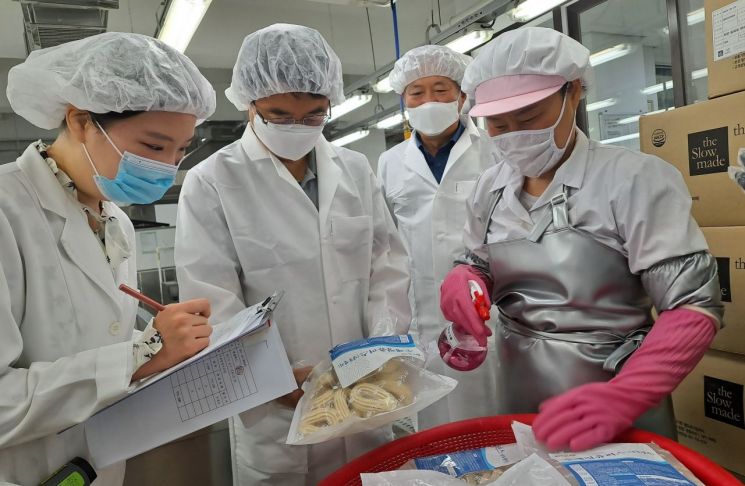 Senior officials of the Daegu Metropolitan Office of Education inspecting hygiene conditions at the Osung Middle School cafeteria in Suseong-gu on June 30.
[Asia Economy Yeongnam Reporting Headquarters Reporter Park Dong-wook] About 13 out of 100 middle and high school students in the Daegu area (1.3%) have reported experiencing 'unbearable stress' even now after the spread of the novel coronavirus infection (COVID-19).
Responses indicating that academic stress has increased compared to before the COVID-19 outbreak accounted for 45% overall, revealing anxiety about the online remote learning system. Among teachers as well, the rate of negative responses regarding job satisfaction and life satisfaction increased due to COVID-19.
The Daegu Metropolitan Office of Education announced the results of the 'Post-COVID-19 School Disaster Mental Health Assessment' conducted via a survey commissioned to the Daegu Student Suicide Prevention Center (Chilgok Kyungpook National University Hospital) on the 6th. This survey was conducted from May 29 to June 21, targeting 8,177 students enrolled in 82 middle and high schools in Daegu (4,463 middle school students and 3,714 high school students) and 2,322 teachers from 217 middle and high schools, totaling 10,499 students and teachers.
The survey was divided into periods: before the COVID-19 spread (before December 2019), after the spread (after January 2020), the peak of COVID-19 spread (February to March 2020), and the current period after the return to school in May. The main areas covered were mental health status before and after COVID-19, emotional regulation issues, and adaptation to COVID-19.
The survey results showed that middle and high school students in Daegu experienced more unbearable stress and emotional and psychological difficulties such as depression and anxiety after the COVID-19 outbreak than before it.
The percentage of those feeling unhealthy was highest at the peak of COVID-19 spread (7.4%), followed by the current period after school reopening (5.1%), and before the COVID-19 outbreak (3.9%). Unbearable stress was highest at the peak of COVID-19 spread (16%), followed by the current period after school reopening (12.7%), and before the COVID-19 outbreak (9%).
Normally, students' stress sources were mainly academic stress such as studying (77.9%) and grades (62.6%), but at the peak of COVID-19 spread, stress was caused by unusual experiences (57.1%) and fear of infection (45.8%). After school reopening, students felt stress from studying (62.3%), grades (51.9%), and unusual experiences (32.2%) together.
In particular, responses indicating that academic stress increased after the COVID-19 outbreak (44.8%) were much higher than those indicating a decrease (9.4%). Female students (50.5%) and students who had experienced infection (49.3%) reported more academic stress than male students (39.0%).
Many adolescents complained of depression and anxiety caused by COVID-19. At the peak of COVID-19, 'fear' was most felt, while before and currently, 'helplessness' was more commonly experienced. The proportion of students who experienced emotional crises was 7.6%, and 61.7% of students responded that the frequency of emotional crisis experiences increased after COVID-19.
Regarding counseling targets, 36.0% of surveyed students said they had no one to consult for overcoming emotional crises, while the rest mainly consulted friends (34.7%) and parents (20.8%). Methods for overcoming emotional crises included listening to and singing songs (50.9%), finding solutions alone (46.7%), and sleeping (43.1%).
Teachers also experienced the most unbearable stress at the peak of COVID-19 spread (43.3%), and reported more stress currently (33.1%) than before COVID-19 (15.8%).
Before COVID-19, stress areas for teachers were work environment (57.6%), health (42.9%), and students (35.6%) in that order, but at the peak of COVID-19, unusual experiences (64.4%), fear of infection (61.9%), and negative emotions (43.9%) were the top stressors. Currently, the order has changed to fear of infection (46.4%), unusual experiences (46.2%), and work environment (45.5%).
COVID-19 was also found to have a negative impact on teachers' job satisfaction and life satisfaction. Job satisfaction decreased in the order of teachers who had experienced infection (67.7%), female teachers (64.7%), and male teachers (46.9%). Life satisfaction was reported to have decreased in the order of teachers who had experienced infection (84.1%), female teachers (81.2%), and male teachers (66.7%).
Won Seung-hee, director of the Daegu Student Suicide Prevention Center (Wee Center director at Kyungpook National University Hospital), who led this disaster mental health assessment, stated, "It was confirmed that both students and teachers are experiencing emotional difficulties and stress as they are placed in an environment distinctly different from before due to COVID-19," emphasizing the importance of infectious disease prevention and treatment support along with disaster psychological support for students and staff.
Daegu Superintendent of Education Kang Eun-hee pledged, "By objectively understanding the psychological and emotional difficulties experienced by students and staff and responding proactively, we will focus on fostering mental health and psychological resilience to wisely live in the With COVID-19 era."
© The Asia Business Daily(www.asiae.co.kr). All rights reserved.
![Clutching a Stolen Dior Bag, Saying "I Hate Being Poor but Real"... The Grotesque Con of a "Human Knockoff" [Slate]](https://cwcontent.asiae.co.kr/asiaresize/183/2026021902243444107_1771435474.jpg)
















