A Place Shaped by Volcanoes, Wind, and Time
South Korea's Only UNESCO Natural World Heritage Site 'Geomeunoreum'
8,000 Years of Mystery, Partial Opening from the 4th to the 20th Next Month
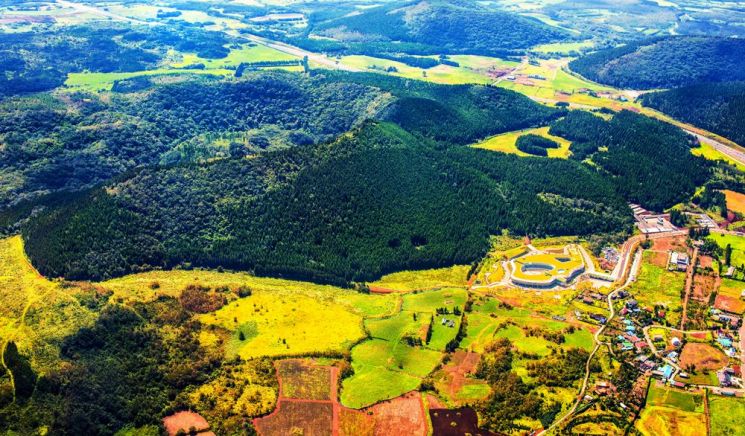
Jeju Oreum, where the wind and clouds take a rest. Geomeun Oreum (Natural Monument No. 444) proves it. Among the 368 oreums in Jeju, its forest is the most lush. Within it, cedar, cypress, Korean arborvitae, and pine trees dance with the wind and clouds as their companions. Ten thousand years ago, two travelers created what is now Geomeun Oreum. They cooled the lava produced by parasitic volcanic activity and breathed life into it.
The stones and soil formed in this way are unusually dark, so much so that it is called Geomeun Oreum, meaning "black oreum." The underground is no different. Empty spaces here and there are shrouded in darkness. Bengdu Cave, Utsanjeon Cave, Daerim Cave, Manjang Cave, Gimnyeong Cave, Yongcheon Cave, Dangcheomul Cave... collectively known as the Geomeun Oreum lava cave system. When first formed, they were connected in a single line. The basaltic lava flow erupted from Geomeun Oreum flowed along the northeast surface slope toward the coast, forming these caves.
It is the only UNESCO World Natural Heritage site in Korea. It has been recognized for its outstanding scenic value and unique geological environment. However, only a portion of Manjang Cave has been opened to the public, and its true nature remains largely hidden. Awareness of the value of lava caves and their preservation is also insufficient.
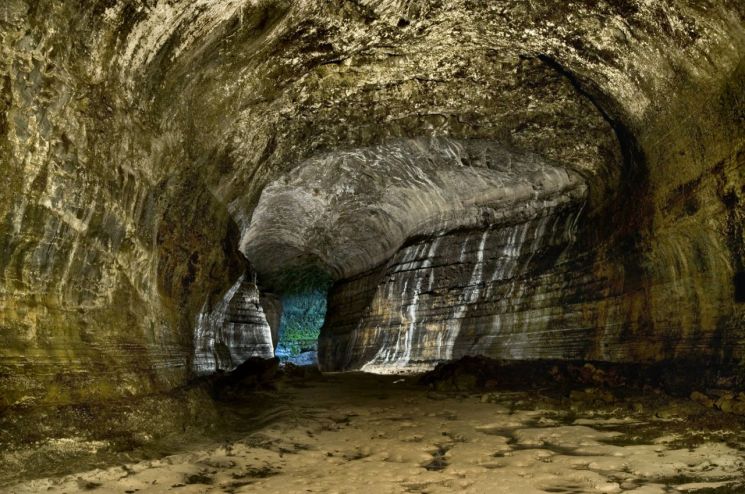
The Cultural Heritage Administration and Jeju Province will open some sections of Geomeun Oreum and the lava cave system during the World Heritage Festival from the 4th to the 20th of next month. Three trekking courses will be created following the flow of lava. A special exploration team will also be recruited to explore the main caves.
Kim Tae-wook, the general director of the World Heritage Festival, said, "The life and history shaped by volcanoes, wind, and clouds are the core of Jeju's World Natural Heritage," adding, "We aim to feel the important meaning and value and to secure our identity."
Similar attempts were made during the Joseon Dynasty. The person responsible was Nam Gu-myeong (1661?1719), who was appointed as the Jeju magistrate in the 38th year of King Sukjong's reign (1712). He recorded mountains, rivers, landscapes, climate, and local customs after crossing mountains and waters. His great-grandson Nam Hong-yang compiled these with poems and other writings into the 'Uammunjip (寓庵文集).' The following is an exploration record of Gimnyeong Cave.
"The cave is on flat land, and its entrance is wide open, resembling the furnace of a pottery kiln. Several people holding torches entered inside, where the height was several dozen feet and the size was enough to house a pavilion. After walking about ten steps, there was a cave opening to the west that was narrow like a door; I was too scared to go further. When I asked a villager, he said, 'If you go inside, it becomes wider and twice the size of the outer cave, and its depth is so great that even walking all day, you cannot find the end. The cave opening to the north reaches the sea, where piles of clam shells, soft-shelled turtles, and fish bones are stacked high.'"
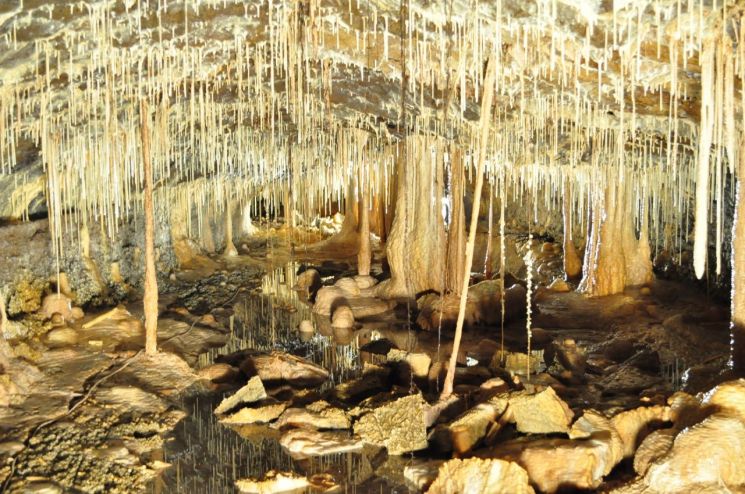
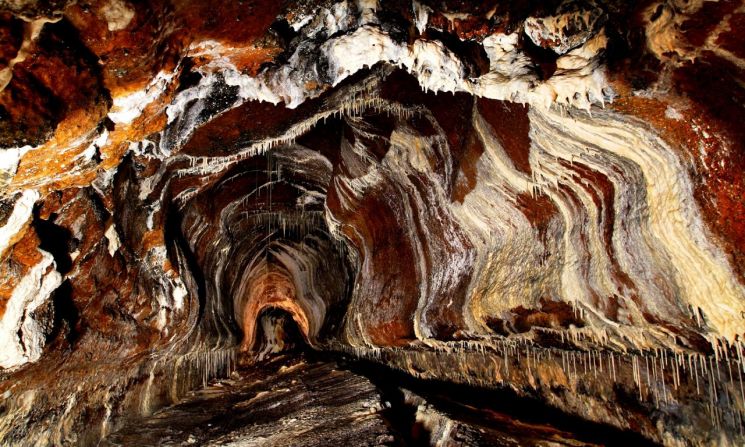
It may have been the sea tens of thousands of years ago. Nearby Dangcheomul Cave and Yongcheon Cave preserve the mysteries of speleothems (crystalline deposits formed inside caves after their formation) such as stalactites and stalagmites in lava caves. Rainwater seeped into sand mainly composed of clam shells, creating a splendid underground palace.
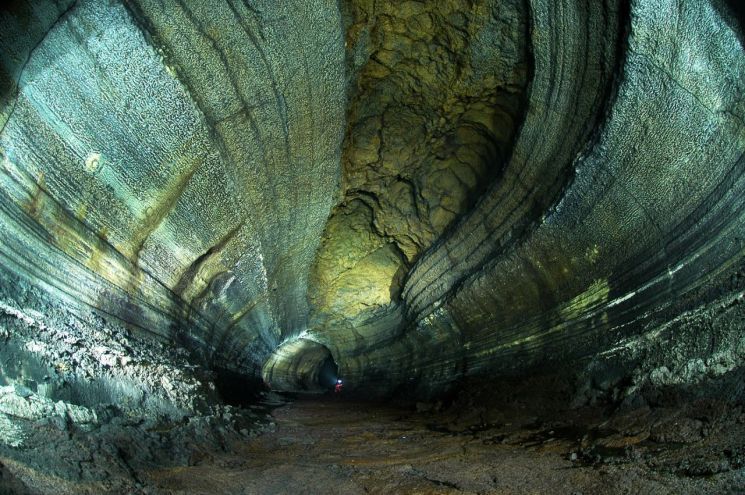
Typical lava caves like Manjang Cave and Daerim Cave show a completely different underground world. Lava that had not yet cooled flowed down the ceiling or walls, leaving various formations such as lava benches, lava crystals, lava stalactites, and lava stalagmites. These can be observed in the 1.2 km section of Manjang Cave that will be opened this time.
The path carved by magma has two branches on the first and second underground floors. The entrances are all filled with fallen rocks. Passing through sharp rocky areas, a long lava bench appears. It was formed by lava flowing along the walls solidifying like a long plank. It serves as an easy passage during exploration. Following it, one can see the floor covered with pahoehoe lava. The lava slowly flowed and solidified in multiple layered lines. Its surface has a silvery-white sheen that inspires awe.
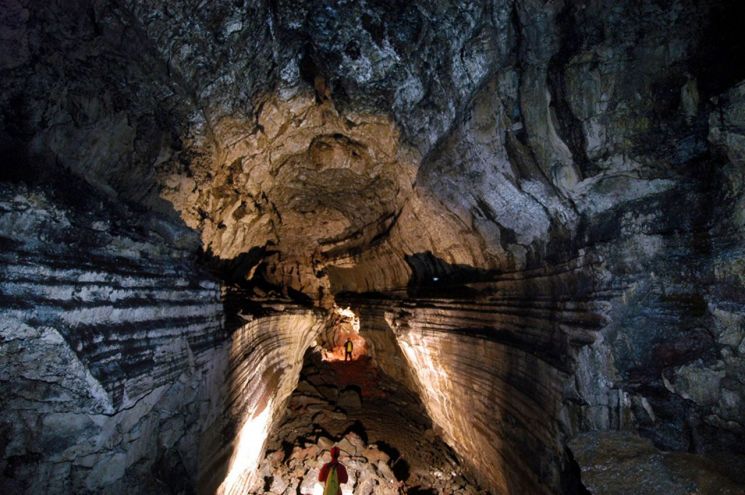
In some sections, lava crystals can also be found. These are masses formed when lava flowed down the walls and solidified. Their smooth surfaces give the illusion of flowing water. Lava stalactites hang from the ceiling like icicles. Compared to limestone cave stalactites, they are shorter and wider, resembling arrowheads. Thin and long roots extend into the sharp rock crevices. They belong to trees above ground, showing vitality enough to penetrate the stone gaps.
Primitive humans also took root and lived in caves. Here, they likely chipped common basalt into tools such as choppers, scrapers, stone knives, and saw blades. As they moved their settlements outside, caves were regarded as sacred halls (dang) where gods dwelled, often symbolizing the wombs of goddesses in indigenous beliefs.
Residents were protected by caves whenever war or disaster struck. Especially during the Jeju 4.3 Incident, caves served as shelters for those who fled to the mid-mountain areas. The traces of pain have vanished over time, fading away with the years.
Excavation is also difficult. Unlike limestone caves that continuously grow through underground water dissolution, lava caves undergo constant collapse. Once damaged, restoration is impossible. In Manjang Cave, there are as many as twenty-three fallen rock areas. Due to groundwater inflow and fracturing, the ceiling rock remains unstable, and collapses are expected to continue.
Periodic monitoring alone is insufficient. A forward-looking perspective is needed to pass it on intact to future generations. Therefore, the concept of this exploration is breath. It is not limited to experiencing the mysterious world shaped by water and time. It also involves understanding the breath of the earth’s rise and fall, which contains changes in environment and history. With a heart to remember and preserve...
© The Asia Business Daily(www.asiae.co.kr). All rights reserved.
![Clutching a Stolen Dior Bag, Saying "I Hate Being Poor but Real"... The Grotesque Con of a "Human Knockoff" [Slate]](https://cwcontent.asiae.co.kr/asiaresize/183/2026021902243444107_1771435474.jpg)


















