Traffic Diverts to Alternate Routes Due to Major Road Controls in Seoul
Morning Commute Turns into Hellish Journey
Road Congestion Causes Widespread Lateness Among Office Workers
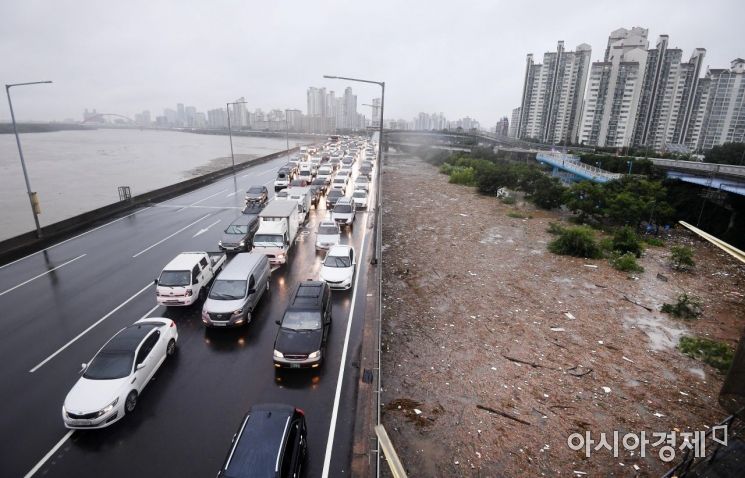 Due to the influence of the monsoon front, heavy rain continued for the fifth consecutive day on the 6th. The water level of the Han River rose due to the discharge from Paldang Dam and Soyanggang Dam, causing severe congestion on Gangbyeonbuk-ro near Mapodaego. Photo by Kim Hyun-min kimhyun81@
[Asia Economy Reporters Byungdon Yoo, Jeongyun Lee] On the morning of the 6th, roads throughout Seoul were gridlocked with vehicles barely moving, resembling parking lots. Due to another heavy downpour overnight, the water levels of the Han River rose as a result of discharges from Paldang Dam and Soyanggang Dam, leading to the closure of major roads crossing Seoul. Vehicles were forced onto detour routes. Although the Seoul subway during the morning rush hour showed congestion levels similar to usual, the road commute became a nightmare amid the summer vacation season.
According to the Seoul Metropolitan Police Agency, from 3:50 a.m. that day, the Dongbu Expressway was completely closed to traffic between Surak Underpass and Seongsu JC due to rising water levels in the Jungnangcheon Stream. Earlier, from 3:10 a.m., two-way traffic was restricted on Gangbyeonbuk-ro between the north end of Wonhyo Bridge and the entrance to the Medical Association. The section of the Naebu Expressway from Majang Ramp to Seongsu JC was also restricted for two-way traffic starting around 2:20 a.m. In addition, the Nodul-ro section between Hangang Bridge and Yeoui Downstream IC, the under-road of Jeungsan Bridge, and the Sacheon Bridge underpass were all closed to traffic from the morning. Two-way traffic was also restricted on Gangdong-daero from the south end intersection of Olympic Bridge to Dunchon Intersection, and on the under-road from Umyeon Bridge Yeongdong 1 Bridge to Yangjaecheon Bridge. The Olympic-daero section from Dongjak Bridge to Yeomchang Interchange has been fully closed in both directions since around 9:25 p.m. the previous day.
Gangbyeonbuk-ro and Olympic-daero, which usually have heavy traffic, experienced severe congestion early that morning. Major roads connecting Gangnam and northern Seoul, such as Banpo Bridge and Hannam Bridge, also saw long queues of vehicles in the rain. For example, bus number 140, which departed from Gangnam Station at 8:25 a.m., took 45 minutes to reach Jongno 3-ga, nearly twice the usual 25 minutes. This delay was mainly due to the 20-minute wait at Hannam Bridge caused by the closures on Olympic-daero and Gangbyeonbuk-ro. Bus driver A said, "There are more passengers than usual today."
Anticipating the traffic chaos, office workers hurried their commutes. Lee Yujin (29), a passenger on Seoul Subway Line 2, which circles the city, said, "I heard the roads were blocked, so I took the subway instead of the bus," adding, "Just in case, I left home 20 minutes earlier than usual." Line 2 showed congestion levels similar to normal that day. However, those who left for work at their usual time faced difficulties. For instance, a car departing from Seonyudo Station in Yeongdeungpo-gu at around 8:40 a.m. took over 40 minutes to reach Yeongdeungpo Rotary, compared to the usual 10 to 15 minutes, a delay of three to four times longer.
The Central Disaster and Safety Countermeasures Headquarters reported that from the 1st until 6 a.m. that day, 16 people had died and 11 were missing due to the heavy rain. There were 991 households and 1,648 people displaced across six provinces and cities including Seoul, Gyeonggi, Gangwon, Chungnam, Chungbuk, and Gyeongbuk. Additionally, 1,598 households and 4,909 people temporarily evacuated due to concerns over landslides and flooding. Particularly in border areas such as Cheorwon in Gangwon Province and Yeoncheon in Gyeonggi Province, which experienced a record rainfall of 755 mm, 2,053 people evacuated as the Imjin River water level rose the previous day.
Seoul's Jamsu Bridge, Yeoui Upstream and Yeoui Downstream Interchanges, Gaehwa Six Gates, and five access gates to Hangang Citizen Park (Jayang Central, Jayang, Noyu, Ttukseom, Byeokcheon Six Gates) remain closed since the previous day. From 5:50 a.m. that day, a flood advisory was issued around the Tancheon Daegok Bridge area in Seoul. The Han River Flood Control Office warned, "There is concern about flood damage due to rising river levels and overflow," urging residents in Gangnam-gu and Songpa-gu in Seoul and Seongnam City in Gyeonggi Province to stay safe.
© The Asia Business Daily(www.asiae.co.kr). All rights reserved.
![Clutching a Stolen Dior Bag, Saying "I Hate Being Poor but Real"... The Grotesque Con of a "Human Knockoff" [Slate]](https://cwcontent.asiae.co.kr/asiaresize/183/2026021902243444107_1771435474.jpg)
















