Re-bidding for Terminal 1 (T1) Phase 4 Duty-Free Operators
Six Business Rights Either Failed or Withdrawn After Bidding
Temporary 'Operating Rate' Applied Until COVID-19 Recovery
Rent Calculated Based on Sales Fluctuations... Rent Discount Up to 30%
Industry "Welcomes... Success Uncertain"

[Asia Economy Reporter Seungjin Lee] The re-bidding for the 4th phase duty-free shop operators at Incheon International Airport Terminal 1 (T1), which was previously canceled due to the impact of the novel coronavirus disease (COVID-19), is now underway. Incheon International Airport Corporation, which had conflicts with the duty-free industry over rental fees amounting to hundreds of billions of won, has lowered the minimum acceptable amount (rent) and temporarily applied operating rates to ease the entry barriers, considering the business environment of the duty-free industry.
On the 6th, Incheon International Airport Corporation announced the re-bidding for four zones at Terminal 1: DF2 (perfume & cosmetics), DF3 (liquor & tobacco), DF4 (liquor & tobacco), DF6 (fashion & accessories), as well as DF8 (all items) and DF9 (all items) designated for small and medium-sized enterprises. The contract period remains the same as the first bidding, with a basic contract period of 5 years and an option to extend for an additional 5 years based on performance evaluation, allowing a maximum operation period of 10 years. The new operators will begin running the duty-free shops from March next year.
These zones were either failed bids or contracts abandoned by the selected preferred negotiation candidates in the bidding held last March. At that time, the industry’s top two companies, Lotte Duty Free and Shilla Duty Free, were selected as preferred negotiation candidates for DF3 and DF4 zones respectively but gave up the contracts considering the impact of COVID-19. SM Duty Free, a mid-sized company that participated in the DF8 and DF9 bids, also withdrew due to rental fee burdens.
◆ Applying rental rates by product category until passenger numbers recover = The biggest change in this bidding is the method of rent payment. Previously, Incheon Airport duty-free shops paid the awarded 'minimum acceptable amount' monthly. Reflecting the difficult situation of duty-free shops, Incheon International Airport Corporation decided to collect rent linked to sales until monthly passenger demand recovers to 60% or more of the 2019 level. Operators only need to pay rent based on sales multiplied by the operating rates by product category. The operating rates set by the corporation are 30% for perfume & cosmetics, 34% for liquor, 31% for tobacco, 20% for fashion & accessories, and 8% for electronics.
Once normal demand is restored, the rent payment will switch to a fixed rent system. However, if passenger demand decreases by more than 40% compared to the same month of the previous year, as in the COVID-19 situation, the rent will be immediately reduced by half of the passenger decrease rate. Additionally, the minimum acceptable amounts (winning bids) have been reduced by 18-30% for each zone. For example, the minimum acceptable amount for DF2 was 116.1 billion won in the previous bidding, but it has been lowered by about 27% to 84.2 billion won for the first year in this bidding.
Also, unlike the previous system where the minimum acceptable amount was paid as rent in the first year and rent could increase by up to 9% annually from the second year based on passenger fluctuations, this time there is a difference between the minimum acceptable amounts for the first and second years, and from the third year onward, the minimum guaranteed amount from the previous year will be adjusted based on passenger fluctuations. The minimum acceptable amount for the second year increases by about 12% compared to the first year, but since the minimum acceptable amount has been reduced by more than 20%, this measure reduces the rental burden on the duty-free industry.
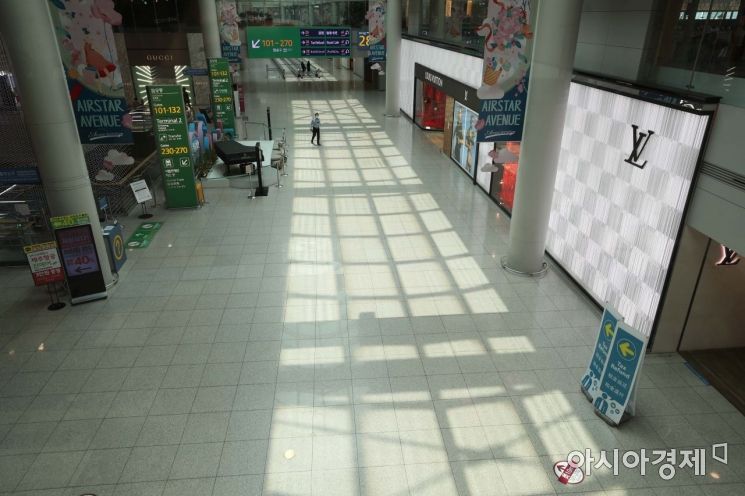 On the 18th, the duty-free shop at Terminal 1 of Incheon International Airport was quiet due to the impact of the novel coronavirus (COVID-19). Photo by Mun Ho-nam munonam@
◆ Duty-free industry: "Regrettable but welcome" = The duty-free industry welcomes Incheon International Airport Corporation’s decision. A representative from a major duty-free company said, "Assuming it will take more than 2-3 years for passenger demand to recover to over 60%, it seems that Incheon International Airport Corporation has taken into account many of the duty-free industry's claims," adding, "This decision allows us to promote employment stability for duty-free employees."
However, there are also forecasts that achieving the usual level of success will be difficult despite the corporation’s rent relief measures. Another representative from a major duty-free company said, "Sales from January to July were severely impacted, and since it is uncertain how the COVID-19 situation will change, it does not seem easy to participate in the bidding just because the conditions have been relaxed."
According to the Korea Duty Free Association, duty-free sales in June amounted to 1.1113 trillion won. Sales slightly increased from 1.0179 trillion won in May due to increased purchases of duty-free goods by Chinese traders. Although the sales recovered to the 1 trillion won level for two consecutive months after falling below 1 trillion won in April, they are still about half of the 2.0247 trillion won sales recorded in January before COVID-19.
© The Asia Business Daily(www.asiae.co.kr). All rights reserved.


















