1028 Vehicles Compensated This Year
Monsoon Forecasted to Prolong Until Next Week
Damage Reports Expected to Increase
Refer to Vehicle Registration Records, etc.
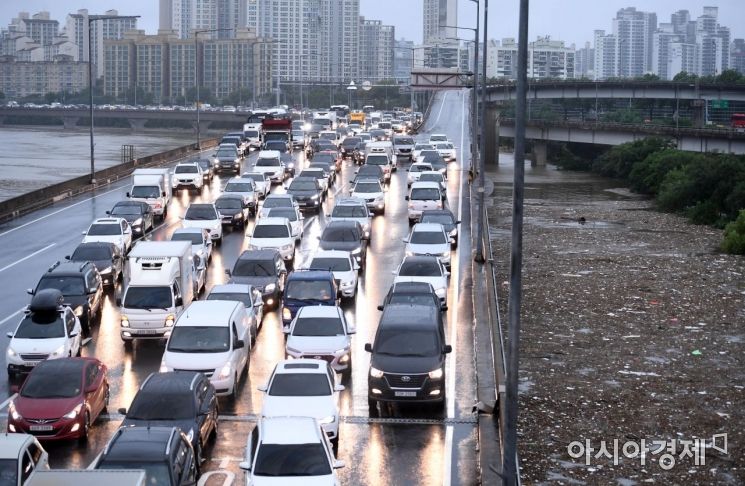 Due to the influence of the monsoon front, heavy rain continued for the fifth consecutive day on the 6th. The water level of the Han River rose due to the discharge from Paldang Dam and Soyanggang Dam, causing severe congestion on Gangbyeonbuk-ro as seen from Mapo Bridge in Seoul. Photo by Hyunmin Kim kimhyun81@
[Asia Economy Reporter Oh Hyung-gil] As the rainy season accompanied by record-breaking heavy rains continues, vehicle flood damage is rapidly increasing. Flooded vehicles are being disguised by concealing repair histories or being passed off as accident-free vehicles and circulated in the used car market, requiring consumer caution.
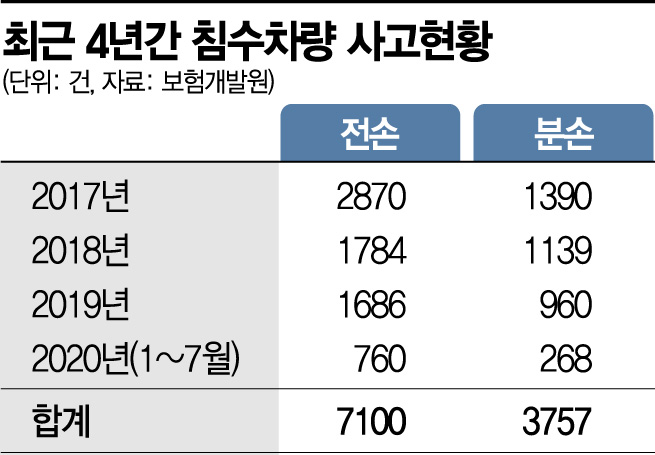
According to the Insurance Development Institute on the 6th, the number of flooded vehicles compensated through auto insurance from 2017 to July this year reached 10,857. Among these, total flood losses accounted for 7,100 cases, and partial flood damages accounted for 3,757 cases. From January to July this year alone, 1,028 flooded vehicles have been compensated.
In particular, the rainy season is forecasted to continue until next week, and including vehicles that have not yet been reported or are in the damage reporting stage, the insurance industry expects the scale of damage to continue increasing.
An official from the Insurance Development Institute explained, "More than 90% of annual flood vehicle damage occurs between July and October due to concentrated heavy rains during the rainy season," adding, "Modern vehicles with many electronic devices are highly likely to have ongoing safety issues due to corrosion of vehicle parts if flooded during the rainy season's heavy rains."
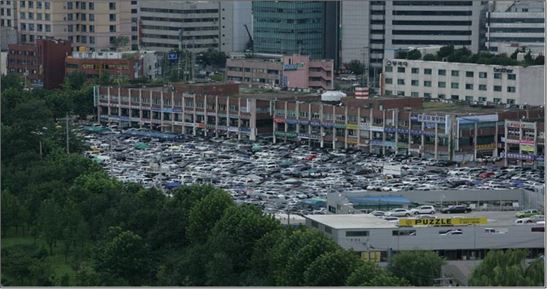 The area around Jang-anpyeong Used Car Market Center in Seongdong-gu, Seoul (Photo by Asia Economy DB)
Typically, flooded vehicles can be compensated through the auto insurance's own vehicle damage coverage (comprehensive coverage) after insurance claim registration, but if the owner has not subscribed to comprehensive coverage, compensation is not possible. Also, in cases where the damage exceeds the vehicle's value and is treated as a total loss, the vehicle proceeds to scrapping.
However, some owners of flooded vehicles minimize losses by using private repair shops to fix the vehicles and then clean them before selling them in a clean state in the used car market, perpetuating the problem of flooded vehicle circulation.
Insurance experts recommend that if you plan to purchase a used car after the rainy season, you should check the used car on the Insurance Development Institute's Car History service. Car History is a service that provides accident history information based on auto insurance accident data. By entering the vehicle number or chassis number, you can check for flood vehicle status free of charge. However, there is a limitation in that it is difficult to verify if the accident was not reported to the insurer or not processed through insurance.
You should also refer to ownership change records through the Ministry of Land, Infrastructure and Transport's automobile civil complaint public portal site via the vehicle registration certificate. If the owner has changed multiple times within a short period, it is a listing to be cautious about.
There are also ways consumers can verify directly. You can compare the manufacturing date marked on major electronic components (ECU, BCM) with the vehicle manufacturing date or check for contamination of major parts. Also, when operating the air conditioner (heater), check for mold, rust, or mud odors. It is also advisable to check if mud is stuck or corrosion traces remain on interior parts such as seat belts.
© The Asia Business Daily(www.asiae.co.kr). All rights reserved.
![Clutching a Stolen Dior Bag, Saying "I Hate Being Poor but Real"... The Grotesque Con of a "Human Knockoff" [Slate]](https://cwcontent.asiae.co.kr/asiaresize/183/2026021902243444107_1771435474.jpg)

















