The Secretary Office Location as Key Evidence Site... Focus on Possibility of On-Site Investigation
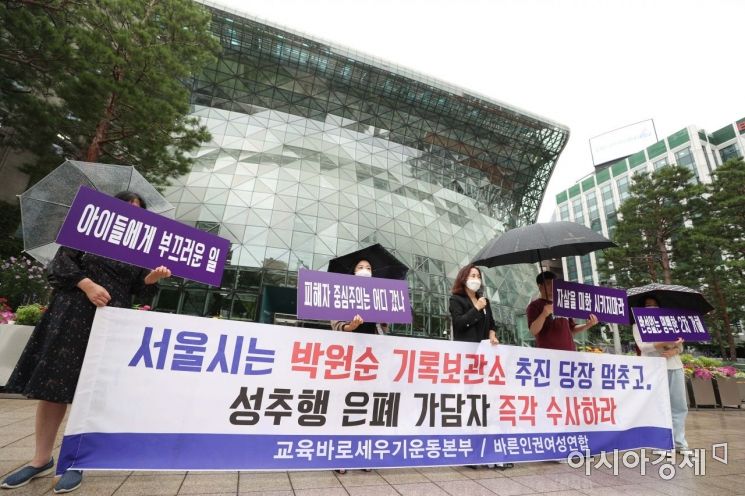 A press conference opposing the establishment of the archive for the late Park Won-soon, former Mayor of Seoul, was held in front of Seoul City Hall on the 27th of last month. Photo by Moon Ho-nam munonam@
[Asia Economy reporters Donghoon Jeong and Jeongyun Lee] The National Human Rights Commission of Korea has launched an ex officio investigation to clarify allegations of sexual harassment against the late Park Won-soon, former mayor of Seoul, drawing attention to whether an on-site investigation will be conducted on the 6th floor of Seoul City Hall, which the police were unable to search.
According to the Human Rights Commission and the National Human Rights Commission Act on the 6th, the Commission can conduct on-site investigations or request submission of materials based on its judgment during the investigation. Although it does not have compulsory investigative authority, it can proceed with investigations without a court warrant.
The 'Ex Officio Investigation Team on Sexual Harassment Allegations against Former Seoul Mayor Park Won-soon,' established the day before, is highly likely to inspect the 6th floor of Seoul City Hall. This floor houses the secretariat office, a key location for evidence related to the incident. The victim's side views this space as the key to resolving allegations of sexual harassment by Mayor Park Won-soon and suspicions of employee complicity. However, the Seoul Northern District Court dismissed the police's warrant request for a search of the mayor's secretariat office on the 6th floor of Seoul City Hall on the 22nd of last month, citing a lack of necessity for compulsory investigation.
According to the Human Rights Commission Act, Commission staff can directly visit Seoul City Hall to conduct on-site investigations. They can also request the attendance of parties involved in the so-called '6th floor people' case, which involves allegations that Park's political aides concealed sexual harassment, and take their statements. However, if they refuse to attend, only a fine can be imposed, so there is no compulsory power.
The Commission can also request materials from investigative agencies such as the police or prosecution. However, there are limitations in grasping the substance. Article 35 of the Human Rights Commission Act, which limits the purpose of investigations, includes provisions such as 'not interfering with the functions of state agencies' and 'investigations must not be conducted with the improper intention of interfering with ongoing investigations.' This suggests that the police may be reluctant to provide investigation materials even if requested by the Commission. In fact, the police have refused to submit materials related to ongoing investigations. Lawyer Jeong Sang-hwan, a former standing member of the Human Rights Commission, stated, "Due to regulations allowing the police to refuse submission of materials related to ongoing investigations, they have refused to provide materials." A Seoul Metropolitan Police Agency official said, "Regarding the Act on Special Cases Concerning the Punishment of Sexual Crimes and the Act on Disclosure of Information by Public Agencies, it may be difficult to provide materials related to ongoing investigations," adding, "It is necessary to carefully review such requests."
© The Asia Business Daily(www.asiae.co.kr). All rights reserved.

















