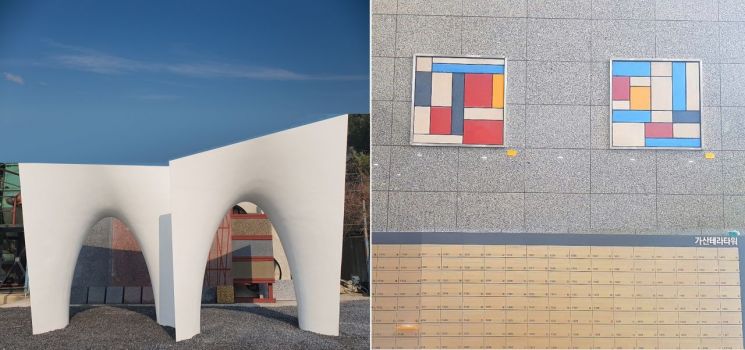
 An irregular structure (left) constructed using the 'Construction Technology for Irregular Buildings Using UHPC Material' jointly developed by Sampyo and Hyundai Engineering. Using 3D technology, site workers completed a life-sized structure based on the architect's design. The right photo shows a point frame-type UHPC color panel installed on the lobby wall of the first floor of Gasan Terra Tower, a knowledge industry center in Gasan-dong, Geumcheon-gu, Seoul (constructed by Hyundai Engineering). Although concrete, the basic material, was used as the finishing material instead of paint, it is highly valued for its artistic merit.
 [Photo by Sampyo]
[Asia Economy Reporter Kim Jonghwa] Rough and coarse concrete is transforming into a material for art pieces. This is because it has fluidity that allows for strength capable of supporting structures without using rebar, as well as the ability to create graceful curves, and its color can be adjusted to pastel tones.
The concrete that architects frequently use for artistic expression is Ultra-High Performance Concrete (UHPC). Until now, UHPC has been limited to civil engineering structures such as buildings over 50 stories tall or bridges, but recently, the situation has changed with the application of 3D printing technology in architecture.
UHPC has up to 10 times the strength of ordinary concrete and greater fluidity. It can bear higher loads while using less material than regular concrete, enabling lightweight structures and allowing various designs without using rebar. Moreover, it can express desired shapes, colors, and textures.
Therefore, UHPC is often used in artistic works symbolizing buildings or in interior design. In April, Sampyo Group’s Technology Research Institute jointly developed 'Construction Technology for Freeform Structures Using UHPC' with Hyundai Engineering. Using this technology, architects’ freeform designs were realized into full-scale structures on-site through 3D technology, verifying the technical capability.
They also succeeded in implementing 'High-Performance Architectural Color PC Finishing Material' with interior elements. A representative example is the point frame-shaped UHPC color panel installed on the lobby wall of the first floor of Gasan Terra Tower (constructed by Hyundai Engineering) in Gasan-dong, Geumcheon-gu, Seoul. Instead of paint, concrete as a base material was used as the finishing material.
The high-performance architectural color PC finishing material was developed through joint research by Sampyo Technology Research Institute, Sampyo P&C, and Hyundai Engineering. It uses UHPC with a compressive strength of 120 megapascals (MPa) and slump (workability) over 800 mm, and employs white cement and inorganic pigments to express both primary and pastel colors in concrete.
The frame-shaped color panels installed in the building lobby are highly praised for their artistic quality, making it hard to believe they are made of concrete. The panels are divided by black lines filled with various colors such as blue, red, yellow, and white, inspired by the works of Piet Mondrian, a pioneer of abstract painting. A concrete surface hardening delay method was applied to elegantly and luxuriously express the natural texture of concrete, achieving color without painting, using only concrete.
A Sampyo official said, "This finishing material (concrete) maintains strength and durability while being thin enough to freely express desired shapes," adding, "Since it satisfies both durability and unique design, it has high usability in interior design and will be widely used as interior and exterior materials for various buildings."
The concrete technology upgraded from UHPC is called 'Mega Double Wall (MDW).' MDW is a factory-assembled wall developed for the first time in Korea by Sampyo Technology Research Institute in October last year. Recently, when constructing large spaces, the 'PC (Precast Concrete) method' is preferred, where concrete walls are cast in molds at the factory and then transported and assembled on-site, instead of pouring concrete into formwork made on-site.
While previous technology allowed walls with thicknesses of 18?50 cm and lengths of up to 10 m, MDW can produce walls more than twice as thick (60?120 cm) and up to 14 m long. This increased strength and durability make it useful for assembling wide factories or logistics warehouses with minimal partitions and columns.
Other types of concrete recently used on construction sites include self-compacting concrete that does not require pumping because the raw materials do not separate during pouring, rapid-hardening concrete that sets within 18 hours after pouring, concrete that does not freeze and hardens even at temperatures as low as minus 5°C, and soft concrete that uses smaller aggregate particles (maximum size 20 mm) than ordinary concrete to enhance workability.
A Sampyo Group official said, "Specialty concretes have received great market response as they were developed by actively reflecting the voices of construction sites aiming to shorten construction time and reduce costs," adding, "Efforts to create perfect concrete, including the development of eco-friendly concrete, will continue."
© The Asia Business Daily(www.asiae.co.kr). All rights reserved.
![Clutching a Stolen Dior Bag, Saying "I Hate Being Poor but Real"... The Grotesque Con of a "Human Knockoff" [Slate]](https://cwcontent.asiae.co.kr/asiaresize/183/2026021902243444107_1771435474.jpg)
















