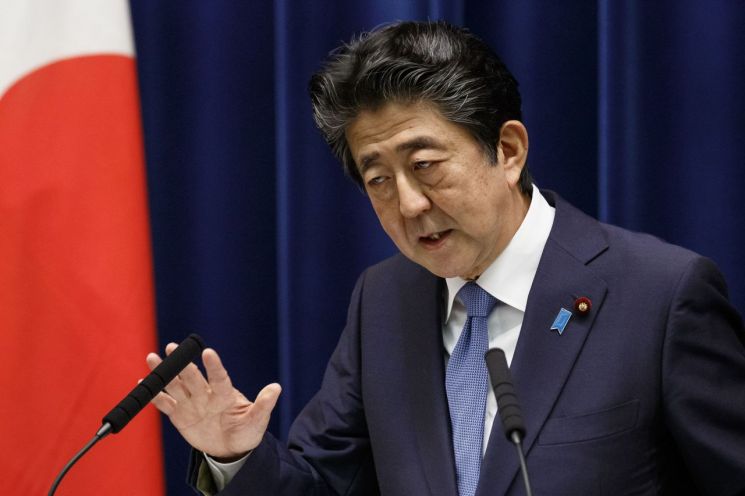
[Asia Economy Reporter Jeong Hyunjin] Japanese Prime Minister Shinzo Abe showed a positive response to the ruling Liberal Democratic Party's proposal to possess enemy base strike capabilities, stating, "We will present a new direction and implement it swiftly," according to the Asahi Shimbun on the 5th. This appears to be an emphasis on the necessity of possessing enemy base strike capabilities, mainly by the LDP, following the suspension of the land-based missile defense system project 'Aegis Ashore.'
According to the report, Prime Minister Abe told reporters at the Prime Minister's Office the previous day regarding the enemy base strike capability proposed for review by the LDP, "We will accept the proposal, certainly derive a new direction, and proceed with swift implementation." This remark was in response to the LDP holding a Policy Research Council meeting on the same day, approving the proposal organized by the missile defense review team, and the team's chair, former Defense Minister Itsunori Onodera, officially presenting it to Prime Minister Abe.
The LDP proposed a missile defense plan to possess the capability to intercept ballistic missiles within the opponent's territory under the constitution's scope and the principle of exclusive self-defense. Although the term "enemy base strike capability" was not used, since it explained that it is not limited to intercepting ballistic missiles flying toward Japan but also to prevent missile launches in enemy territory, it is effectively interpreted as having the same meaning.
Asahi reported that when former Defense Minister Onodera explained the proposal, Prime Minister Abe muttered to himself, "How can we enhance deterrence?" and immediately afterward presided over the National Security Council (NSC). A member of the LDP review team said, "The Prime Minister feels determined." At a press conference on June 18, Abe also said regarding the argument within the LDP that Japan should possess enemy base strike capabilities, "The government wants to have new discussions as well."
Possessing enemy base strike capabilities inevitably faces controversy for violating the principle of exclusive self-defense based on Japan's pacifist constitution. Asahi pointed out, "This discussion leads to a major shift in Japan's security policy, which is based on exclusive self-defense," and added, "Amid criticism over the response to the novel coronavirus infection (COVID-19) and a decline in cabinet approval ratings, it is unclear what the Prime Minister's objective is."
Asahi also reported opinions that the LDP's proposal lacks practicality. There are concerns that possessing enemy base strike capabilities could lead to a reconsideration of the role-sharing in exclusive self-defense and the Japan-U.S. alliance, and that it is technically difficult to realize due to North Korea and others advancing missile technology. A senior official of the Self-Defense Forces told Asahi, "The reality is that we do not even know the launch locations of North Korea's missiles," adding, "(Enemy base strike) is detached from reality and is not being discussed."
© The Asia Business Daily(www.asiae.co.kr). All rights reserved.

















