Seoul City States Initial Opposition to Government's Public Reconstruction Plan
Explains 50-Story 'Apartment' Also Not Allowed... "35-Story Rule Still Valid"
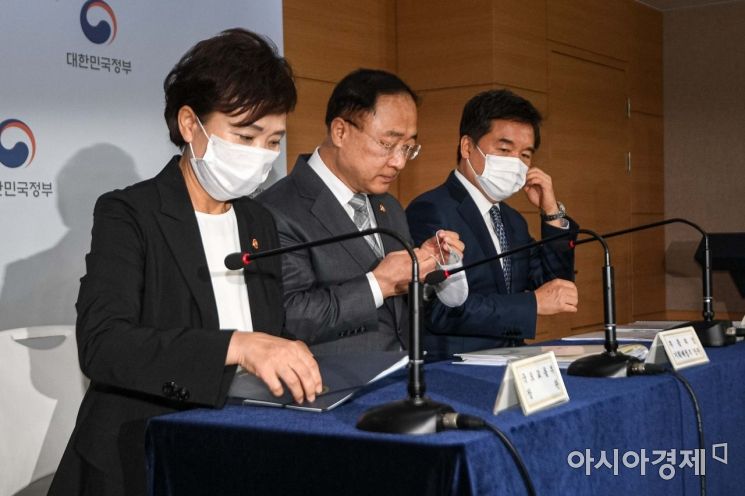 Hong Nam-ki (center), Deputy Prime Minister and Minister of Economy and Finance, Kim Hyun-mi (left), Minister of Land, Infrastructure and Transport, and Seo Jeong-hyeop, Acting Mayor of Seoul, are waiting on the 4th at the Government Seoul Office in Jongno-gu, Seoul, to announce plans to expand housing supply in the Seoul metropolitan area and surrounding regions. Photo by Kang Jin-hyeong aymsdream@
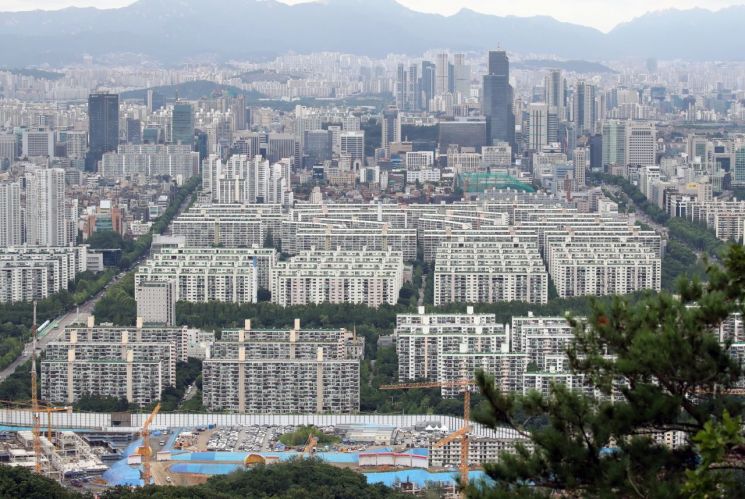
[Asia Economy Reporter Onyu Lim] The Seoul Metropolitan Government, in cooperation with the central government, plans to supply an additional total of 110,000 housing units by 2028. However, as Seoul expressed a negative stance toward one of the government's key measures, the public participation high-density reconstruction, there is a possibility that the supply of 50,000 units could face setbacks.
On the afternoon of the 4th, Seoul announced detailed supply plans regarding the 'Housing Supply Expansion Plan,' jointly released with related agencies such as the Ministry of Economy and Finance and the Ministry of Land, Infrastructure and Transport. Seoul stated it will supply housing through four main measures: ① Activation of public redevelopment (20,000 units), ② Discovery and complex development of idle sites (30,000 units), ③ Promotion of public participation high-density reconstruction projects (50,000 units), and ④ Introduction of equity accumulation type sale housing.
First, Seoul will supply a total of 20,000 additional housing units by 2023 through public redevelopment projects. Public redevelopment is a project led by public institutions such as the Seoul Housing and Communities Corporation (SH Corporation) to promote housing supply within the city center. It receives public support such as increased floor area ratio and expedited permits. Seoul has expanded the scope to include maintenance scheduled zones and maintenance cancellation zones, which were initially excluded.
The project to supply housing for youth and newlyweds by complex development of underutilized idle sites or aging public facilities will also be expanded. Additionally, given the limited available land in the city center, Seoul plans to promote the 'public participation high-density reconstruction' method in consultation with the government to supply housing through reconstruction. Furthermore, a new sales model called equity accumulation type sale housing will be introduced to supply housing to non-homeowners in their 30s and 40s who lack financial resources.
Public Reconstruction Reluctantly Announced... Seoul Says "We Never Originally Supported It"
However, controversy arose as Seoul expressed a negative stance on the third measure, public reconstruction, during the briefing. Public reconstruction is a new type of redevelopment project led jointly by public institutions such as the Korea Land and Housing Corporation (LH) and the Seoul Housing and Communities Corporation (SH). It relaxes the floor area ratio to 300-500%, allowing housing supply to be more than double the existing number of units, and recovers 50-70% of the increased floor area ratio through donation in kind.
Kim Seong-bo, head of the Housing and Architecture Headquarters of Seoul, while announcing public reconstruction as part of the supply plan, clearly conveyed that the announcement was made reluctantly following government policy. Kim said, "Public redevelopment and public reconstruction are not exempt from the price ceiling system, so there are practical doubts about whether the private sector can participate," adding, "Seoul originally did not support this method much."
He explained that while Seoul agrees with strengthening the public nature of reconstruction projects, private sector involvement is not an appropriate measure. Kim added, "Basically, the position is that the public nature of reconstruction should be strengthened through rental housing, but it is unbalanced for the public sector to lead private reconstruction projects due to the nature of the business."
Regarding the government's estimate of 50,000 units, Kim said, "Seoul does not have a separate estimate for the volume the government has set," and also commented on the government's estimation method, "The government ran simulations; Seoul does not know about it." This implies opposition to public reconstruction discussions and limited involvement in the planning process. When asked if any associations have expressed willingness to participate in public reconstruction, he briefly replied, "None."
Is the Government's 50-Story Reconstruction Apartment Plan Off the Table? Seoul Says "50-Story Apartments Without Mixed Use Are Currently Impossible"
Seoul also showed disagreement with the government's relaxation of floor area ratio and height regulations for public reconstruction. The government announced that "when promoting public reconstruction, the floor area ratio can be increased up to 500% and 50-story apartment buildings can be constructed through zoning upgrades." However, Seoul maintains that 50-story apartments are not possible under current regulations.
Lee Jeong-hwa, director of the Seoul Urban Planning Bureau, stated, "The height issue has been finalized within the framework of the 2030 Seoul Basic Urban Plan (Seoul Plan)," emphasizing, "Whether in general residential or semi-residential areas, purely residential apartments can only be built up to 35 stories." However, she explained, "In semi-residential areas, buildings including non-residential uses as mixed-use complexes can be built over 40 stories depending on the hierarchy of the central area."
Kim Seong-bo, head of the Housing and Architecture Headquarters of Seoul, echoed this, saying, "As per Seoul's basic stance, residential areas allow up to 35 stories, and semi-residential areas allow up to 50 stories."
Since Seoul, which holds authority over urban maintenance planning and permits, has firmly stated that "residential apartments are limited to 35 stories," a '50-story reconstruction apartment' appears practically impossible. Consequently, the government's target of 50,000 units is also likely to face difficulties.
© The Asia Business Daily(www.asiae.co.kr). All rights reserved.
![Clutching a Stolen Dior Bag, Saying "I Hate Being Poor but Real"... The Grotesque Con of a "Human Knockoff" [Slate]](https://cwcontent.asiae.co.kr/asiaresize/183/2026021902243444107_1771435474.jpg)

















