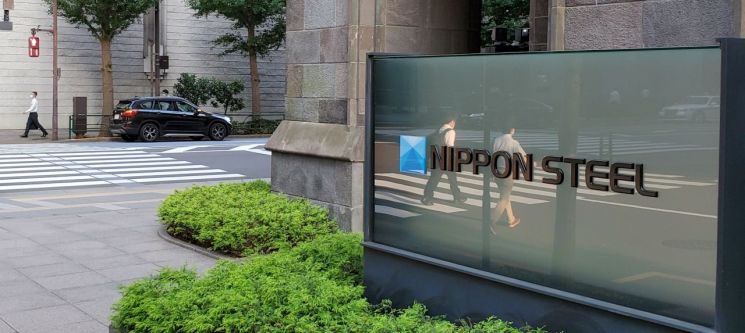
[Asia Economy Reporter Jeong Hyunjin] Nippon Steel (formerly Shin Nippon Steel & Sumitomo Metal), the defendant in the forced labor compensation lawsuit during the Japanese colonial period, has decided to file an immediate appeal regarding the South Korean court's asset seizure order. This is to prevent the effectuation of the court's public notice of the seizure order for assets in South Korea and the confirmation of the order. It is expected to take several months before the actual liquidation of assets occurs.
The Japanese government has stated that it will respond actively if liquidation is carried out, considering measures such as suspension of visa exemption and financial sanctions, while the South Korean government has expressed its intention to respond in kind. As a result, it is anticipated that Korea-Japan relations will remain on a knife-edge for the time being.
According to NHK and other sources on the 4th, Nippon Steel stated, "We understand that the issue surrounding forced labor was 'completely and finally resolved' by the Korea-Japan Claims Agreement, an official agreement between the two countries," and added, "Considering the diplomatic negotiations between the governments of Korea and Japan, we will file an immediate appeal regarding the procedures for future asset disposition."
This stance by Nippon Steel is a measure to prevent the effectuation of the court's public notice of the asset seizure order in South Korea, which took effect as of midnight on the same day. On October 30, 2018, the South Korean Supreme Court ruled in the final appeal trial for damages filed by four forced labor victims against Nippon Steel, ordering compensation of 100 million KRW each. After Nippon Steel showed a refusal to accept the ruling, the plaintiffs applied to the court in December of the same year to seize shares of PNR, a joint venture between Nippon Steel and POSCO, to secure the damage claims.
Accordingly, the Pohang Branch of the Daegu District Court decided in January last year to seize 81,075 shares corresponding to the amount of the damage claims, and the plaintiffs applied for the sale of these assets in May last year. The nominal value of the shares is approximately 400 million KRW.
However, the Japanese government refused to deliver the South Korean court's asset seizure decision to Nippon Steel. Consequently, the Pohang Branch initiated a public notice procedure on June 1, posting the documents on the court bulletin board and official gazette, considering the content delivered, and this procedure took effect from that day.
However, if the defendant files an immediate appeal against the public notice, a legal stay of execution takes effect. Nippon Steel's deadline for the immediate appeal is midnight on the 11th. If the higher court confirms the stock seizure order again, the next steps such as stock appraisal and sale order can proceed. It appears that Nippon Steel intends to buy time by filing an immediate appeal. NHK reported, "As the South Korean government maintains its position of respecting the judiciary's decision, if the court orders asset liquidation and cash conversion occurs, the Japanese government is considering countermeasures, raising concerns about further deterioration of Korea-Japan relations."
Japanese foreign media reported that the Japanese government is considering countermeasures such as financial sanctions. The Asahi Shimbun forecasted that amid stalled Korea-Japan diplomatic negotiations over the forced labor compensation lawsuit, there is a possibility that Nippon Steel's assets in South Korea could be liquidated within the year to compensate the plaintiffs. It also reported, citing Japanese government officials, that the Japanese government is considering financial sanctions as visa exemption suspension and summoning the Japanese ambassador to South Korea alone would not balance the damage suffered by Japanese companies. A Ministry of Foreign Affairs official told Asahi, "We must not set a precedent," and added, "If liquidation occurs, countermeasures will be necessary."
The Nihon Keizai Shimbun predicted that the Japanese government will respond with three types of measures: diplomatic, economic, and international legal actions. Diplomatic measures may include summoning the Japanese ambassador to South Korea and suspending visa exemptions or tightening visa issuance requirements. Economic measures could involve stricter application of the export controls on South Korea that Japan strengthened last year. International legal measures might include filing a case with the International Court of Justice (ICJ) or requesting arbitration from the International Centre for Settlement of Investment Disputes (ICSID) under the World Bank.
The right-leaning Sankei Shimbun predicted, "If the liquidation of Nippon Steel's assets by the South Korean side becomes a reality, the withdrawal of Japanese companies from South Korea is likely to accelerate." Sankei argued that "liquidation is an unjust infringement of private property that unilaterally overturns the intergovernmental Korea-Japan Claims Agreement, clarifying the risks faced by businesses in South Korea," and claimed that in addition to Nippon Steel, about 70 Japanese companies including Mitsubishi Heavy Industries and Fujikoshi could become defendants in forced labor lawsuits in South Korea.
Meanwhile, the day before, the conservative faction within Japan's Liberal Democratic Party, called the "Conservative Unity Association," held a meeting and decided to request the government to impose economic sanctions if the South Korean side liquidates Japanese companies' assets.
© The Asia Business Daily(www.asiae.co.kr). All rights reserved.

















