Controversy Persists After Party-Government-Blue House Reform Plan Announcement
Organization Left Intact, Only Duties and Command Authority Decentralized
Frontline Police Concerned They May Bear Local Government Tasks
Strong Opposition Over Scope of Prosecutors' Direct Investigations
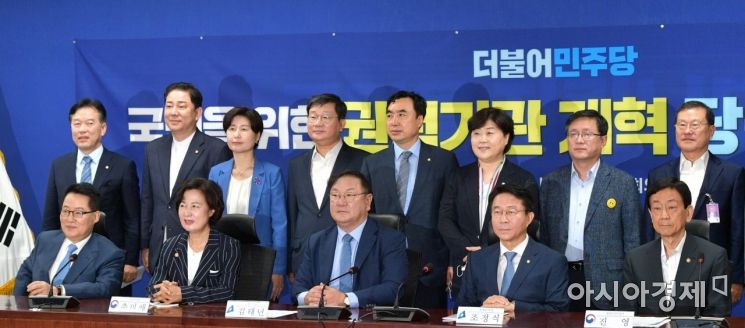 On the 30th, Kim Tae-nyeon, floor leader of the Democratic Party of Korea, Choo Mi-ae, Minister of Justice, Jin Young, Minister of the Interior and Safety, and Park Ji-won, Director of the National Intelligence Service, along with other key attendees, are taking a commemorative photo at the "Power Institution Reform Consultation for the People" held at the National Assembly. Photo by Yoon Dong-joo doso7@
[Asia Economy Reporter Lee Gwanju] Four days have passed since the ruling party, government, and Blue House announced reform measures for power institutions, including the adjustment of investigative authority between the prosecution and police and the introduction of autonomous police, but the aftershocks continue. Within the police force, while frontline officers continue to oppose the revised autonomous police introduction plan, there are also voices criticizing the scope of prosecution investigations.
From Dual System to Unified System... Autonomous Police Regresses
According to the police on the 3rd, the National Police Agency held a briefing session for workplace councils (WCs) related to the autonomous police introduction plan on the 31st of last month. Representatives of workplace councils from police stations nationwide attended the briefing to share their opinions on the autonomous police introduction plan. At this meeting, the National Police Agency reportedly explained to the WCs that "there are no special changes in current duties, and the current national police system will remain, with plans to decentralize after reinforcing personnel once the national budget becomes abundant."
The most significant change regarding autonomous police in the ruling party, government, and Blue House announcement is the shift from the previously promoted dual system model of national and autonomous police to a unified system model. The organization continuing from the National Police Agency to provincial police agencies and police stations remains intact, with only duties and command authority being decentralized. Accordingly, nationwide duties such as public security policy formulation, intelligence, and security will be handled by the existing national police; community-related duties such as traffic, security, and public safety will be handled by the autonomous police; and investigative duties will be managed by the separately established 'National Investigation Headquarters.' Command authorities will be divided among the Commissioner General of the National Police Agency, the city/provincial autonomous police committee, and the head of the National Investigation Headquarters, respectively. However, in practice, there is little difference from the current national police system.
This is because the affiliation or status of police officers does not change, and they continue to work as before. Since the original purpose of introducing autonomous police was to decentralize the increasingly powerful police authority due to investigative authority adjustments and the transfer of counterintelligence investigation authority from the National Intelligence Service, there is inevitable criticism that police reform has taken a step backward.
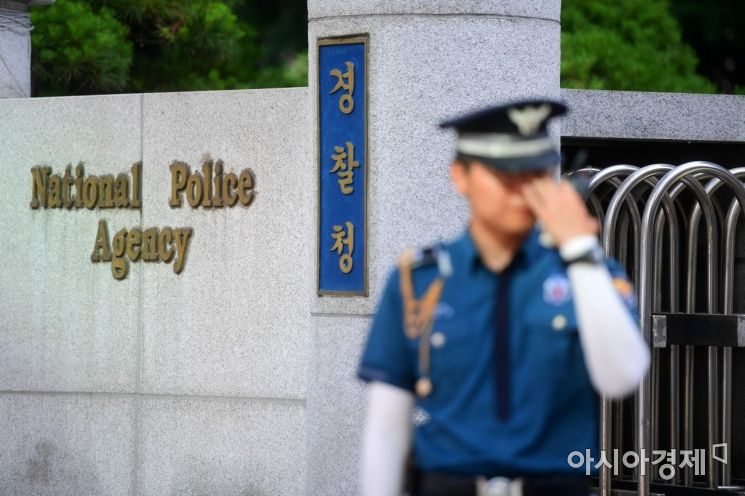
"Local Governments Burdened" Regional Police Oppose
Dissatisfaction within the police is also rising. There is concern that while the organization remains the same, only local government duties will be burdened on the police. On the Facebook page 'Police Human Rights Center,' where current and former police officers are active, voices criticizing the autonomous police introduction plan continue as the National Police Agency's briefing content is shared. One frontline police officer (lieutenant) pointed out, "It is accurate to say that in order to acquire investigative authority, the local police were handed over the community service duties agreed upon by the provincial governors and provincial police chiefs." Other officers agreed, saying, "It's a half-baked autonomous police," and "Only the top leadership increased to three." There were also criticisms that the autonomous police promotion is detached from the police field. One lieutenant sharply stated, "Crimes have become more regionalized, but the police organization with interconnected duties is being torn apart, only increasing the responsibility of frontline staff."
Complaints Over Prosecution Investigations of Drug and Cyber Crimes
Opposition within the police continues regarding the prosecution's direct investigation scope. The core controversy lies in the inclusion of drug crimes and cyber crimes within the prosecution's direct investigation scope. Hwang Sooncheol, investigation advisor (sergeant) at the Seoul Songpa Police Station, wrote on the police internal network that morning, "The purpose of the amendment is to limit the scope of direct investigations by prosecutors to decentralize prosecutorial power and complete prosecution reform," adding, "It is complacent and dangerous to be satisfied with the police being designated as the primary investigative agency and exercising some degree of termination authority while compromising at an appropriate level." He further demanded, "Police officials participating in the Presidential Investigation Authority Reform Follow-up Task Force should raise stronger objections."
© The Asia Business Daily(www.asiae.co.kr). All rights reserved.


















