First Revealed at the 2015 Military Parade with the Latest Tactical Ballistic Missile
Estimated to Possess Over 1,200 Tactical Ballistic Missiles from China's Dongfeng Series
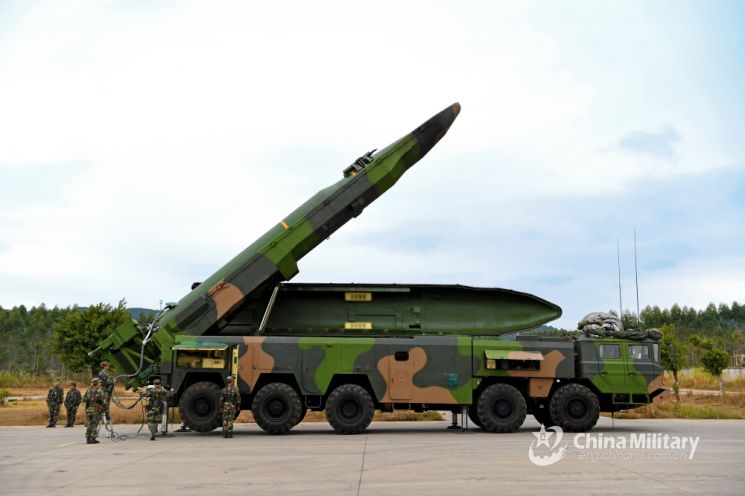 The warhead weight of the Dongfeng-16 reaches 1.5 tons (t), making it the largest among tactical ballistic missiles currently deployed by militaries around the world. Photo by the Chinese Ministry of National Defense
[Military Analyst Kim Daeyoung] The Dongfeng (DF)-16 is the latest tactical ballistic missile developed by China, which made its first public appearance at the military parade held in Beijing on September 3, 2015, commemorating the 70th anniversary of the Chinese People's War of Resistance Against Japanese Aggression and the World Anti-Fascist War Victory.
A tactical ballistic missile generally refers to a ballistic missile with a range of less than 1,000 km, used for tactical purposes. The Rocket Force, which can be considered effectively the fourth branch of the Chinese military, operates a large number of tactical ballistic missiles, unlike the United States and Russia. It is reported that the Chinese Rocket Force possesses approximately 1,200 tactical ballistic missiles, including the Dongfeng-11, -15, and -16. The tactical ballistic missile brigades, which constitute the majority of the force, are composed of six battalions, each equipped with six transporter erector launchers (TELs), each carrying one tactical ballistic missile.
Including reserve missiles, these tactical ballistic missile brigades are said to be capable of launching up to around 140 missiles. Before the development of the Dongfeng-16, two types of ballistic missiles, the Dongfeng-11 and Dongfeng-15, were deployed in large numbers. All these missiles utilize TELs, which provide high mobility and survivability.
China began developing tactical ballistic missiles in the late 1970s, and as a result, started deploying the Dongfeng-11 in 1992. The Dongfeng-11, with a range of 300 km, resembled the Soviet-made Scud B in terms of launcher and missile appearance, but used solid fuel instead of liquid fuel for propulsion. The improved version, Dongfeng-11A (Type A), extended the range to 600 km and reduced the error margin to 20?30 meters by using GPS, the U.S. satellite positioning system.
In the 2000s, as the Dongfeng-11 became outdated, the Chinese military developed a new missile to replace it. The new tactical ballistic missile known as the Dongfeng-16 drastically shortened the launch preparation time from a minimum of 15 minutes and a maximum of 30 minutes, while significantly enhancing accuracy and destructive power. Notably, the warhead weight of the Dongfeng-16 reaches 1.5 tons, making it the largest warhead among tactical ballistic missiles currently in service worldwide.
The Dongfeng-16 is reported to carry high-explosive warheads, cluster munitions, and bunker-buster warheads designed to destroy underground facilities. Additionally, the Dongfeng-17, known for carrying a hypersonic glide vehicle flying at speeds exceeding Mach 5, was developed based on the Dongfeng-16. The Dongfeng-16 has a range of approximately 800 km to 1,000 km and has been deployed since 2011. Concentrated in southern China, the Dongfeng-16 targets areas including Taiwan and some Japanese islands. It is especially known as the "Taipei Express" due to its capability to strike Taipei, Taiwan, with precision in a short time.
© The Asia Business Daily(www.asiae.co.kr). All rights reserved.
![Clutching a Stolen Dior Bag, Saying "I Hate Being Poor but Real"... The Grotesque Con of a "Human Knockoff" [Slate]](https://cwcontent.asiae.co.kr/asiaresize/183/2026021902243444107_1771435474.jpg)
















