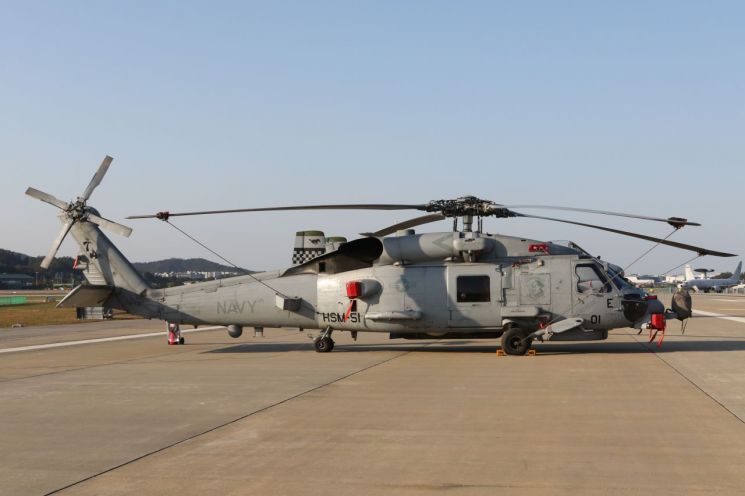
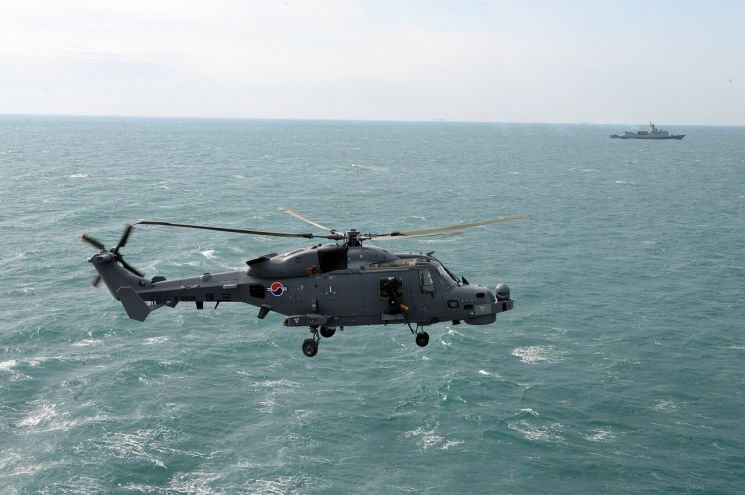
[Monthly Defense Times Editor-in-Chief An Seung-beom] The Navy's second phase of the maritime operational helicopter project, which involves introducing 12 units with a budget of 1 trillion KRW to enhance operational capabilities, was decided in March 2019 by the Defense Acquisition Program Administration’s Defense Project Promotion Committee to be procured overseas through a competitive bidding process.
A project briefing was held in May 2019, and in August, Lockheed Martin Sikorsky, the manufacturer of the MH-60R helicopter, and Leonardo, the manufacturer of the AW-159 which the Navy procured 8 units from in the first phase, submitted their proposals.
Leonardo submitted its proposal for the AW-159 through a commercial sales method, while Lockheed Martin Sikorsky participated in the competition using the U.S. government sales method, FMS. Price and technical negotiations proceeded until May 2020, and local testing and evaluation were planned thereafter but were delayed due to the COVID-19 pandemic. Document evaluation was conducted first in June, and in mid-month, the MH-60R helicopter from Lockheed Martin Sikorsky underwent test evaluation in San Diego, USA. According to regulations, the test evaluation in the U.S. was conducted immediately after Korean test pilots completed three days of survival training.
Leonardo’s AW-159 local test evaluation is scheduled until mid-August. The UK test evaluation will also be conducted after the pilots undergo survival training at the Yeovil Naval Air Squadron base. Meanwhile, during the suspension period of the June test evaluation, it was emphasized that there was no price gap between the competing models, suggesting that a new model might have an advantage.
However, the actual evaluation is calculated with 30% weight on price, 35% on performance, 25% on operational suitability, and 10% on other conditions. The AW-159 side proposes offset trade, renamed industrial cooperation, and assembly production through domestic companies, while the MH-60R side emphasizes the U.S. government guarantee method.
The companies participating in this second phase of the maritime operational helicopter project view it as a golden opportunity to secure the volume of 24 units planned for the third phase of the maritime operational helicopter project and are actively engaging in negotiations.
The third phase of the maritime operational helicopter project was initially planned to be pursued over time, but in December 2019, the existing Super Lynx Mk.99A upgrade project was canceled, shifting to rapid procurement.
Currently, the Naval Aviation Unit operates 23 units combining Lynx helicopters introduced in 1990 and Super Lynx helicopters introduced in 2000, and has deployed 8 AW-159 units procured in the first phase of the maritime operational helicopter project in 2016. The second phase project is proceeding to replace the aging Lynx helicopters introduced in 1990, which are facing difficulties in follow-up logistics support. The Lynx helicopters are scheduled to be phased out starting in 2026.
Meanwhile, the acquisition method for the third phase of the maritime operational helicopter project?whether to proceed with overseas procurement or domestic development?has not yet been decided and is expected to surface prominently through ongoing studies.
© The Asia Business Daily(www.asiae.co.kr). All rights reserved.
![Clutching a Stolen Dior Bag, Saying "I Hate Being Poor but Real"... The Grotesque Con of a "Human Knockoff" [Slate]](https://cwcontent.asiae.co.kr/asiaresize/183/2026021902243444107_1771435474.jpg)












