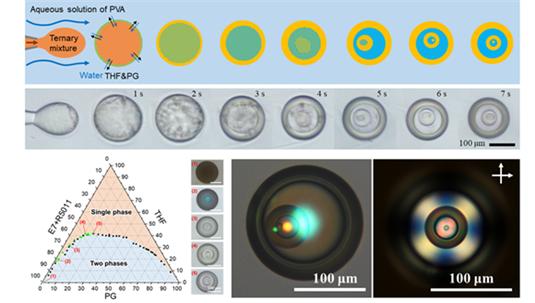
 Liquid crystal particles with multiple layers formed through a phase separation process developed by the KIST-KAIST joint research team
[Asia Economy Reporter Junho Hwang] Domestic researchers have developed a technology to create liquid crystal particles with multiple layers by utilizing the principle that water and oil do not mix. This technology allows for easy construction of multilayer liquid crystal particles. These liquid crystal particles can impart unique optical properties to each layer, and are expected to be used as anti-counterfeiting technology that can replace color-changing inks used in banknotes and identification cards.
The research team led by Dr. Lee Sang-seok at the Functional Composite Materials Research Center of the Jeonbuk Branch of the Korea Institute of Science and Technology (KIST), in collaboration with the research team of Professor Kim Shin-hyun from the Department of Bio and Chemical Engineering at the Korea Advanced Institute of Science and Technology (KAIST), announced on the 30th that they have developed a technology to easily create liquid crystal particles with multiple layers repeating at the thickness of a human hair, which was introduced in the international academic journal Advanced Materials.
The research team added a co-solvent that dissolves simultaneously in both oil and water to uniformly mix three components: an oil-friendly liquid crystal material and an organic alcohol moisturizer that is water-friendly.
They then emulsified the mixture in water to form fine droplets. At this time, the co-solvent, moisturizer, and water molecules, which mix with each other, exchange through the interface of the fine droplets, causing compositional changes that separate the oil-friendly layers and water-friendly layers. The research team confirmed that the number of layers ranged from 1 to 5 depending on the ratio of the mixture. Furthermore, as the separation phenomenon continuously progressed within the droplets, the concentration of additives in the liquid crystal material changed in each layer, demonstrating that various structural colors could be expressed. This means that multilayer liquid crystal particles can be realized solely through the emulsification process.
Dr. Lee Sang-seok of KIST stated, "This achievement allows for the creation of multilayer liquid crystal particles by a very simple method, which can be utilized like functional inks that impart unique optical properties to materials," and added, "Based on this, we plan to devote ourselves to developing various functional particles for the complexification of materials."
© The Asia Business Daily(www.asiae.co.kr). All rights reserved.
![User Who Sold Erroneously Deposited Bitcoins to Repay Debt and Fund Entertainment... What Did the Supreme Court Decide in 2021? [Legal Issue Check]](https://cwcontent.asiae.co.kr/asiaresize/183/2026020910431234020_1770601391.png)