Space Launch Vehicle Regulations Lifted
Expansion of Private Sector in Space Development Projects
Various Companies Including Hanwha and KAI Benefit
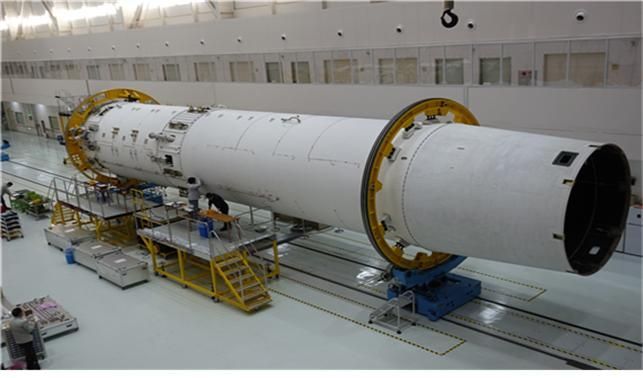
[Asia Economy Reporter Junho Hwang] On the 28th, following the revision of the South Korea-US missile guidelines, a new chapter opened in the history of South Korea's private space development companies. With the allowance to use solid fuel in space launch vehicles that send satellites into space, an expansion of the private sector is anticipated. Hanwha Group's affiliates, which possess technological capabilities in solid fuel and engine manufacturing, along with various companies, have emerged as beneficiary companies.
Hanwha and Various Companies Expected to Benefit
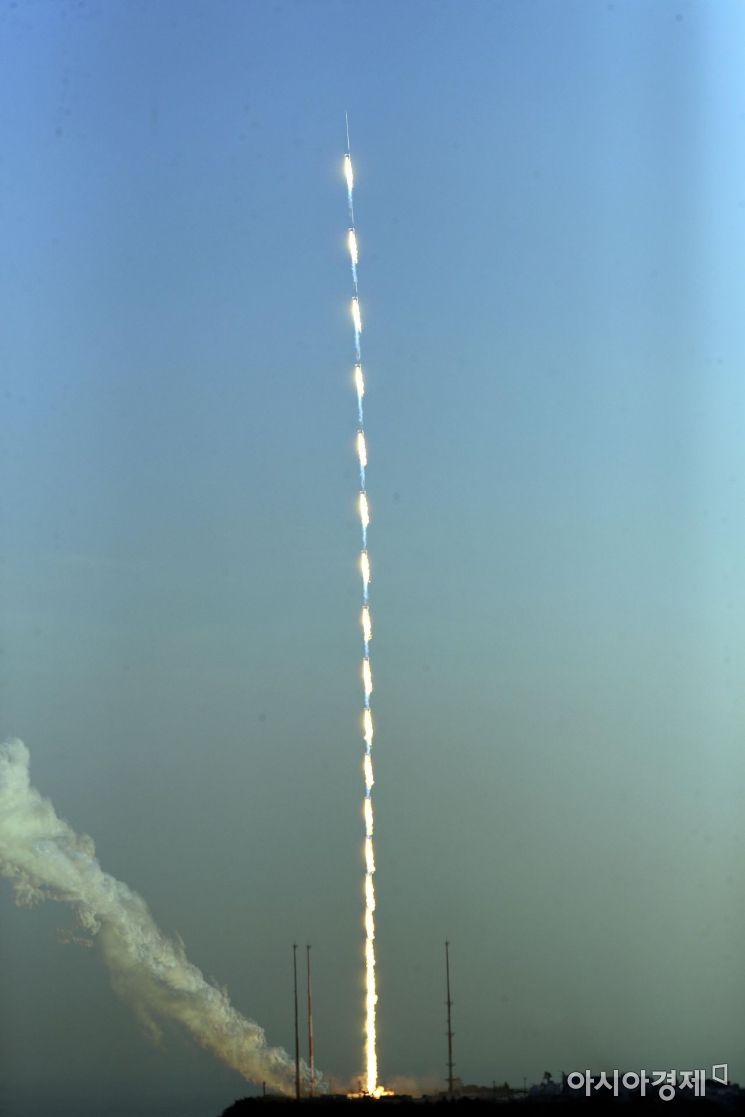 On the afternoon of the 28th, at the launch pad of Naro Space Center in Bongrae-myeon, Goheung-gun, Jeollanam-do, the test launch vehicle of the Korean launch vehicle Nuriho's engine is soaring into the sky, emitting white smoke. This engine test launch vehicle is designed to verify the performance of the 75-ton liquid engine used in the Korean launch vehicle 'Nuriho' and corresponds to the second stage of Nuriho, which consists of a total of three stages. The test launch vehicle is 25.8 meters long, has a maximum diameter of 2.6 meters, and weighs 52.1 tons. / Goheung = Photo by Joint Press Corps
According to the aerospace industry on the 29th, the guideline revision is expected to benefit companies participating in the development project of the Korean space launch vehicle Nuri, scheduled for launch next year.
Hanwha Co., Ltd., leading the domestic explosives industry, is considered the only domestic company with technological expertise in solid fuel used in missiles and rockets. In particular, Hanwha developed the 'pyro igniter' for Nuri. Among various ignition methods, Nuri uses an ignition method that lights the engine through explosives, and the explosives used in this igniter itself are solid fuel, according to industry explanations.
Hanwha Aerospace, Hanwha Group's aircraft engine manufacturer, is also expected to have the path opened for solid fuel engine development due to this guideline revision. This company is responsible for manufacturing Nuri's engines, and if a national plan for solid fuel utilization emerges in the future, it is highly likely to be in charge of engine development accordingly.
In the case of KAI, which is producing the system integration and first-stage fuel tank of Nuri, benefits from this guideline revision are expected. The Nuri project aims to place a 1.5-ton class practical satellite into low Earth orbit (600~800km), and KAI is responsible for the core task of total launch vehicle assembly in this project.
Additionally, Doowon Heavy Industries, which developed the second and third-stage fuel tanks of Nuri, and Hanyang ENG, a software developer, can be considered beneficiary companies. Satellite developer Satrec Initiative is also expected to have opportunities to develop heavy multi-purpose practical satellites. Utilizing solid fuel will enable sending heavier satellites into space compared to the current payload capacity of Nuri's satellites (1.5 tons).
Nuri Uses Liquid Fuel, Future Launch Vehicle Business Expected
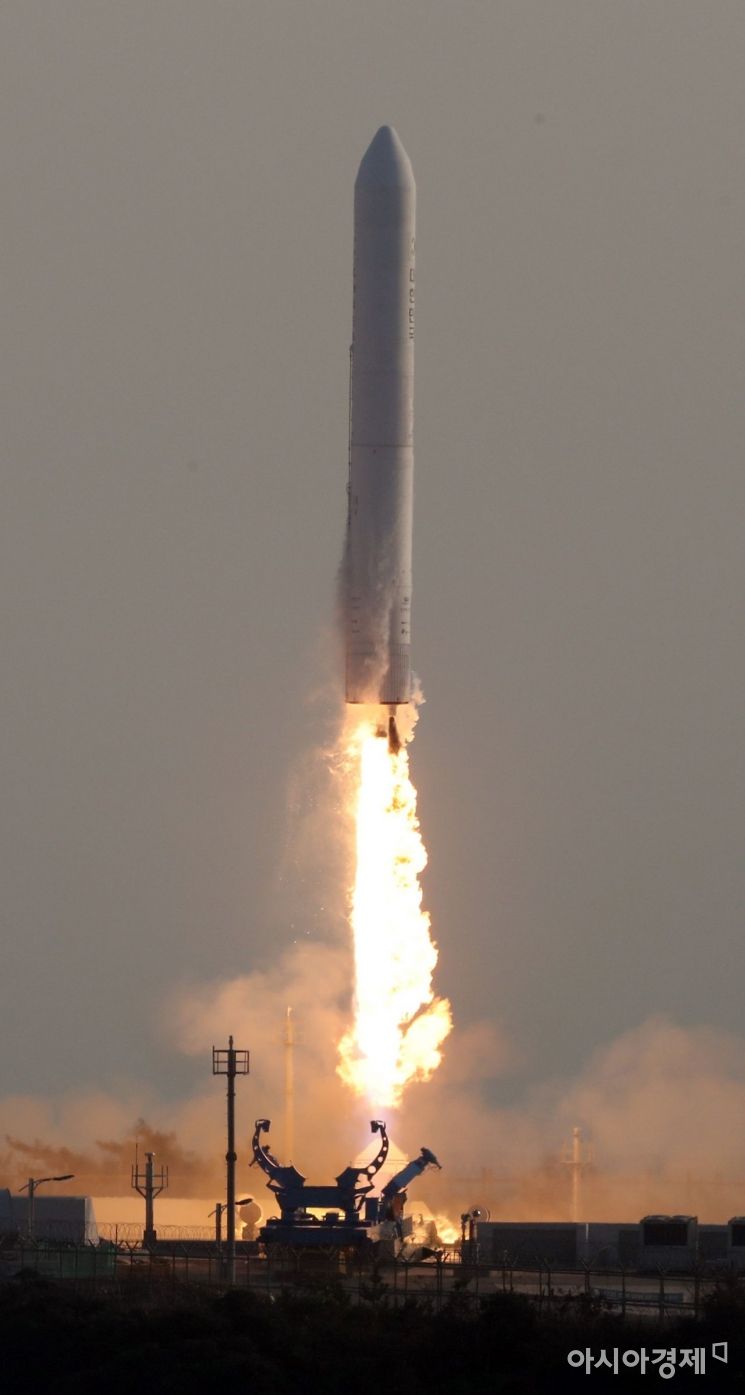 On the afternoon of the 28th, at the launch pad of Naro Space Center in Bongrae-myeon, Goheung-gun, Jeollanam-do, a test launch vehicle of the Korean launch vehicle Nuriho's engine emitted white smoke and soared into the sky. This engine test launch vehicle is designed to verify the performance of the 75-ton liquid engine used in the Korean launch vehicle 'Nuriho' and corresponds to the second stage of Nuriho, which consists of a total of three stages. The test launch vehicle is 25.8 meters long, has a maximum diameter of 2.6 meters, and weighs 52.1 tons. / Goheung = Photo by Joint Press Corps
An industry official said, "Although solid fuel space launch vehicle development has been intermittently carried out with KSR-1 (1993), KSR-2 (1998), and Naroho second stage (2013), it cannot be said that there is no technological capability related to solid fuel," adding, "Since launch vehicles using solid fuel cost about one-tenth of those using liquid fuel, private companies' entry into the launch vehicle business, like SpaceX in the US, can be expected."
Currently, Nuri, the only domestic launch vehicle, was developed with a liquid fuel-based engine. However, with this guideline revision, there is a possibility of developing new solid fuel auxiliary boosters or new launch vehicle development projects using solid fuel.
The Korea Aerospace Research Institute stated, "Only the guidelines have been revised; currently, there are no plans to use solid fuel in Nuri or to develop launch vehicles using solid fuel in the future."
© The Asia Business Daily(www.asiae.co.kr). All rights reserved.
![Clutching a Stolen Dior Bag, Saying "I Hate Being Poor but Real"... The Grotesque Con of a "Human Knockoff" [Slate]](https://cwcontent.asiae.co.kr/asiaresize/183/2026021902243444107_1771435474.jpg)


















