Trump's Post-Inauguration Decline Recovery Uncertain
Contrasting with China's Rise Under Xi Jinping
Similar Humiliation as Russia's Approval Ratings
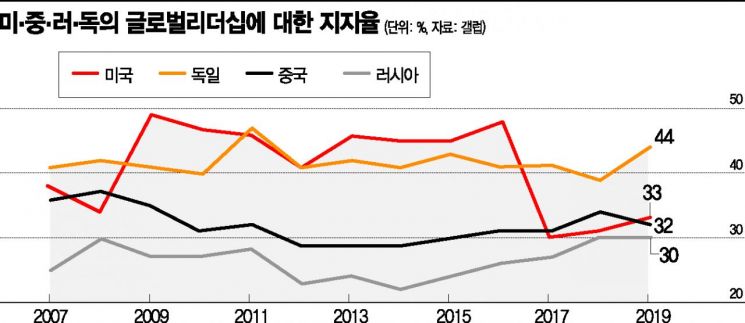
[Asia Economy New York=Correspondent Baek Jong-min] Since the inauguration of President Donald Trump, the approval rating of the United States' global leadership has hovered around the low 30% range for three consecutive years, marking an all-time low. In contrast, the global leadership approval rating of Chinese President Xi Jinping, whom President Trump has been attacking daily, rose to 32%. As the US-China conflict escalates to a new Cold War level, with the US emphasizing that countries worldwide should side with it, this is interpreted as a result of a fundamental lack of trust.
According to a perception survey on global leadership of the US, China, Germany, and Russia conducted by Gallup on the 27th (local time), targeting 1,000 people each from 135 countries worldwide from March last year to February this year, only 33% responded that they support the US's global leadership.
This is a slight increase compared to 30% in 2017, the first year of President Trump's inauguration, and 31% in 2018, but it still indicates a lack of international trust in the Trump administration. The approval rating in 2016, the last year of former President Barack Obama's term, was 48%, the highest among the four countries surveyed. It is even 20 percentage points lower than during former President George W. Bush's era, when the US image was damaged due to the Iraq War.
Dissatisfaction with President Trump was high in Europe and Asia, including the Middle East. Europe's approval rating, which has continuously clashed over trade and security since his inauguration, was the lowest at 24%. Considering that President Trump announced the reduction of US troops in Germany after this survey, public opinion is presumed to have worsened further.
The approval rating in Asia was 32%. Gallup cited the US-China clash, conflicts with Iran, and the withdrawal of US troops stationed in Iraq and Afghanistan as causes. However, in South Korea, the approval rating was somewhat higher than the regional average at 41%, but the response of 'do not support' was higher at 47%. In South Korea, the approval rating was around 40% throughout President Trump's term, with 39% in 2017 and 44% in 2018.
On the other hand, China's trustworthiness has been steadily rising. This year's approval rating was 32%, down 1 percentage point from a year ago but higher than the 29% recorded in 2013 when President Xi took office. This means China is competing for leadership at a level comparable to the US. Despite President Trump and US officials recently belittling President Xi as the General Secretary of the Communist Party, trust in China is not easily declining contrary to US intentions. Russia also showed no significant difference with 30%.
In this survey, Germany maintained the top spot with 44%. Germany has been ranked first for three consecutive years. Gallup described that while the US, China, and Russia compete for second place, Germany is gaining unparalleled trust.
Mohamed Yunis, Gallup's editor-in-chief, also stated, "For three years, the US has received historically low evaluations even from some of its closest allies." The Washington Post expressed concern, saying, "As US leadership collapses, China has gained an advantage in competition with the US, and even Russia has achieved a level of trust comparable to the US."
The US's trustworthiness is expected to decline further. This survey included the peak period of the novel coronavirus infection (COVID-19) situation in China but did not reflect the US's COVID-19 situation. Gallup also predicted that the image of US leadership could be seriously affected by the failure to control infection rates. This serves as a warning that in next year's survey, approval ratings for the US and China could be reversed.
© The Asia Business Daily(www.asiae.co.kr). All rights reserved.
![User Who Sold Erroneously Deposited Bitcoins to Repay Debt and Fund Entertainment... What Did the Supreme Court Decide in 2021? [Legal Issue Check]](https://cwcontent.asiae.co.kr/asiaresize/183/2026020910431234020_1770601391.png)