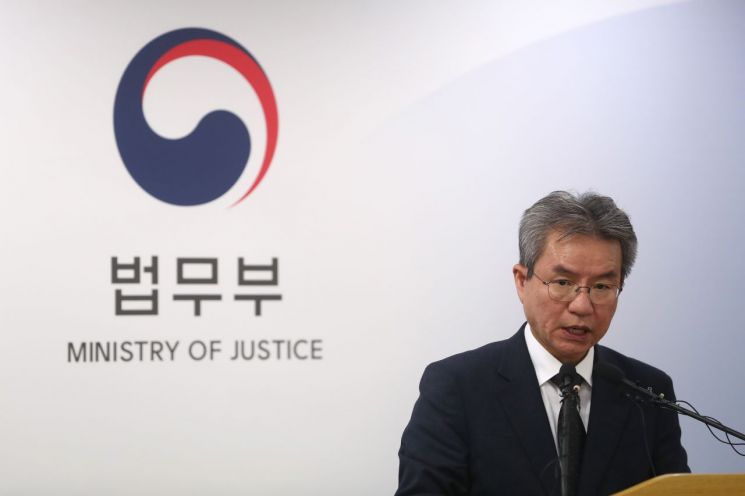
[Asia Economy Reporter Kim Hyung-min] The Ministry of Justice's Legal and Prosecutorial Reform Committee is set to release a recommendation on the 27th that significantly reduces the powers of the Prosecutor General. If this proposal is actively pursued, resistance from the current Prosecutor General Yoon Seok-yeol and the prosecution organization is expected, likely intensifying the tension between the Ministry of Justice and the prosecution.
The Reform Committee announced that it will hold a meeting at the Ministry of Justice Government Gwacheon Complex in the afternoon to review and approve the 21st recommendation, which includes reducing the powers of the Prosecutor General. The agenda items disclosed by the committee include ▲dispersing the Prosecutor General's specific investigative command authority ▲improving the procedure for the Prosecutor General to express opinions on prosecutor personnel appointments ▲diversifying the appointment process of the Prosecutor General. The recommendation announcement was scheduled for 4 p.m. that day.
The proposal to improve the Prosecutor General's investigative command authority appears to involve distributing the General's powers to frontline high prosecutors and district prosecutors. This stems from the concern that the current situation, where the General intervenes and commands frontline investigations, has led to abuse of power. Prosecutor General Yoon has recently been closely directing investigations into allegations involving government interference, personally receiving detailed reports to maintain importance and neutrality. The Reform Committee is reportedly considering improvements in this area.
Additionally, the committee is gathering opinions on transparently improving the procedure by which the Prosecutor General can submit statements of opinion to the Ministry of Justice regarding prosecutor personnel appointments. There was controversy over how much Prosecutor General Yoon's opinions were reflected and the specific procedures during the first personnel appointment conducted after Minister Choo Mi-ae's appointment, as these details were not disclosed. The Reform Committee believes this process should be conducted according to procedure and be transparently disclosed to the public.
Furthermore, it is expected that a proposal will be discussed to allow individuals who are not currently prosecutors to be appointed as Prosecutor General. Article 27 of the current Prosecutors' Office Act stipulates that the qualifications for appointment as Prosecutor General include judges, prosecutors, or lawyers, but in practice, Prosecutor Generals have mostly been appointed from among prosecutors.
The Reform Committee is known to have initiated the discussion of this recommendation on the 27th, viewing the concentration of powers in the Prosecutor General as a factor in the recent conflicts between Minister Choo Mi-ae and Prosecutor General Yoon over various issues. Although the prosecution has been granted independent investigative command authority, there is a recognition that there are no effective checks or that such mechanisms do not function properly. The preparation of this recommendation is also seen as reflecting Minister Choo's intentions.
In May, after Minister Choo posted on her SNS about the need to consider the hard work of criminal division prosecutors, the Reform Committee promptly issued a recommendation to "favor prosecutors from the criminal and trial divisions" in personnel appointments. On the 2nd, the committee also recommended suspending the convening of the Special Investigation Advisory Panel at the Supreme Prosecutors' Office regarding the 'media-prosecution collusion' case, which also aligned with Minister Choo's intentions.
© The Asia Business Daily(www.asiae.co.kr). All rights reserved.

















