Consumers Directly Choose Designers and Service Methods
Lowering Startup Risks and Enhancing Individual Services
Igniting the Spark for Improving the Beauty Ecosystem
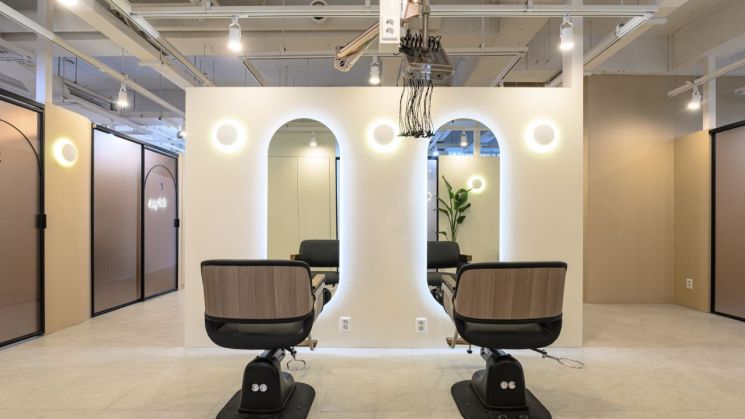 Recently, shared hair salons based on the spread of untact culture and the sharing economy system are gradually increasing. Photo by ShareSpot
[Asia Economy Reporter Kim Heeyoon] #Office worker Kim Siyeon (alias, 33) recently had her hair styled by a hairdresser recommended by artificial intelligence (AI) for the first time. She entered her desired hairstyle and available times on a shared salon’s reservation site and chose one of three recommended designers. Usually visiting a suitable salon near her workplace for each haircut, Kim said, “Trying a shared salon and entrusting my hair to a recommended designer was a fresh and good experience.”
Riding the wave of the sharing economy trend brought about by the COVID-19 pandemic, shared salons are becoming a new trend in the beauty industry.
According to the industry on the 26th, shared salons based on the spreading contactless culture and sharing economy system are gradually increasing.
The beauty industry, once dominated by a few franchise brands, has continuously faced issues of low wages and heavy labor for designers. Shared salons, which align with the new trend of the sharing economy and the contactless culture expanded by COVID-19, have now become a movement with more than 10 brands.
Seven Avenue, which introduced Korea’s first shared salon, operates four branches in Gangnam, Hapjeong, Seongnam, and Bucheon. Directors who have completed basic training pay about 2 million won as a deposit to rent space, and by using reservation systems, they can manage their work schedules as they wish and earn over 50% of the profits. Especially, the brand functions as a platform providing comprehensive support such as branding, promotion, marketing, and skill improvement education, helping designers increase their earnings.
Future Salon’s Share Spot, launched by startup accelerator FuturePlay, also opened a shared salon in Yeoksam, Seoul. Unlike other shared salons, instead of on-site staff, customers select services via a kiosk. When customers choose their desired hairstyle and services, AI recommends suitable designers. Particularly, customers can opt for styling without conversation or treatment recommendations, minimizing the discomfort of exhausting talks or product suggestions, which has received positive feedback, according to a Future Salon representative.
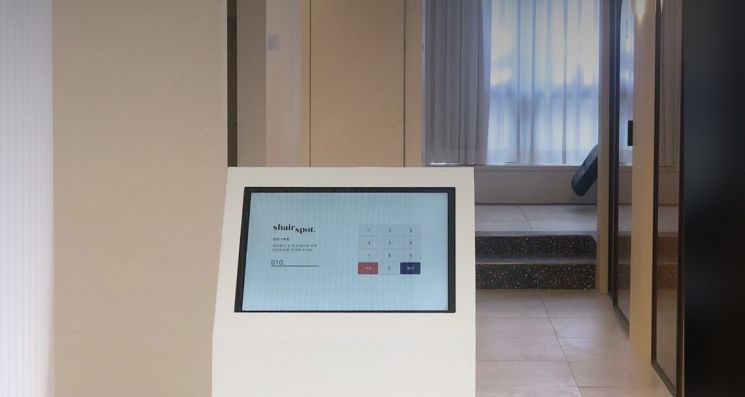 The non-face-to-face unmanned system, which allows reservation and service selection, is also receiving positive responses from consumers in line with the untact culture that has spread due to the impact of COVID-19. Photo by Sharespot
Through online platforms, shared salons allow consumers to directly check designers’ experience and portfolios with photos and videos according to their preferred time and style, confirm prices for each treatment, and even prepay. This prevents the previously opaque treatment process and establishes fixed pricing per service.
Experts explain that the expansion of shared salons will provide consumers with more opportunities for personalized services and offer designers, who suffered from low wages and heavy labor, chances for small-capital entrepreneurship. Song Kihyun, CEO of Future Salon, said, “The service area of shared salons will gradually expand in the future, including extending the shared salon service?providing specialized dedicated designers tailored to customers?into the big data domain through datafication.”
© The Asia Business Daily(www.asiae.co.kr). All rights reserved.


















