Real-time Interactive Experience Classes
Integrated Online and Offline Group Classes
Students Choose Both Subject and Method
Content Presentation Remote Classes
Assignments Uploaded to Google Classroom
Receive Individual Feedback and Supplementary Lessons
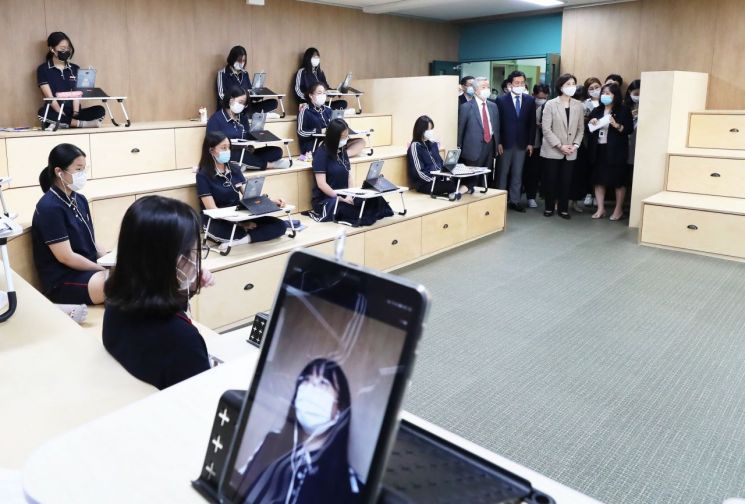 Students at Busan International Foreign Language High School are attending a second foreign language German class. A native instructor from the Goethe-Institut is conducting an interactive remote lesson. (Provided by the Ministry of Education)
#Busan International Foreign Language High School German class. Second-year students are wearing headsets and focusing on the tablet PC screens. Students take turns answering in simple German through the speakers. On the screen, a native German instructor from the Goethe-Institut is conducting an interactive class via 'ZOOM.' With German classes held four times a week, students can learn German conversation directly from a native speaker at school without taking private lessons.
#At the same time, first-year students are in a science elective class. They are learning the unit 'Architecture and Science,' and one student is presenting alone. Next door, there is a lab where students cut architectural models using 3D printing. Teams of three to four students work together, assisted by only one teacher. The student who was presenting earlier is looking at a monitor and presenting the prepared content to someone. Due to the impact of COVID-19, the original class of 27 students was split into two. Half of the students continue with the 3D printing practice after their presentations, while the other half attend the class upstairs, listening to their classmates' presentations with the teacher.
[Asia Economy Reporter Lee Hyun-joo] The education field, which seemed absolutely unchanging and unwilling to change, is transforming into a site of innovation due to the impact of COVID-19. Students who used to attend the same class at the same time and place are now divided and participating in various forms of classes. Reviewing recorded lessons that transcend time and space has become standard.
The introduction of blended learning, which was once thought to be a distant future, has been significantly accelerated by COVID-19. Initially a passive response to an unavoidable situation, a natural environment where online and offline education are integrated has been established through a semester of classes. It has moved beyond simply transferring offline education to an online setting and entered a stage preparing for future education that enables self-directed learning.
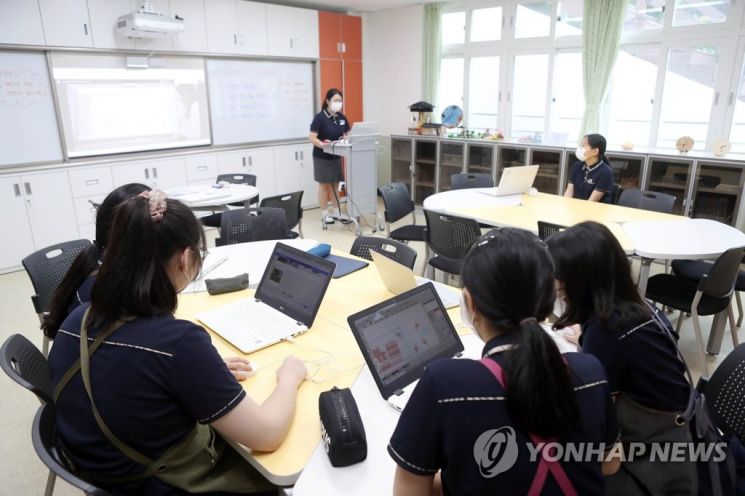
Neungju High School in Hwasun County, Jeollanam-do. At this school, 'real-time interactive' and 'content delivery' classes were conducted in roughly equal proportions. Teacher Jeong Seon-ho said, "When students decide everything from subject selection to class methods, they feel more responsible and participate more actively," adding, "Seeing their opinions directly reflected in the school makes them feel that student autonomy is being realized." He emphasized, "Now is the time for schools to change and strive to be chosen by students."
Commonality is 'Self-Directed' Learning
Increased Student Responsibility and Efficiency
Positive Outlook on 2025 High School Credit System Introduction
Not all schools pursued only interactive classes during the COVID-19 situation. Each school conducted classes in ways suited to their environment. However, regardless of the method, active teacher adaptation, student-led participation, and proactive support from education offices were common elements. Galmae High School in Guri City, Gyeonggi Province, focuses on project activities. Therefore, they mainly conduct remote classes in a content delivery format rather than real-time interaction. When students complete assignments and upload them to 'Google Classroom,' individual feedback follows. As assignments accumulate, teachers can easily identify which supplementary lessons are needed. Galmae High School is also considering using remote learning methods when the high school credit system is introduced. If students fail to earn credits, they can take supplementary classes online. Teacher Park Si-young said, "Supplementary classes after school tend to have low participation, but online classes are advantageous in overcoming this drawback," adding, "We can check students' assignment completion during breaks or lunch and provide feedback on repeatedly missed problems."
Junggyeong High School in Yongsan District, Seoul, conducts about 70% of all subjects through interactive online classes. Initially, there was confusion due to varying digital device skills among teachers. To resolve this, Junggyeong High School held small-group teacher training sessions. Research Director Choi Seung-gyu said, "Based on remote class experience, we can actively utilize it for the high school credit system and shared campus." As Director Choi mentioned, experience with remote classes after COVID-19 is advantageous for preparing for the high school credit system. The Ministry of Education plans to fully implement the high school credit system in 2025, allowing students to select various subjects according to their aptitudes and career paths, and graduate once accumulated credits meet the criteria. Incorporating remote classes into the credit system enables students to take classes at schools other than their own without physically transferring, by utilizing remote classes offered by those schools.
A similar approach can also aid the establishment of shared campuses. Shared campuses are systems that regionalize nearby schools to jointly operate curricula and programs. A Ministry of Education official said, "We will ensure the high school credit system is established through the 2022 curriculum reform," adding, "We will also spare no effort in supporting capacity building related to remote classes."
© The Asia Business Daily(www.asiae.co.kr). All rights reserved.


















