Q1 Startup Traffic Light at 'Risk' Stage
Seoul Store 3-Year Survival Rate at 50.9%
[Asia Economy Reporter Seulgina Jo] Once hailed as a popular startup course for a 'second act in life,' mobile phone stores are quietly disappearing. Just three years ago, there were nearly 30,000 stores nationwide, but that number is now estimated to have been cut in half. This is due to the saturation of the mobile telecommunications market, the establishment of new distribution cultures such as online sales, and the direct impact of the COVID-19 pandemic.
The Korea Mobile Telecommunications Distribution Association, representing domestic mobile phone sales and dealerships, recently assessed the distribution network crisis caused by COVID-19 as severe and is currently tracking closure statuses. An industry insider said on the 23rd, "The number of sales and dealership locations is estimated to be less than 15,000," adding, "The number sharply declined immediately after the enforcement of the Act on the Improvement of Mobile Device Distribution Structure (Device Distribution Act), and since 2017, closures have increased due to rising commission burdens." The workforce, which once numbered around 200,000, is estimated to have shrunk to a quarter.
◆Half of Mobile Phone Stores Closed Within 3 Years
Mobile phone stores were once considered a startup course for retirees alongside convenience stores and chicken restaurants. This was because mobile phones, the main product, are essential goods and have a shorter replacement cycle compared to other home appliances, making them profitable. However, the situation rapidly changed as it became possible to purchase devices separately online and subsidy competition weakened due to the Device Distribution Act, causing mobile phone stores to rank among the industries with the highest closure rates.
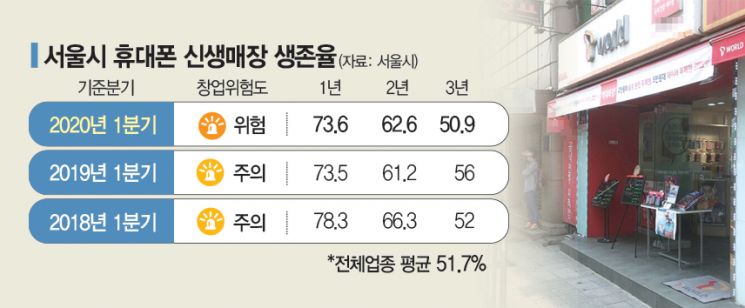
According to the Seoul City Commercial Area Analysis Service, the 'Startup Traffic Light,' which indicates the survival probability of the mobile phone sales sector, dropped from the 'Caution (Yellow)' stage to the 'Danger (Orange)' stage in the first quarter of this year. The three-year survival rate of mobile phone stores in Seoul slipped from 56% in the first quarter of last year to 50.9% in the first quarter of this year, approaching the 40% range. This means that one out of every two stores cannot survive even three years. This rate is even lower than the average across all industries. In previous surveys, mobile phone stores ranked second among industries with the highest closure rates as of 2013.
The situation has become more severe this year as the economy froze due to COVID-19 and face-to-face sales virtually ceased. Kim, a 60-year-old store owner who opened stores in the metropolitan area three years ago with retirement funds but has since closed some, sighed, "Young generations these days buy online," adding, "I tried various events, even at the risk of losses, but it was hard to sell even one unit a day." Given this situation, existing stores are abandoning offline operations and turning to online sales. Another store owner lamented, "Offline stores are deserted, and the internet is a battlefield," expressing frustration with the reality.
◆Concerns Grow Over Rapid Untact Transition
The full-scale shift to untact (contactless) services triggered by COVID-19 is another warning sign for the mobile phone distribution network. Recently, Coupang secured dealership codes from KT and LG Uplus, signaling its intention to offer online activation services. In response, the Korea Mobile Telecommunications Distribution Association, feeling threatened for survival, protested, calling it "an act that kills small businesses in local neighborhoods." Unmanned stores promoted by SK Telecom and LG Uplus are also moves aligned with the 'Digital New Deal' era, but since they are directly linked to job creation, nationwide adoption is expected to be difficult.
However, consumers seem to welcome such innovations. With the sales process streamlined, future price reductions on devices are also anticipated. The unmanned store SK Telecom plans to open near Hongik University in September will allow customers to handle basic paperwork, activation, and device pickup through kiosks and customized vending machines. LG Uplus is also preparing to open untact stores within the year. KT has started offering a '1-minute order & 1-hour delivery' service online from this month.
© The Asia Business Daily(www.asiae.co.kr). All rights reserved.
![Clutching a Stolen Dior Bag, Saying "I Hate Being Poor but Real"... The Grotesque Con of a "Human Knockoff" [Slate]](https://cwcontent.asiae.co.kr/asiaresize/183/2026021902243444107_1771435474.jpg)











