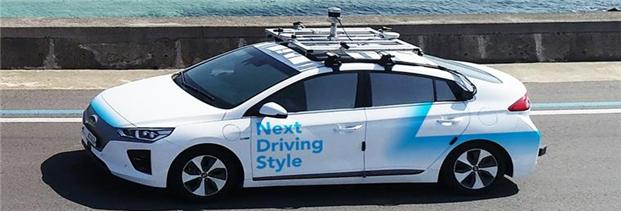
 Autonomous Driving Demonstration Vehicle (Provided by Ministry of Land, Infrastructure and Transport)
[Asia Economy Reporter Lee Chun-hee] Jeju Island is becoming a mecca for autonomous vehicles. Through vehicle-to-vehicle and vehicle-to-infrastructure communication (Next-Generation Intelligent Transportation System, C-ITS), which can be applied not only to autonomous vehicles but also to general vehicles, the entire Jeju Island will be transformed into a zone where autonomous driving services are available.
The Ministry of Land, Infrastructure and Transport and Jeju Special Self-Governing Province held a demonstration event on the 22nd showcasing autonomous cooperative driving that provides traffic safety information to autonomous vehicles via C-ITS.
During the event held on a 5 km round-trip section between Jeju Airport and the rental car parking lot, an autonomous vehicle (Hyundai Ioniq Electric) demonstrated safe control by receiving traffic signal information from traffic lights using communication infrastructure, driving at a maximum speed of 80 km/h. This system is explained to respond to situations where it is difficult for sensors to recognize traffic lights due to bad weather, sun glare, or obstruction by large vehicles ahead, and to control speed in advance by recognizing the remaining time of the traffic light ahead.
RideFlux, an autonomous driving startup that participated in the demonstration, plans to enhance autonomous driving functions through traffic signals and safety information provided by C-ITS and expand autonomous driving verification throughout Jeju Island. Park Jung-hee, CEO of RideFlux, said, "By utilizing traffic signal information provided through C-ITS, it has become possible to respond to various unexpected situations," adding, "It is expected that the usability of C-ITS traffic safety services will be high in the process of expanding autonomous driving services across Jeju Island."
The ongoing Jeju C-ITS demonstration project has provided traffic safety information not only on traffic signals but also on unexpected situations such as illegal parking, wrong-way driving, and jaywalking to 2,000 general rental cars without autonomous driving functions in Jeju Island. According to a survey conducted on actual users, 83.1% of drivers were able to drive safely by decelerating, stopping, or changing lanes based on the traffic safety information they received.
The Jeju demonstration project management team, composed of the Korea Intelligent Transportation Systems Association and the Korea Research Institute for Human Settlements, expects an actual reduction in traffic accidents and plans to analyze real data and announce the effects of traffic safety improvement through C-ITS by the end of this year.
Eom Myung-so, Director of Comprehensive Transportation Policy at the Ministry of Land, Infrastructure and Transport, said, "C-ITS is a core area of the Korean New Deal," adding, "The Ministry of Land will begin nationwide construction of C-ITS to enhance traffic safety and will open C-ITS traffic safety information free of charge to private companies to continuously support autonomous driving technology development."
No Hee-seop, Director of Future Strategy at Jeju Province, also said, "As a pilot city for electric vehicles and with the introduction of leading autonomous driving pilot services, we aim to create a low-carbon Jeju as a testbed. This autonomous cooperative driving demonstration event is in line with that trajectory and is expected to help operate private-led electric vehicle autonomous driving services."
© The Asia Business Daily(www.asiae.co.kr). All rights reserved.

















