Elderly Population Exceeds 7%... Growth in Senior-Related Industries Such as Silver Towns
[Asia Economy Kuala Lumpur Hong Seong-ah, Guest Reporter] Malaysia is considering raising the retirement age to 65 in response to the decline in the working-age population. As the aging process accelerates, industries related to the elderly are showing high growth.
According to the Malaysian Department of Statistics on the 21st, the proportion of the population aged 65 and over is expected to exceed 7% this year, marking the entry into an aging society. Malaysia's population is expected to increase by 200,000 from 32.5 million last year to 32.7 million this year, with the population aged 65 and over rising by 100,000 to reach 2.3 million during the same period. The population turning 65 this year accounts for half of the total population increase.
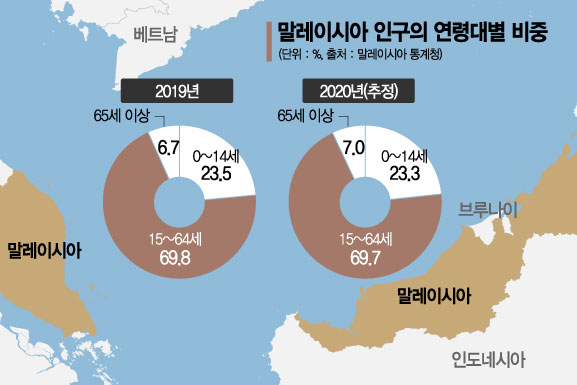
On the other hand, both the youth population (0-14 years) and the working-age population (15-64 years) in Malaysia are predicted to decline. The proportion of the youth population is expected to decrease by 0.2 percentage points from 23.5% last year to 23.3%, while the working-age population is projected to drop by 0.1 percentage points from 69.8% to 69.7%. If this trend continues, Malaysia is expected to enter the visible range of an aged society where the population aged 65 and over exceeds 14% of the total population. According to the World Bank (WB), Malaysia is projected to enter an aged society by 2044.
The serious aging in Malaysia is largely influenced by the decline in the Chinese and Indian populations. The proportion of the Chinese population decreased from 22.8% to 22.6%, and the Indian population from 6.9% to 6.8%. Meanwhile, the indigenous Bumiputera population increased from 69.3% to 69.6%.
The Malaysian government is reviewing a plan to raise the retirement age from the current 60 to 65 to address issues arising from aging. Among the 10 ASEAN countries, seven, including Malaysia, have a retirement age of 60. Singapore applies the highest retirement age in ASEAN at 62. According to data from the United Nations (UN) surveying 153 countries, as of last year, Singapore had the highest proportion of population aged 60 and over in ASEAN at 20.9%, followed by Thailand (19.2%), Vietnam (12.3%), and Malaysia (11%).
As aging becomes an increasingly tangible reality, industries related to the elderly are growing. Recently in Penang, a newly built condominium complex featuring nursing staff on-site and doctors conducting regular check-ups was introduced. The condo offers programs tailored to the elderly, including yoga, badminton, and art classes. Elderly care facilities are expected to increase mainly in regions with high elderly population ratios such as Perak, Penang, Melaka, and Perlis.
According to Data Bridge Market Research, Malaysia's elderly care industry is expected to grow at an average annual rate of 5.5% until 2027, forming a market worth $3.8 billion. Interest in home care services for the elderly is also increasing.
© The Asia Business Daily(www.asiae.co.kr). All rights reserved.

















