COVID-19 Setback Spurs Structural Reform
Homeplus Sells Its Top-Performing Stores
Lotte Mart Focuses on Selecting Winners
Emart Closes Underperforming Specialty Stores
Renews Large Discount Stores Like Wolgye Branch
Grocery Sections Expanded
Achieves 2.5% Sales Growth in First Half
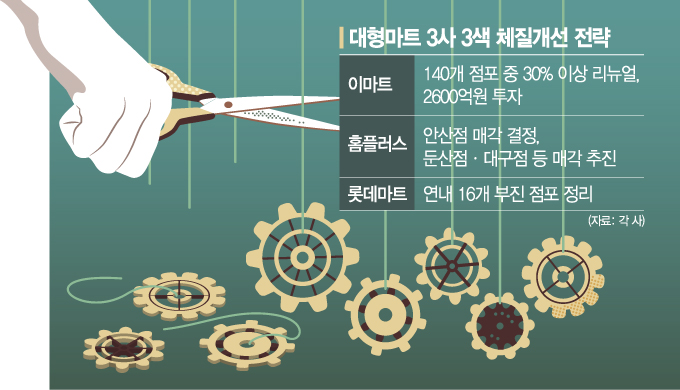
[Asia Economy Reporter Seungjin Lee] The three major large-scale marts, which have embarked on structural reform after the outbreak of the novel coronavirus infection (COVID-19), are showing different approaches. Homeplus has decided to resolve liquidity issues by selling prime assets, Lotte Mart is streamlining unprofitable stores to improve store efficiency, and Emart, which undertook proactive restructuring last year, is solidifying its industry-leading position through renovations of existing stores.
◆ Homeplus cutting to the bone, Lotte Mart trimming the fat = On the 21st, Homeplus announced the decision to sell its Ansan store. This decision came as asset liquidation became urgent due to years of severe performance decline. Following the Ansan store, Homeplus is also pushing for the sale of the Dunsan and Daegu stores. Industry insiders regard Homeplus's decision to sell stores as a painful sacrifice. The Ansan store is known to be one of the highest-grossing stores nationwide. The Dunsan and Daegu stores are also reported to be among the top revenue-generating stores, indicating the severity of Homeplus's crisis.
Homeplus's consolidated operating profit for fiscal year 2019 (March 2019 to February 2020) decreased by 38.4% compared to the previous year, and sales also dropped by 4.7%. Under previous accounting standards, operating profit was less than 10 billion KRW. Homeplus plans to invest the proceeds from the sales into future growth engines such as its online business.
Lotte Mart is also undergoing large-scale restructuring but is focusing on sorting out good and bad assets, which is the opposite situation from Homeplus. In May, it closed the Yangju and Cheonan-Asan stores, and in June, it shut down the VIC Shinyoungtong store (a warehouse discount store). This month, it will close the Uijeongbu, Cheonan, and VIC Kintex stores. A total of 16 stores will be closed this year.
Lotte Shopping initially planned to sequentially close about 200 stores, approximately 30% of its 700 stores including department stores, marts, supermarkets, and LOBs, over the next 3 to 5 years, but the schedule was accelerated due to the unexpected adverse impact of COVID-19. At the VCM (formerly the CEO meeting) in the second half of the year on the 14th, Shin Dong-bin, Chairman of Lotte Group, emphasized again the need to strengthen competitiveness through innovation in the core business from a long-term perspective, signaling that Lotte Shopping will speed up the closure of unprofitable stores.
◆ Closing specialty stores and expanding large discount stores = Emart is closing its underperforming specialty store business and focusing investment on large discount stores. Starting with the Wolgye store, Emart plans to extensively renovate more than 30% of its 140 stores nationwide. The investment for renovations alone amounts to 260 billion KRW. The core of the renovation is maximizing profitability. The Wolgye store, which completed renovation in May, was designed as a complex shopping mall combining Emart, Traders, and The Town Mall. The grocery (food) section, Emart's strength, was significantly expanded, making Wolgye the first store where the grocery area is larger than the non-food area.
Jung Yong-jin, Vice Chairman of Shinsegae Group, is also actively supporting Emart. After visiting the Wolgye store in June, he made a surprise visit to the Gangneung store last weekend and posted about it on his Instagram account. Like the Wolgye store, the Gangneung store recently completed renovations and significantly strengthened its grocery section.
Vice Chairman Jung said during his visit to the Wolgye store, "Fresh food that customers seek must be available at Emart, and furthermore, there must be differentiated products that can only be found at Emart to attract customers," adding, "In this regard, the fresh food section at the Wolgye store is expected to receive positive responses from customers," emphasizing the expansion of the grocery section.
Among the three major large marts, Emart also opened a new store, the Sinchon store, after a year and a half. Rather than indiscriminately downsizing, the company plans to break through low growth by efficiently opening new stores. Considering that nearly half of the population around Sinchon is in their 20s and 30s and that there are many single-person households, the store was designed focusing on "small-quantity grocery" items. 83% of the total area is dedicated to fresh and processed food sections, focusing on maximizing profitability.
Emart's strategy showed some results in the first half of the year. Emart's total sales for the first half of this year (January to June) were preliminarily estimated at 7.3385 trillion KRW, a 2.5% increase compared to the same period last year. In June, despite the double setbacks of the COVID-19 impact and the exclusion of disaster relief funds as a payment method, sales increased by 1.6% compared to the same period last year.
An industry insider from the large mart sector explained, "The offline retail industry, which is experiencing severe downturns, is devising survival strategies tailored to their respective situations," adding, "Homeplus and Lotte Mart are expected to focus on downsizing for the time being, making Emart's progress appear more prominent."
© The Asia Business Daily(www.asiae.co.kr). All rights reserved.

















