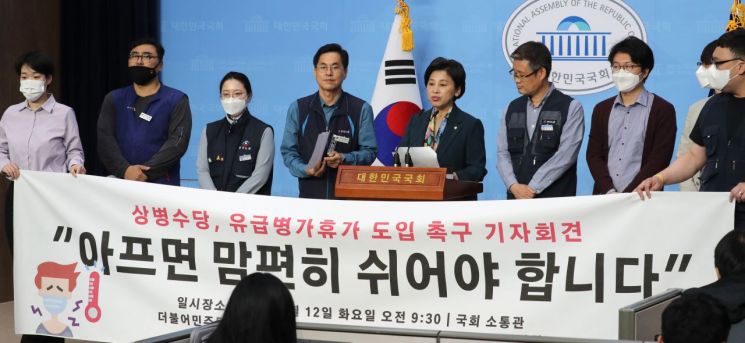
 Democratic Party lawmaker Nam In-soon, along with representatives from Health and Alternatives, the Korean Confederation of Trade Unions, the Health and Medical Organizations Alliance, the Association of Doctors for Humanism, People's Solidarity for Participatory Democracy, and the Federation of Korean Trade Unions, held a press conference last May at the National Assembly Communication Hall in Yeouido, Seoul, urging the introduction of sickness benefits and paid sick leave as a social safety net to overcome COVID-19 and as a system that allows workers to rest comfortably when they are ill.
 [Asia Economy Reporter Choi Dae-yeol] The government has decided to promote the introduction of sickness benefits for certain groups as early as 2022.
The Ministry of Health and Welfare announced on the 20th that it will pursue key tasks related to an inclusive society within the employment and social safety net of the recently announced "Korean New Deal." One of these is the "Korean-style sickness benefits." Starting next year, a research project will be conducted to introduce this system, and from the year after next, a pilot project targeting low-income groups and others is being considered. Based on the results of the pilot project, specific institutional introduction plans such as payment methods, support conditions, and linkage with related systems will be prepared.
Sickness benefits refer to payments that compensate for income loss occurring when a person cannot work due to treatment for non-work-related injuries or illnesses. Injuries or illnesses incurred at work are covered by workers' compensation insurance, which guarantees treatment costs (medical benefits) and income loss costs (temporary disability benefits). Among the 36 countries that are members of the Organisation for Economic Co-operation and Development (OECD), 34 countries implement sickness benefits except for South Korea and the United States (where some states have introduced it). The International Labour Organization also recommends this system.
The Ministry of Health and Welfare stated, "In the future, South Korea will also introduce a sickness benefits system to strengthen medical coverage by supporting treatment costs when unable to work due to non-work-related sickness, and to compensate for income loss during treatment, thereby completing the public health protection system."
Starting this month, the ministry will gather opinions from various sectors and form a working-level consultative body with related agencies and experts to design the system and prepare legislation. Next month, a research project will be conducted on the actual status of paid sick leave and application plans for vulnerable groups. From 2022, a pilot project using multiple models will be conducted targeting low-income groups to verify variables such as target diseases and individual characteristics.
Additionally, the Ministry plans to gradually abolish the support obligation criteria for livelihood benefits, which have been maintained since 2000, by 2022. This will allow the selection of livelihood benefit recipients based solely on the applicant's recognized income amount. Following the expansion of the basic pension maximum monthly support of 300,000 won to the bottom 40% income group this year, it will be expanded to the bottom 70% income group starting next year. The target group for the disability pension basic benefit of 300,000 won will also be expanded to the bottom 70% income group from next year.
© The Asia Business Daily(www.asiae.co.kr). All rights reserved.
![User Who Sold Erroneously Deposited Bitcoins to Repay Debt and Fund Entertainment... What Did the Supreme Court Decide in 2021? [Legal Issue Check]](https://cwcontent.asiae.co.kr/asiaresize/183/2026020910431234020_1770601391.png)















