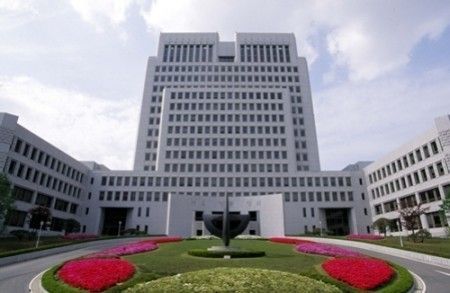
[Asia Economy Reporter Kim Hyung-min] The Supreme Court has ruled that the administrative sanction imposing a fine on an unmanned lodging facility that allowed cohabitation of teenagers without verifying their age is lawful.
The Supreme Court's First Division (Presiding Justice Lee Ki-taek) overturned the lower court's ruling, which had favored the plaintiff, A Corporation operating the unmanned lodging facility, in a lawsuit against the Yongin City Mayor seeking to nullify the fine imposition, and remanded the case to the Suwon High Court on the 20th.
The court found that A Corporation's unmanned motel did not have electronic identification equipment capable of verifying age through ID cards or similar means, as it operated without staff, thus violating relevant laws.
Article 27, Paragraph 1 of the Enforcement Decree of the Youth Protection Act specifies that public hygiene establishments must have facilities that can verify age using ID cards and confirm the authenticity of the ID through electronic identification methods such as fingerprint or facial recognition in place of staff.
The court stated, "The lower court erred in its legal interpretation regarding the prohibition of cohabitation between male and female youths by concluding that there was no evidence to recognize that the guests were teenagers and allowed to cohabit."
In February 2019, A Corporation was ordered by Yongin City to pay a fine of 1.89 million KRW in lieu of a one-month business suspension under the Public Hygiene Management Act.
Yongin City cited the fact that three teenage boys and girls stayed together at the unmanned motel operated by A Corporation as a violation of the Youth Protection Act, which prohibits cohabitation of male and female youths.
According to Article 11 of the Public Hygiene Management Act, public hygiene establishments notified of violations of the Youth Protection Act are subject to business suspension or fines of up to 100 million KRW.
The first trial dismissed A Corporation's claim, ruling that Yongin City's fine imposition was lawful.
However, the fine was canceled in the second trial.
The court held that for a fine to be imposed under the Public Hygiene Management Act, a violation of the Youth Protection Act must be recognized. Since A Corporation was cleared by the prosecution, there was no ground to impose the fine.
© The Asia Business Daily(www.asiae.co.kr). All rights reserved.
![User Who Sold Erroneously Deposited Bitcoins to Repay Debt and Fund Entertainment... What Did the Supreme Court Decide in 2021? [Legal Issue Check]](https://cwcontent.asiae.co.kr/asiaresize/183/2026020910431234020_1770601391.png)
















